Question 12 Marks
An infinite line charge produces a field of $9 \times 10^4 N/C$ at a distance of $2 \ cm.$ Calculate the linear charge density.
AnswerGiven, Electric field $, E = 9\ x\ 10^4 N/C$
Distance, $r = 2 x 10^{-2} m$
Using the formula of electric field for uniformly charged wire,
$\text{E}=\frac{\lambda}{2\pi\text{r}\epsilon_0}$
$\therefore\lambda=\text{E}.\ 2\pi\text{r}.\epsilon_0$
$\lambda= 9 \times 10^4 \times 2\pi \times 2 \times 10^{-2} \times 8.854 \times 10^{-12}$
$= 10 \times 10^{-6}$
linear charge density $- \lambda = 10\ µC/m.$
View full question & answer→Question 22 Marks
A uniformly charged conducting sphere of $2.4\ m$ diameter has a surface charge density of $80.0 \mu C/m^2.$
- Find the charge on the sphere.
- What is the total electric flux leaving the surface of the sphere?
AnswerGiven, Diameter of the sphere $= 2.4$
$ \therefore$ Radius of sphere, $r = \frac{2.4}{2} = 1.2 m$ Surface charge density of conducting sphere, $\sigma = 80 \times 10^{-6} C/m^2$
- Charge on sphere
$\sigma.\text{A}=\sigma.4\pi\text{r}^2$
$q = 80 \times 10^{-6 }\times 4 \times 3.14 \times (1.2)^2$
$q = 1.45 \times 10^{-3} C$
- The total electric flux leaving the surface of the sphere using the gauss formula,
$\phi=\frac{\text{q}}{\epsilon_0}$
$=\frac{1.45\times10^{-3}}{8.854\times10^{-12}}$
$=1.6\times10^8 \text{Nm}^2/\text{C}$ View full question & answer→Question 32 Marks
When a glass rod is rubbed with a silk cloth, charges appear on both. A similar phenomenon is observed with many other pairs of bodies. Explain how this observation is consistent with the law of conservation of charge.
AnswerRubbing produces charges of equal magnitude but of opposite nature on the two bodies because charges are created in pairs. This phenomenon of charging is called charging by friction. The net charge on the system of two rubbed bodies is zero. This is because equal amount of opposite charges annihilate each other. When a glass rod is rubbed with a silk cloth, opposite natured charges appear on both the bodies. This phenomenon is in consistence with the law of conservation of energy. A similar phenomenon is observed with many other pairs of bodies.
View full question & answer→Question 42 Marks
An oil drop of $12$ excess electrons is held stationary under a constant electric field of $2.55 \times 10^4 NC^{-1}$ in Millikan’s oil drop experiment. The density of the oil is $1.26 g \ cm^{-3}$. Estimate the radius of the drop. $(g = 9.81\ m\ s^{-2}; e = 1.60 \times 10^{-19} C).$
AnswerGiven,
Electric field $= 2.25\ x\ 10^4 NC^{-1}$
Number of electrons $= 12$
Density of oil, $\rho = 1. 26\ gm \ cm^{-3} = 1. 26\ x\ 10^3\ kg\ m^{-3}$
Since, the droplet is stationary,
Weight of the droplet $=$ force due to the electric field
mg $= Eq$
$\therefore \frac{4}{3}\pi\text{r}^3\rho\text{g}= \text{Ene}$
$\Rightarrow\ \text{r}^3=\frac{3\ \text{Ene}}{4\pi\ \rho\text{g}}$
$\Rightarrow\ \text{r}^3=\frac{3\times2.55\times10^4\times12\times1.6\times10^{-19}}{4\times3.14\times1.26\times10^3\times9.81}$
$= 0.9 \times 10^{-18}$
$r = (0.9 \times 10^{-18}) ^{1/3}$
$r = 9.81 \times 10^{-7 }m.$
View full question & answer→Question 52 Marks
- An electrostatic field line is a continuous curve. That is, a field line cannot have sudden breaks. Why not?
- Explain why two field lines never cross each other at any point?
Answer
- An electrostatic field line is a continuous curve because a charge experiences a continuous force when traced in an electrostatic field. The field line cannot have sudden breaks because the charge moves continuously and does not jump from one point to the other.
- If two field lines cross each other at a point, then electric field intensity will show two directions at that point. This is not possible. Hence, two field lines never cross each other.
View full question & answer→Question 62 Marks
- Explain the meaning of the statement ‘electric charge of a body is quantised’.
- Why can one ignore quantisation of electric charge when dealing with macroscopic i.e., large scale charges?
Answer
- Electric charge of a body is quantized. This means that only integral (1, 2, …., n) number of electrons can be transferred from one body to the other. Charges are not transferred in fraction. Hence, a body possesses total charge only in integral multiples of electric charge.
- In macroscopic or large scale charges, the charges used are huge as compared to the magnitude of electric charge. Hence, quantization of electric charge is of no use on macroscopic scale. Therefore, it is ignored and it is considered that electric charge is continuous.
View full question & answer→Question 72 Marks
How much positive and negative charge is there in a cup of water?
AnswerLet us assume that the mass of one cup of water is $250 g$. The molecular mass of water is $18 g$. Thus, one mole $\left(=6.02 \times 10^{23}\right.$ molecules) of water is $18 g$. Therefore the number of molecules in one cup of water is $(250 / 18) \times 6.02 \times 10^{23}$.
Each molecule of water contains two hydrogen atoms and one oxygen atom, i.e., 10 electrons and 10 protons. Hence the total positive and total negative charge has the same magnitude. It is equal to $(250 / 18) \times 6.02 \times 10^{23} \times 10 \times 1.6 \times 10^{-19} C =1.34 \times 10^7 C$
View full question & answer→Question 82 Marks
Considering the case of a parallel plate capacitor being charged, show how one is required to generalize Ampere’s circuital law to include the term due to displacement current.
AnswerAccording to Ampere’s circuital Law$\oint\overrightarrow{\text{B}}\text{d}\overrightarrow{\text{l}} = \mu_{0}\text{I}$
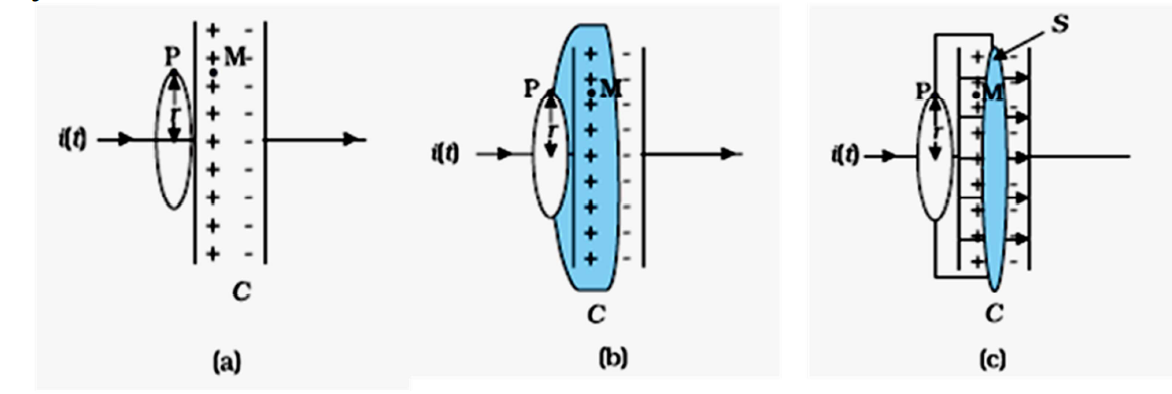 Applying ampere’s circuital law to fig (a) we see that, during charging, the right hand side in Ampere’s circuital law equals $\mu_{0}\text{I}$ However on applying it to the surfaces of the fig (b) or fig (c), the right hand side is zero. Hence, there is a contradiction. We can remove the contradiction by assuming that there exists a current (associated with the changing electric field during charging), known as the displacement current. When this current $( = \frac{\text{d}\phi_{E}}{\text{dt}})$ is added on the right-hand side, Ampere’s circuital law, the inconsistency disappears. It was, therefore necessary, to generalize the Ampere’s circuital law, as$\oint\overrightarrow{\text{B}}\text{d}\overrightarrow{\text{l}} = \mu_{0}\text{I}_{c} + \mu_{0}\in_{o}\frac{\text{d}\phi_{E}}{\text{dt}}.$
 View full question & answer→Question 92 Marks
A parallel plate capacitor of capacitance C is charged to a potential V. It is then connected to another uncharged capacitor having the same capacitance. Find out the ratio of the energy stored in the combined system to that stored initially in the single capacitor.
AnswerEnergy stored in a capacitor $ = \frac{1}{2}\text{QV} = \frac{1}{2}\text{CV}^{2} = \frac{1}{2}\frac{\text{Q}^{2}}{\text{C}}$ Capacitance of the (parallel) combination = C+C=2C Here, total charge, Q, remains the same$\therefore\text{ initial energy } = \frac{1}{2}\frac{\text{Q}^{2}}{\text{C}}$
And final energy = $\frac{1}{2}\frac{\text{Q}^{2}}{2\text{C}}$$\therefore\frac{\text{ final energy }}{\text{ initial energy }} = \frac{1}{2}$
Parallel or (ii) Series combination to remain constant (=V) and obtain the answers as (i) 2:1 or (ii) 1:2.
View full question & answer→Question 102 Marks
A capacitor, made of two parallel plates each of plate area A and separation d, is being charged by an external ac source. Show that the displacement current inside the capacitor is the same as the current charging the capacitor.
Answer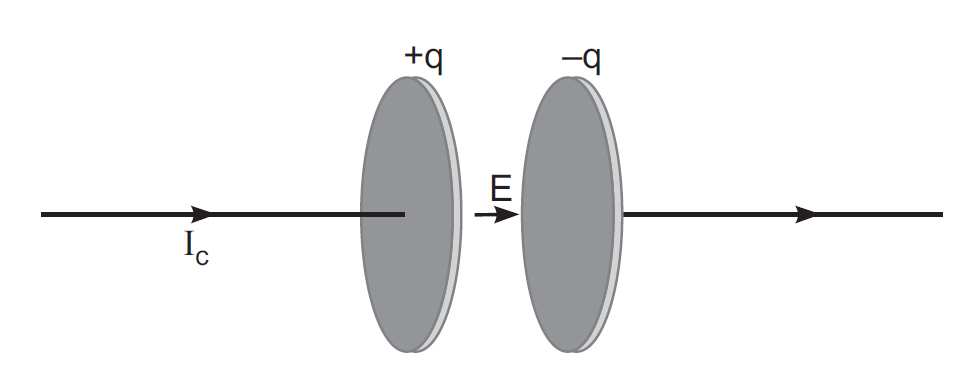 In Fig. conduction current is flowing in the wires, causes charge on the plates So, $\text{I}_{c} = \frac{\text{dq}}{\text{dt}}$ According to Maxwell, displacement current between plates$\text{I}_{d} = \varepsilon_{0}\frac{\text{d}\varphi_{E}}{\text{dt}}\text{ where }\Phi_{E} =\text{ Electric flux}$
Using Gauss’s Theorem, if one of the plate is inside the tiffin type Gaussian surface$\Phi_{E} = \frac{\text{q}}{\varepsilon_{0}}$
So $\text{I}_{d} = \varepsilon_{0}\frac{\text{d}}{\text{dt}}\big(\frac{\text{q}}{\varepsilon_{0}}\big)$$\text{I}_{d} = \frac{\text{dq}}{\text{dt}}$
From equation (2) and (3), Both conduction current and displacement currents are equal. View full question & answer→Question 112 Marks
A thin straight infinitely long conducting wire having charge density λ is enclosed by a cylindrical surface of radius r and length l, its axis coinciding with the length of the wire. Find the expression for the electric flux through the surface of the cylinder.
AnswerCharge enclosed by the cylindrical surface $\text{q} = \lambda l $ Flux $\varphi =\frac{\text{q}}{\varepsilon_{0}}$$ = \frac{\lambda l }{\varepsilon_{0}}$
Alternate Answer
$\varphi = \oint\overrightarrow{\text{E}}.\text{d}\overrightarrow{\text{S}} = \frac{\text{q}}{\varepsilon_{0}}$
$\varphi = \frac{\lambda l }{\varepsilon_{0}}.$
View full question & answer→Question 122 Marks
Plot a graph showing the variation of coulomb force (F) versus$\bigg(\frac{1}{\text{r}^{2}}\bigg)$; where r is the distance between the two charges of each pair of charges: (1 μC, 2 μC) and (2 μC, – 3 μC). Interpret the graphs obtained.
Answer
-
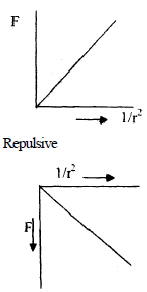 Alternate Answer
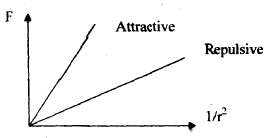
(Attractive force is greater than repulsive force since magnitude of the slope is more for attraction.)
View full question & answer→Question 132 Marks
Show that the electric field at the surface of a charged conductor is given by $\overrightarrow{\text{E}} = \frac{\sigma}{\varepsilon_{o}}\hat{\text{n}},$where σ is the surface charge density and $\hat{\text{n}}$is a unit vector normal to the surface in the outward direction.
Answer
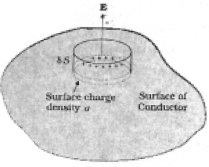 $\text{E}\delta\text{S} = \frac{\sigma\delta\text{S}}{\varepsilon_{0}}$
$\Rightarrow\text{E} = \frac{\sigma}{\varepsilon_{0}}$
In vector form
$\overrightarrow{\text{E}} = \frac{\sigma\hat{\text{n}}}{\varepsilon_{0}}$
Alternate Answer
Also accept the derivation of electric field on the surface of spherical shell.
$\oint_{s}\overrightarrow{\text{E}}.\overrightarrow{\text{ds}} = \frac{\text{q}}{\varepsilon_{o}}$
$\text{E}\times4\pi\text{r}^{2} = \frac{\text{q}}{\varepsilon_{0}}$
$\text{E} = \frac{\text{q}}{4\pi\text{r}^{2}\varepsilon_{0}}$
$\Rightarrow\overrightarrow{\text{E}} = \frac{\sigma}{\varepsilon_{0}}\hat{\text{n}}.$ View full question & answer→Question 142 Marks
Define electric flux. Write its $S.I.$ unit.
$A$ charge $q$ is enclosed by a spherical surface of radius $R.$ If the radius is reduced to half, how would the electric flux through the surface change?
AnswerElectric lines of force passing through the surface normally.Alternate Answer
Electric flux $\Delta\Phi$ through an area element $\Delta\text{S}$ is defined by$\Delta\phi = \text{E}\cdot\Delta\text{S} = \text{E}\Delta\text{S}\cos\theta$
SI unit: νolt$-$meter or $NM^2/C$ On decreasing the radius of spherical surface to half there will be no effect on the electric flux.
View full question & answer→Question 152 Marks
Two point charges $4Q, Q$ are separated by $1\ m$ in air. At what point on the line joining the charges is the electric field intensity zero?
Also calculate the electrostatic potential energy of the system of charges, taking the value of charge, $Q = 2 \times 10^{–7} C.$
Answer
- $\frac{\text{K}4\text{Q}}{\text{x}^{2}} =\frac{\text{KQ}}{(\text{r} - \text{x})^{2}}$
$\text{x} = \bigg(2\big/3\bigg)\text{m}$ or $ \text{x} = 2\text{ m}$ from $ 4\text{Q})$
- $\text{u} = \frac{\text{kq}_{1}\text{q}_{2}}{\text{r}}$
$\text{u} = 1.44\times10^{-3}\text{J}.$ View full question & answer→Question 162 Marks
Given a uniform electric field$\overrightarrow{\text{E}}: 4 \times 10^3\ \hat{i} N/C,$ find the flux of this field through a square of $5\ cm$ on a side whose plane is parallel to the $y-z$ plane. What would be the flux through the same square if the plane makes a $30^{\circ}$ angle with the $x-$axis?
Answer$\phi = \text{EA}\cos\theta$$= 4\times 10^{8}\times25\times{10}^{-4}\cos0$
$= 10 \text{NM}^{-2}\text{ m}^{-1}.$
$\phi= 4\times 10^{3}\times25\times{10}^{-4}\cos60$
$= 5 \text{ NM}^{-2}\text{ m}^{-1}.$
View full question & answer→Question 172 Marks
Given a uniform electric field $\overrightarrow{\text{E}} = 2 \times 10^3\ \hat{i}\ N/C$ find the flux of this field through a square of side $20 \ cm,$ whose plane is parallel to the $y-z$ plane. What would be the flux through the same square, if the plane makes an angle of $30^{\circ}$ with the$ x-$axis?
Answer$\phi = \text{EA}\cos\theta= 2\times 10^{3}\times{4}\times 10^{-2} \cos 0^{0}$
$=80\ NC^{-1}\ m^2$
$\phi=2 \times10^{3}\times4\times10^{2}\cos60^{0}$
$40\ NC^{-1}{ m}^2$
View full question & answer→Question 182 Marks
Given a uniform electric field$\overrightarrow{\text{E}}: 5 \times 10^3\ \hat{i}\ N/C,$ find the flux of this field through a square of $10 \ cm$ on a side whose plane is parallel to the $y-z$ plane. What would be the flux through the same square if the plane makes a $30^0$ angle with the $x-$axis?
Answer$\phi = \text{EA}\cos\theta= 5\times 10^{3}\times 10^{-2} \cos 0^{0}\text{NC}^{-1}\text{m}^{2}$
$ = 50 \text{NC}^{-1}\text{m}^{2}$
$\phi = 5\times10^{3}\times10^{-2}\cos60^{o}\text{NC}^{-1}\text{m}^{2}$
$= 25 \text{NC}^{-1}\text{m}^{2}.$
View full question & answer→Question 192 Marks
An electric dipole of length $4 \ cm,$ when placed with its axis making an angle of $60^\circ$ with a uniform electric field, experiences a torque of $4\sqrt{3}\ Nm.$ Calculate the potential energy of the dipole, if it has charge $\pm 8\ nC.$
Answer$\tau = \text{pE}\sin\theta$$4\sqrt{3} = \text{pE}\sin60^{0} = \text{pE}\frac{\sqrt{3}}{2}$
$\Rightarrow\text{pE} = 8 $
Potential energy
$ \text{U} = - \text{pE}\cos\theta$
$ = - 8 \text{ x }\cos60^{\circ} $
$= -4\text{J}.$
View full question & answer→Question 202 Marks
The electric field E due to a point charge at any point near it is defined as $\text{E} = \DeclareMathOperator*{\median}{\text{lim}} \median_{\text{q}\rightarrow0}\frac{\text{F}}{\text{q}}$ where q is the test charge and F is the force acting on it. What is the physical significance of $\DeclareMathOperator*{\median}{\text{lim}} \median_{\text{q}\rightarrow0}$ in this expression? Draw the electric field lines of a point charge Q when (a) Q>0 and (b) Q<0.
View full question & answer→Question 212 Marks
Define electric flux. Write its $S.I.$ units. A spherical rubber balloon carries a charge that is uniformly distributed over its surface. As the balloon is blown up and increases in size, how does the total electric flux coming out of the surface change? Give reason.
AnswerElectric flux is the total number of electric field lines passing normally through a given surface. Alternate Answer
Electric Flux $\int_{s}\vec{\text{E}}.\text{d}\vec{s}$
$S.I.$ unit $Nm^2/C$
Alternate Answer
$V.m$ No Change
As the total charge enclosed remains the same.
View full question & answer→Question 222 Marks
A block of mass m containing a net positive charge q is placed on a smooth horizontal table which terminates in a vertical wall as shown in figure. The distance of the block from the wall is d. A horizontal electric field E towards right is switched on. Assuming elastic collisions (if any) find the time period of the resulting oscillatory motion. Is it a simple harmonic motion?
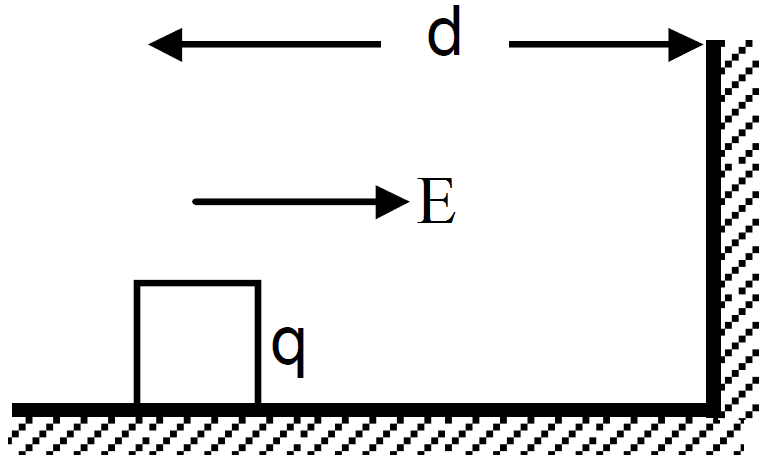
AnswerThe block does not undergo. SHM since here the acceleration is not proportional to displacement and not always opposite to displacement. When the block is going towards the wall the acceleration is along displacement and when going away from it the displacement is opposite to acceleration. Time taken to go towards the wall is the time taken to goes away from it till velocity is: 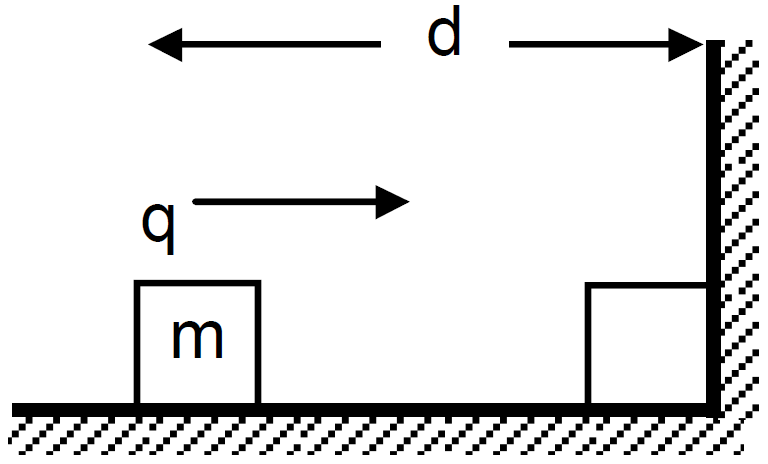 $\text{d}=\text{ut}+\Big(\frac{1}{2}\Big)\text{at}^2$
$\Rightarrow\text{d}=\frac{1}{2}\times\frac{\text{qE}}{\text{m}}\times\text{t}^2$
$\Rightarrow\text{t}^2=\frac{2\text{dm}}{\text{qE}}$
$\Rightarrow\text{t}=\sqrt{\frac{2\text{md}}{\text{qE}}}$
$\therefore\ $Total time taken for to reach the wall and com back (Time period)
$=2\text{t}=2\sqrt{\frac{2\text{md}}{\text{qE}}}$
$=\sqrt{\frac{2\text{md}}{\text{qE}}}$ View full question & answer→Question 232 Marks
Find the flux of the electric field through a spherical surface of radius $R$ due to a charge of $10^{-7}C$ at the centre and another equal charge at a point $2R$ away from the centre.
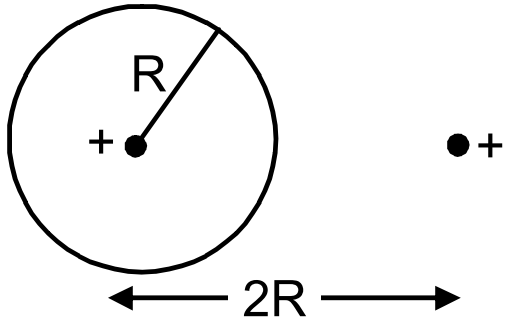
AnswerGiven: Let charge $Q$ be placed at the centre of the sphere and $Q$ be placed at a distance $2R$ from the centre. Magnitude of the two charges $= 10^{-7}C$ According to Gauss's Law, the net flux through the given sphere is only due to charge $Q$ that is enclosed by it and not by the charge $Q$ that is lying outside. So, only the charge located inside the sphere will contribute to the flux passing through the sphere. Thus,$\phi=\int{\text{E}}.\text{d}{\text{s}}=\frac{\text{Q}}{\epsilon_0}=\frac{10^{-7}}{8.85\times10^{-12}}$
$\Rightarrow\phi=1.1\times10^{4}\text{Nm}^2\text{C}^{-1}$
View full question & answer→Question 242 Marks
A charge $Q$ is placed at the centre of an imaginary hemispherical surface. Using symmetry arguments and the Gauss's law, find the flux of the electric field due to this charge through the surface of the hemisphere $($figure$).$
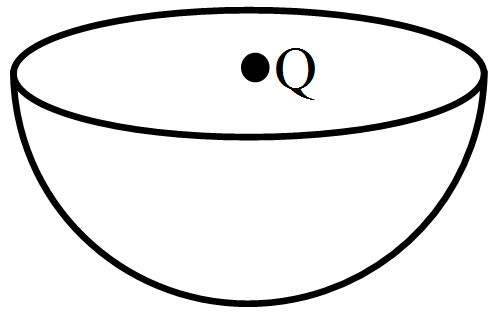
AnswerFrom Guass's law, flux through a closed surface, $\phi=\frac{\text{Q}_{\text{en}}}{\epsilon_0},$
where $Q_{en} =$ charge enclosed by the closed surface Let us assume that a spherical closed surface in which the charge is enclosed is$ Q.$ The flux through the sphere,$\phi=\frac{\text{Q}}{\epsilon_0}$
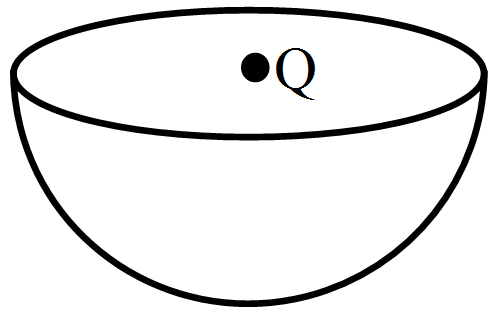
Hence for a hemisphere$($open bowl$),$ total flux through its curved surface, $\phi'=\frac{\text{Q}}{\epsilon}\times\frac{1}{2}=\frac{\text{Q}}{2\epsilon_0}$ View full question & answer→Question 252 Marks
Find the electric force between two protons separated by a distance of $1$ fermi $(1$ fermi $= 10^{-15}\ m).$ The protons in a nucleus remain at a separation of this order.
AnswerWe know: Charge on a proton, $q = 1.6 \times 10^-{19}\ C$ Given, separation between the charges, $ r = 10^-{15}\ m$ By Coulomb's Law, electrostatic force, $\text{F}=\frac{1}{4\pi\in_0}\frac{\text{q}_1\text{q}_2}{\text{r}^2}$
$\Rightarrow\text{F}=96\times10^9\times\frac{(1.6\times10^{-19})^2}{(10^{-15})^2}$
$\Rightarrow\text{F}=230\text{ N}$
View full question & answer→Question 262 Marks
The force between two point charges kept at a distance r apart in air is F. If the same charges are kept in water at the same distance, how does the force between them change?
AnswerThe force in air $\text{F}_\text{a}=\frac{1}{4\pi\epsilon_0}\frac{\text{q}_1\text{q}_2}{\text{r}^2}$
The force in water $\text{F}_\omega=\frac{1}{4\pi\epsilon_0\text{K}}\frac{\text{q}_1\text{q}_2}{\text{r}^2}$
$\therefore\ \frac{\text{F}_\omega}{\text{F}_\text{a}}=\frac{1}{\text{K}}$
Dielectric constant of water is 81, so the force in water reduces to $\frac{1}{81}$ times.
View full question & answer→Question 272 Marks
A charge Q is placed at the centre of a cube. Find the flux of the electric field through the six surfaces of the cube.
AnswerAccording to Gauss's Law, flux passing through any closed surface is equal to $\frac{1}{\epsilon_0}$ times the charge enclosed by that surface.$\Rightarrow\phi=\frac{\text{q}}{\epsilon_0},$
where $\phi$ is the flux through the closed surface and q is the charge enclosed by that surface. The charge is placed at the centre of the cube and the electric field is passing through the six surfaces of the cube. So, we can say that the total electric flux passes equally through these six surfaces. Thus, flux through each surface,$\phi'=\frac{\text{Q}}{6\epsilon_0}$
View full question & answer→Question 282 Marks
An electric dipole of dipole moment $20 \times 10^{-6}\ C$ is enclosed by closed surface. What is the net electric flux coming out of this surface?
AnswerZero. Reason: Net charge enclosed by surface $=$ Net charge on dipole $= q - q = 0$
$\therefore$ Total electric flux $=\frac{1}{\epsilon_0}\times$ net charge enclosed $= 0$
View full question & answer→Question 292 Marks
In $1959$ Lyttleton and Bondi suggested that the expansion of the Universe could be explained if matter carried a net charge. Suppose that the Universe is made up of hydrogen atoms with a number density $N,$ which is maintained a constant. Let the charge on the proton be: $e_p = -(1 + y)e$ where e is the electronic charge.
Show that the velocity of expansion is proportional to the distance from the centre.
AnswerNet force experience bt the hydrogen atom is given by $\text{F}=\text{F}_\text{C}-\text{F}_\text{G}=\frac{1}{3}\frac{\text{Ny}^2\text{e}^2\text{R}}{\epsilon_0}-\frac{4\pi}{3}\text{ Gm}_\text{p}^2\text{NR}$
Because of this net force, the hydrogen atom experiences an acceleration such that$\text{m}_\text{p}\frac{\text{d}^2\text{R}}{\text{dt}^2}=\text{F}=\frac{1}{3}\frac{\text{Ny}^2\text{e}^2\text{R}}{\epsilon_0}-\frac{4\pi}{3}\text{Gm}_\text{p}^2\text{NR}$
$=\Big(\frac{1}{3}\frac{\text{Ny}^2\text{e}^2}{\epsilon_0}-\frac{4\pi}{3}\text{Gm}_\text{p}^2\text{N}\Big)\text{R}$
$\therefore\ \frac{\text{d}^2\text{R}}{\text{dt}^2}=\frac{1}{\text{m}_\text{p}}\bigg[\frac{1}{3}\frac{\text{Ny}^2\text{e}^2}{\epsilon_0}-\frac{4\pi}{3}\text{Gm}_\text{p}^2\text{N}\bigg]$
$\Rightarrow\ \frac{\text{d}^2\text{R}}{\text{dt}^2}=\alpha^2\text{R}\ .....(\text{iv})$
where, $\alpha^2=\frac{1}{\text{m}_\text{p}}\bigg[\frac{1}{3}\frac{\text{NY}^2\text{e}^2}{\epsilon_0}-\frac{4\pi}{3}\text{Gm}_\text{p}^2\text{N}\bigg]$ The solution of $Eq. (iv)$ is given by $\text{R}=\text{Ae}^{\alpha\text{t}}+\text{Be}^{-\alpha\text{t}}$. We are looking for expansion, here, so $B = 0$ and $\text{R}=\text{Ae}^{\alpha\text{t}}$.
$\Rightarrow$ velocity of expansion,$\text{v}=\frac{\text{dR}}{\text{dt}}=\text{Ae}^{\alpha\text{t}}(\alpha)=\alpha\text{Ae}^{\alpha\text{t}}=\alpha\text{R}$
Hence, $\text{v}\propto\text{R}$, i.e., velocity of expansion is proportional to the distance from the centre.
View full question & answer→Question 302 Marks
Consider two particles A and B having equal charges and placed at some distance. The particle A is slightly displaced towards B. Does the force on B increase as soon as the particle A is displaced? Does the force on the particle A increase as soon as it is displaced?
AnswerElectrostatic force follows the inverse square law, $\text{F}=\frac{\text{k}}{\text{r}^2}.$ This means the the force on two particles carrying charges increases on decreasing the distance between them. Therefore, as particle A is slightly displaced towards B, the force on B as well as a A will increase.
View full question & answer→Question 312 Marks
The distance of the field point, on the equatorial plane of a small electric dipole is halved. By what factor does the electric field due to the dipole change?
AnswerFor small dipole, $\text{E}_\text{equator}=\frac{1}{4\pi\epsilon_0}\frac{\text{p}}{\text{r}^3}\propto\frac{1}{\text{r}^3}$
When r is halved, the electric field strength become 8-times of the original field.
View full question & answer→Question 322 Marks
Show that there can be no net charge in a region m which the electric field is uniform at all points.
AnswerIt is given that the electric field is uniform. If we consider a surface perpendicular to the electric field, we find that it is an equipotential surface. Hence, if a test charge is introduced on the surface, then work done will be zero in moving the test charge on it.
But if there is some net charge in this region, the test charge introduced on the surface will experience a force due to this charge. This force has a component parallel to the surface; thus, work has to be done in moving this test charge. Thus, the surface cannot be said to be equipotential. This implies that the net charge in the region with uniform electric field is zero.
View full question & answer→Question 332 Marks
The dimensions of an atom are of the order of an Angstrom. Thus there must be large electric fields between the protons and electrons. Why, then is the electrostatic field inside a conductor zero?
AnswerIn an atom, number of electrons and protons are equal and the electric fields bind the atoms to neutral entity. Fields are caused by excess charges. There can be no excess charge on the inter surface of an isolated conductor.
View full question & answer→Question 342 Marks
Why does a phonograph-record attract dust particles just after it is cleaned?
AnswerWhen a phonograph record is cleaned, it develops a charge on its surface due to rubbing. This charge attracts the neutral dust particles due to induction.
View full question & answer→Question 352 Marks
At what separation should two equal charges, 1.0C each, be placed so that the force between them equals the weight of a 50kg person?
AnswerGiven: Magnitude of charges, $\text{q}_1=\text{q}_2=1\text{C}$ Electrostatic force between them, F = Weight of a 50kg person$\text{mg}=50\times9.8=490\text{N}$
$\text{mg}=490\text{N}$
Let the required distance be r. By Coulomb's Law, electrostatic force,$\text{F}=\frac{1}{4\pi\epsilon_0}\frac{\text{q}_1\text{q}_2}{\text{r}^2}$
$\Rightarrow490=\frac{9\times10^9\times1\times1}{\text{r}^2}$
$\Rightarrow\text{r}^2=\frac{9\times10^9}{490}$
$\Rightarrow\text{r}=\sqrt{\frac{9}{49}\times10^8}$
$=\frac{3}{7}\times10^4\text{m}$
$=4.3\times10^3\text{m}$
View full question & answer→Question 362 Marks
The charge on a proton is $+1.6 \times 10^{-19}\ C$ and that on an electron is$ -1.6 \times 10^{-19}\ C.$ Does it mean that the electron has a charge $3.2 \times 10^{-19}\ C$ less than the charge of a proton?
AnswerAn electron and a proton have equal and opposite charges of magnitude $1.6 \times 10^{-19}\ C.$ But it doesn't mean that the electron has $3.2 \times 10^{-19}\ C$ less charge than the proton.
View full question & answer→Question 372 Marks
Can a gravitational field be added vectorially to an electric field to get a total field?
AnswerNo, a gravitational field cannot be added vectorially to an electric field. This is because for electric influence, one or both the bodies should have some net charge and for gravitational influence both the bodies should have some mass. Also, gravitational field is a weak force, while electric field is a strong force.
View full question & answer→Question 382 Marks
Define electric field strength. Is it a vector or a scalar quantity?
AnswerThe electric field strength at a point in an electric field is defined as the electrostatic force acting on a unit positive charge when placed at that point and its direction is along the direction of electrostatic force.
Electric field strength is a vector quantity.
View full question & answer→Question 392 Marks
Is there any lower limit to the electric force between two particles placed at a separation of 1cm ?
AnswerYes, there's a lower limit to the electric force between two particles placed at a separation of 1cm, which is equal to the magnitude of force of repulsion between two electrons placed at a separation of 1cm.
View full question & answer→Question 402 Marks
It is said that the separation between the two charges forming an electric dipole should be small. Small compared to what?
AnswerThe separation between the two charges forming an electric dipole should be small compared to the distance of a point from the centre of the dipole at which the influence of the dipole field is observed.
View full question & answer→Question 412 Marks
The electric force experienced by a charge of $1.0 \times 10^{-6}\ C$ is $1.5 \times 10^{-3}\ N.$ Find the magnitude of the electric field at the position of the charge.
Answer$\text{F}_\text{e}=1.5\times10^{-3}\text{N},\ \text{q}=1\times10^{-6}\text{C},$$\text{F}_\text{e}=\text{q}\times\text{E}$
$\Rightarrow\text{E}=\frac{\text{F}_\text{e}}{\text{q}}$
$=\frac{1.5\times10^{-3}}{1\times10^{-6}}$
$=1.5\times10^3\text{N/C}$
View full question & answer→Question 422 Marks
The distance of the field point on the axis of a small dipole is doubled. By what factor will the electric field, due to the dipole change?
AnswerFor a small dipole, $\text{E}_\text{axis}=\frac{1}{4\pi\epsilon_0}\frac{2\text{p}}{\text{r}^3}\propto\frac{1}{\text{r}^3}$
When the distance r is doubled, the electric field strength becomes 1/8 times the original field.
View full question & answer→Question 432 Marks
A circular wire-loop of radius a carries a total charge Q distributed uniformly over its length. A small length dL of the wire is cut off. Find the electric field at the centre due to the remaining wire.
Answer$\frac{\text{Charge}}{\text{Unit length}}=\frac{\text{Q}}{2\pi\text{a}}=\lambda;$ Charge of $\text{d}\ell=\frac{\text{Qd}\ell}{2\pi\text{a}}\text{C}$Initially the electric field was ‘0’ at the centre. Since the element ‘dℓ’ is removed so, net electric field must $\frac{\text{K}\times\text{q}}{\text{a}^2}$
Where q = charge of element $\text{d}\ell$
$\text{E}=\frac{\text{Kq}}{\text{a}^2}$
$=\frac{1}{4\pi\in_0}\times\frac{\text{Q}\text{d}\ell}{2\pi\text{a}}\times\frac{1}{\text{a}^2}$
$=\frac{\text{Qd}\ell}{8\pi^2\in_0\text{a}^3}$
View full question & answer→Question 442 Marks
A point charge is placed at the centre of a closed Gaussian spherical surface of radius r. Electric flux passing through the surface is $\Phi$ How is the electric flux $\Phi$ through the surface affected when the following changes are made in turn:
- The spherical surface is replaced by a cylindrical surface of the same radius?
- The point charge is replaced by an electric dipole?
Justify your answer in each case. Answer
- Since the charge inside the Gaussian surface remains the same, the electric flux through it remains unchanged.
- Since the net charge inside the surface is zero, the electric flux passing through the surface also becomes zero.
View full question & answer→Question 452 Marks
Represent graphically the variation of electric field with distance, for a uniformly charged plane sheet.
AnswerImageElectric field due to a uniformly charged plane sheet.
$\text{E}=\frac{\sigma}{2\epsilon_0}$
Which is independent of distance.
So, it represents a straight line parallel to distance axis.
View full question & answer→Question 462 Marks
A point charge produces an electric field of magnitude $5.0\ NC^{-1}$ at a distance of $40\ cm$ from it. What is the magnitude of the charge?
Answer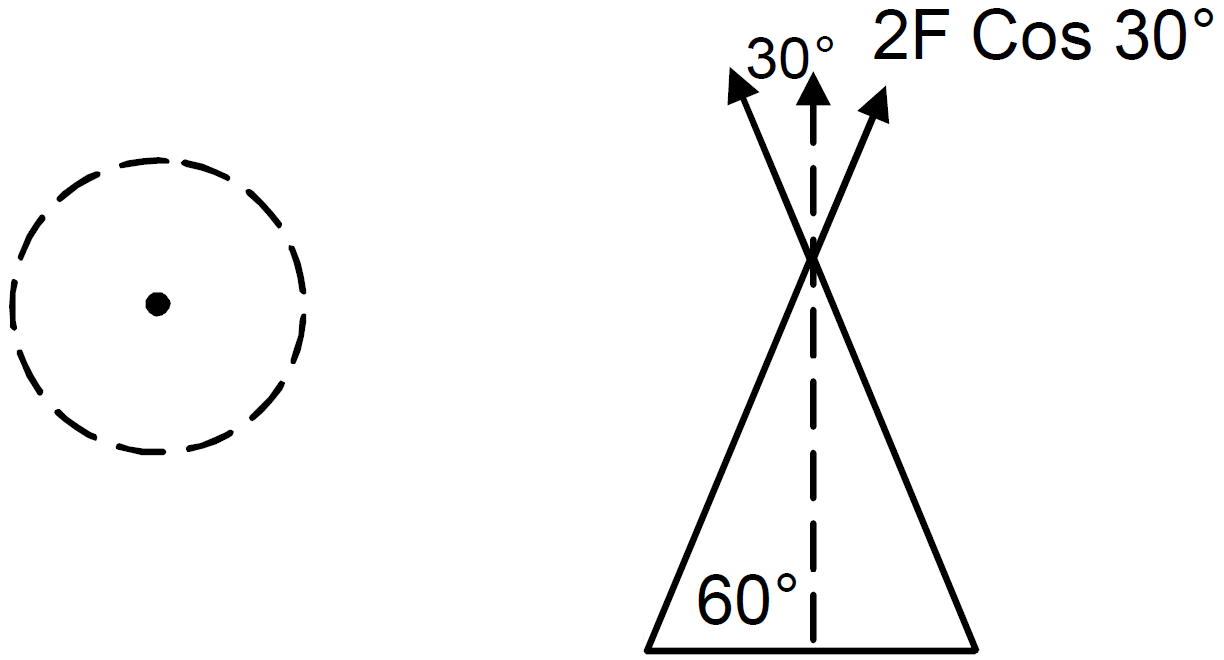
$\text{E}=\frac{1}{4\pi\epsilon_0}\frac{\text{q}}{\text{r}^2}$
$\Rightarrow5.0=9\times10^9\times\frac{9}{(0.4)^2}$
$\Rightarrow\text{q}=8.9\times10^{-11}\text{C}$ View full question & answer→Question 472 Marks
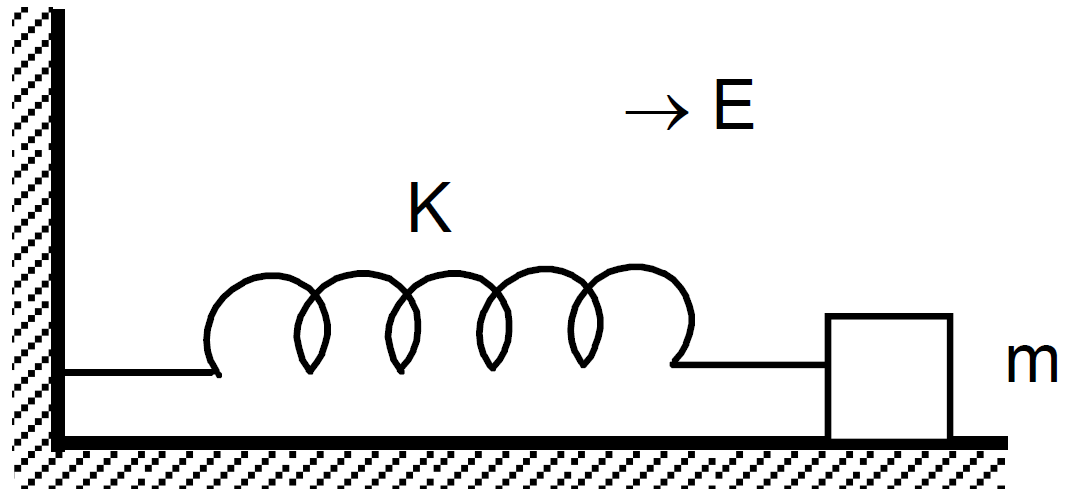
A block of mass m having a charge q is placed on a smooth horizontal table and is connected to a wall through an unstressed spring of spring constant k as shown in figure. A horizontal electric field E parallel to the spring is switched on. Find the amplitude of the resulting SHM of the block.
Answer
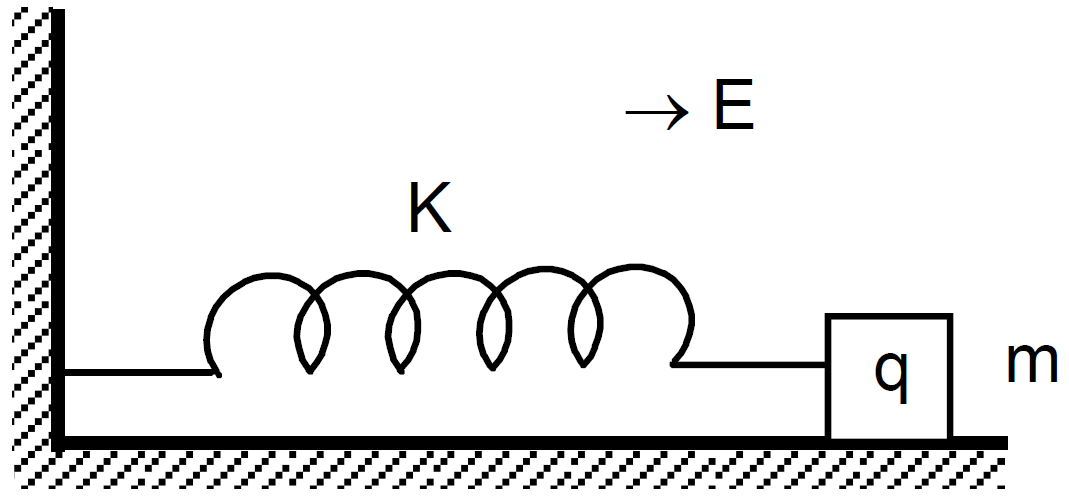 $\text{F}=\text{qE},\ \text{F}=-\text{Kx}$
Where x = amplitude
$\text{x}=\frac{-\text{qE}}{\text{K}}$ View full question & answer→Question 482 Marks
A positive charge q is placed in front of a conducting solid cube at a distance d from its centre. Find the electric field at the centre of the cube due to the charges appearing on its surface.
Answer
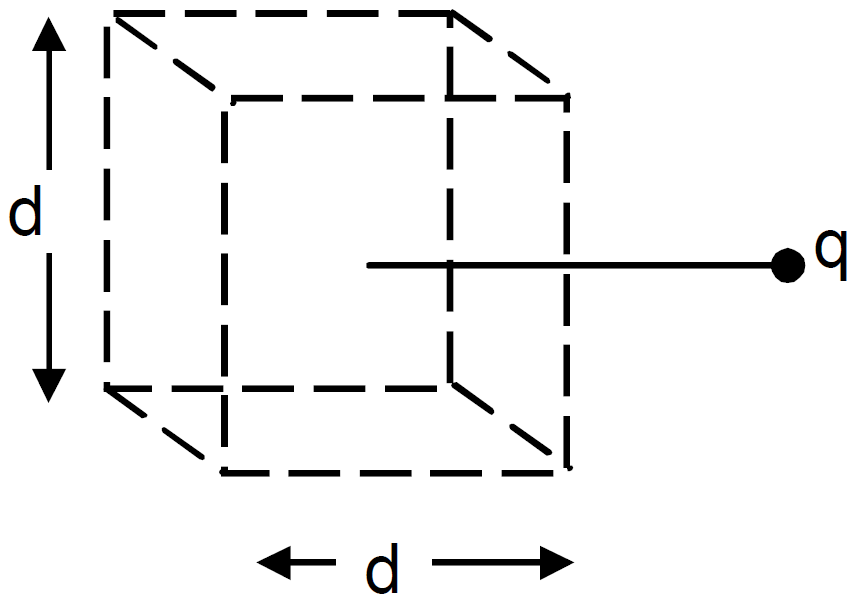 We know,
Electric field at a point due to a given charge
$'\text{E}'=\frac{\text{Kq}}{\text{r}^2}$ Where q = charge, r = Distance between the point and the charge
So, $'\text{E}'=\frac{1}{4\pi\in_0}\times\frac{\text{q}}{\text{d}^2}$ $[\therefore\text{r}=\text{‘d’}\text{here}]$ View full question & answer→Question 492 Marks
A metallic sphere is placed in a uniform electric field. Which one of paths a, b, c and d shown in the figure will be followed by the field lines and why?
Answer
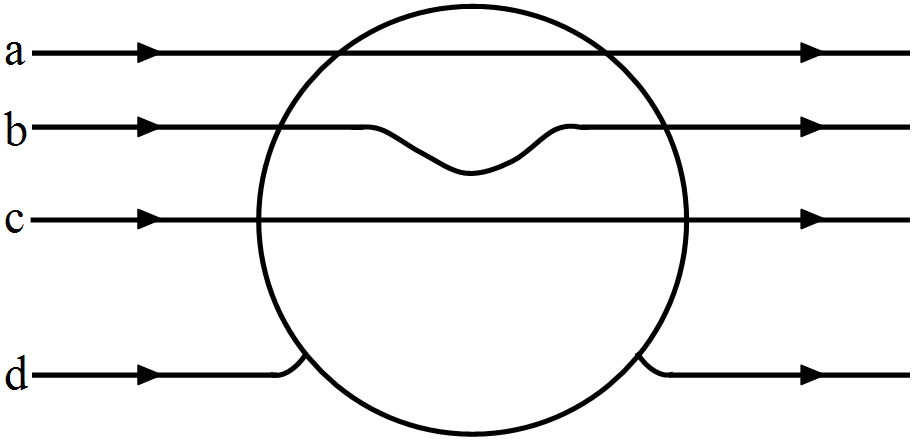
Path (d) is followed by electric field line.
Reason: There are no electric field lines within a metallic sphere and field lines are normal at each point of the surface.
View full question & answer→Question 502 Marks
A wire is bent in the form of a regular hexagon and a total charge q is distributed uniformly on it. What is the electric field at the centre? You may answer this part without making any numerical calculations.
Answer
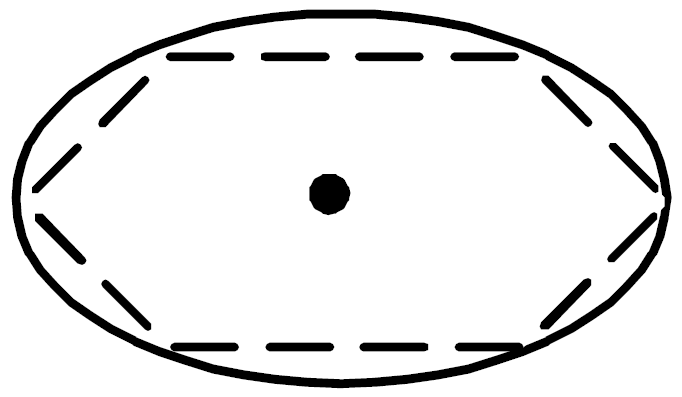
Since it is a regular hexagon. So, it forms an equipotential surface. Hence the charge at each point is equal. Hence the net entire field at the centre is Zero.
View full question & answer→