Question
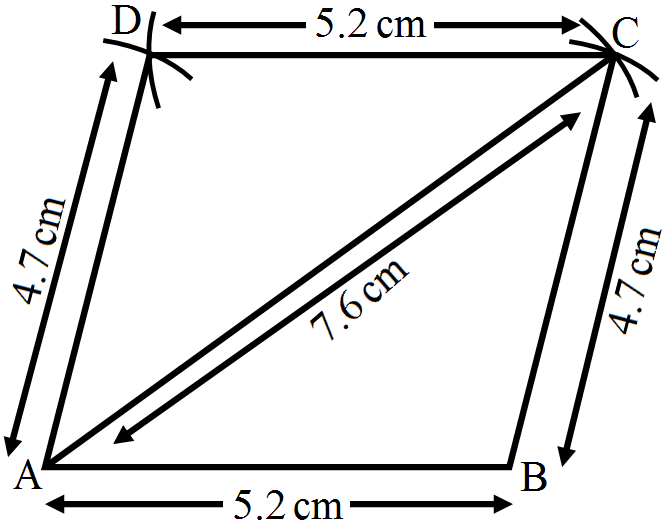
Construct a parallelogram $ABCD$ in which $AB = 5.2\ cm, BC = 4.7\ cm$ and $AC = 7.6\ cm$
Answer


Steps of construction:
Step 1: Draw $AB = 5.2\ cm.$
Step 2: With $B$ as the centre, draw an arc of $4.7\ cm.$​​​​​​​
Step 3: With $A$ as the centre, draw another arc of $7.6\ cm,$ cutting the previous arc at $C.$​​​​​​​
Step 4: Join $A$ and $C.$​​​​​​​
Step 5: We know that the opposite sides of a parallelogram are equal. Thus, with $C$ as the centre, draw an arc of $5.2\ cm.$​​​​​​​
Step 6: With $A$ as the centre, draw another arc of $4.7\ cm,$ cutting the previous arc at $D.$​​​​​​​
Step 7: Join $CD$ and $AD.$
Then, $ABCD$ is the required parallelogram.

Need a full question paper?

Generate a complete, print-ready paper with questions like this in minutes — across 16+ boards, with answer keys.
Start Generating Free

Similar questions

State true or false. Explain your reasoning.
(i) The cube of any odd number is even.
(ii) There is no perfect cube that ends with 8.
(iii) The cube of a 2-digit number may be a 3-digit number.
(iv) The cube of a 2-digit number may have seven or more digits.
(v) Cube numbers have an odd number of factors.
Find all the other angles inside the following rectangles.
Image
Using Euler's formula find the unknown:
Faces
$?$
$5$
$20$
Vertices
$6$
$?$
$12$
Edges
$12$
$9$
$?$
The following table gives the distances travelled by a car at various time$-$intervals. Study the table and draw a linear graph for the same.
Time
$6 a.m.$
$7 a.m.$
$8 a.m.$
$9 a.m.$
Distance $($ in $km)$
$40$
$80$
$120$
$160$
From your graph, answer the questions given below:
$i.$ How much distance did the car cover during the period from $7:30\ a.m.$ to $8\ a.m.$
$ii.$ What was the time when the car had covered a distance of $100\ km$, since its start?
$iii.$ How much distance had the car covered by $8:30\ a.m.?$
A cylindrical vessel, without lid, has to be tin-coated on its both sides. If the radius of the base is $70\ cm$ and its height is $1.4m$, calculate the cost of tin - coating at the rate of $Rs\ 3.50$ per $1000\ cm^2$.
A die is thrown. Find the probability of getting:
$i.$ A prime number.
$ii. 2$ or $4.$
$iii.$ A multiple of $2$ or $3.$
Find the area of the following fields. All dimensions are in metres.
Construct a quadrilateral $ABCD$ in which $BC = 7.5\ cm, AC = AD = 6\ cm, CD = 5\ cm$ and $BD = 10\ cm$.
Find the cube root of the following numbers: $-729 \times 15625$
Factorise the following, using the identity $\left(a^2-2 a b+b^2\right)=(a-b)^2$.
(i) $y^2-14 y+49$
(ii) $\frac{x^2}{4}-2 x+4$
(iii) $a^2 y^3-2 a b y^2+b^2 y$
(iv) $9 y^2-4 x y+\frac{4 x^2}{9}$