Question
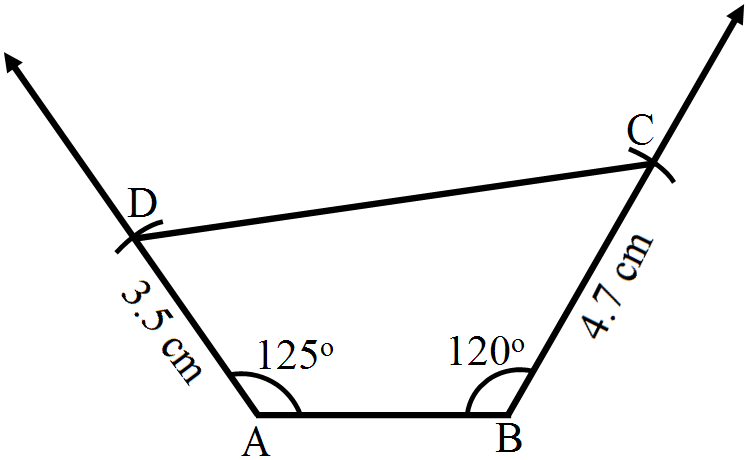
Construct a quadrilateral $ABCD$, in which $AD = 3.5\ cm, AB = 4.4\ cm, BC = 4.7\ cm$, $\angle\text{A}=125^\circ.$ and $\angle\text{B}=120^\circ.$
Answer


Steps of construction:
Step $I$: Draw $QR = 2.5\ cm$.
Step $II$: Construct $\angle\text{PQr}=75^\circ$ at $Q$.
Step $III$: With $Q$ as the centre and radius $3.5\ cm$, cut off $QP = 3.5\ cm$.
Step $IV$: Construct $\angle\text{QRS}=120^\circ$ at $R$.
Step $V$: With $R$ as the centre and radius $4.1\ cm$, cut off $RS = 4.1\ cm$.
Step $VI$: Join $PS$.
The quadrilateral so obtained is the required quadrilateral.

Need a full question paper?

Generate a complete, print-ready paper with questions like this in minutes — across 16+ boards, with answer keys.
Start Generating Free

Similar questions

A tank open at the top is made of iron sheet $4m$ wide. If the dimensions of the tank are $12m \times 8m \times 6m$, find the cost of iron sheet at $Rs. 17.50$ per metre.
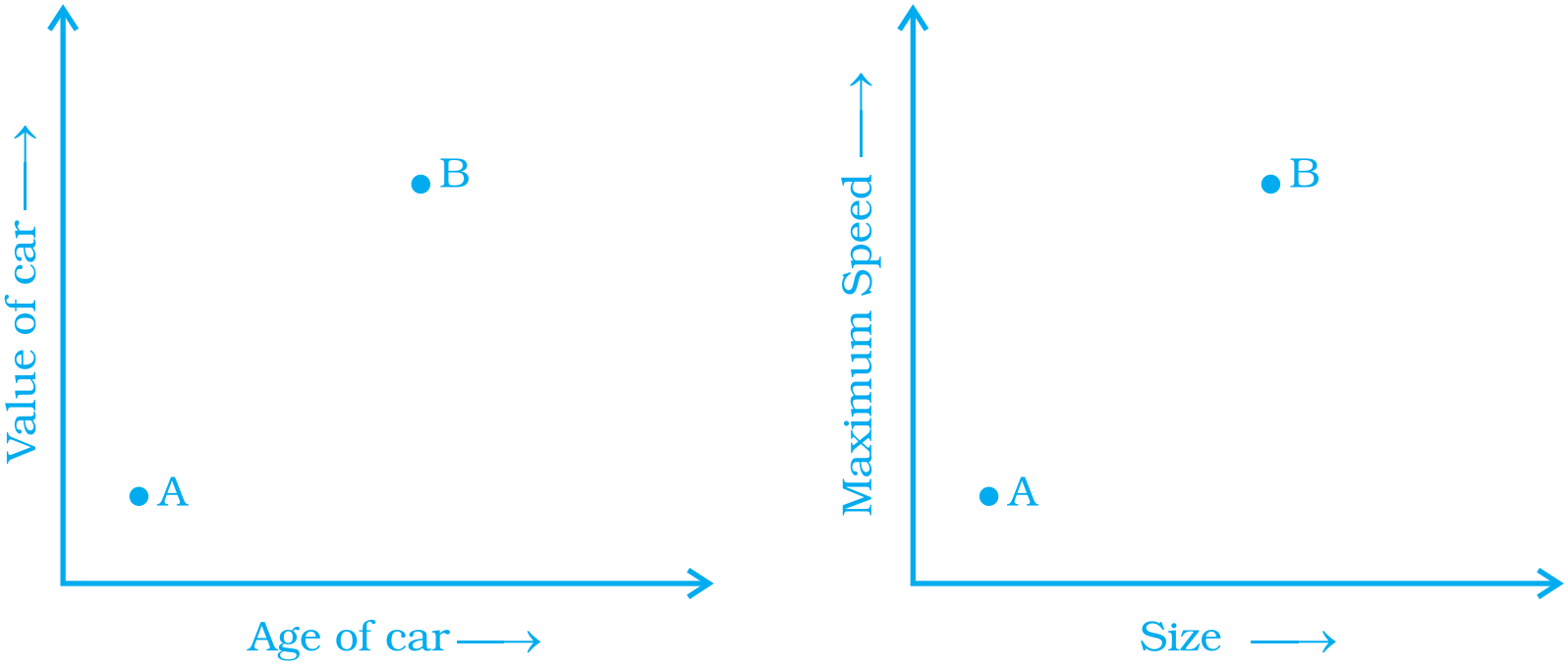
The two graphs below compare Car $A$ and Car $B$. The left graph shows the relationship between age and value. The right graph shows the relationship between size and maximum speed.

Use the graphs to determine whether each statement is true or false, and explain your answer.
$a.$ The older car is less valuable.
$b.$ The faster car is larger.
$c.$ The larger car is older.
$d.$ The faster car is older.
$e.$ The more valuable car is slower.
A company sells biscuits. For packing purpose they are using cuboidal boxes : Box $A \rightarrow 3 cm \times 8 cm \times 20 cm$ and Box $B \rightarrow 4 cm \times 12 cm \times 10 cm$. What size of the box will be economical for the company? Why? Can you suggest any other size (dimensions) which has the same volume but is more economical than these?
Divide the sum of $\frac{13}{5}$ and $\frac{-12}{7}$ by the product of $\frac{-31}{7}$ and $\frac{1}{-2}$.
Swati borrowed $Rs. 40960$ from a bank to buy a piece of land. If the bank charges $12\frac{1}{2}\%$ per annum, compounded half-yearly, what amount will she have to pay after $1\frac{1}{2}$ years? Also, find the interest paid by her.
On one day a rickshaw puller earned $Rs. 160.$ Out of his earnings he spent $\text{Rs. }26\frac{3}{5}$ on tea and snacks, $\text{Rs. }50\frac{1}{2}$ on food and $\text{Rs. }16\frac{2}{5}$ on repairs of the rickshaw. How much did he save on that day?
A shopkeeper alllows his custmers $10\%$ off on the marked price of goods and still gets a profit of $25\%$. What is the actual cost to him of an article marked $Rs. 250$?
Construct a quadrilateral $ABCD$, where $AB = 5.5\ cm, BC = 3.7\ cm,$$\angle\text{A}=60^\circ,$ $\angle\text{B}=105^\circ$ and $\angle\text{D}=90^\circ$
Match the ordinates of the points given in Column $A$ with the items mentioned in Column $B$
 
Column $A$
 
Column $B$
$(a)$
$(7, 0)$
$(i)$
The ordinate is double the abscissa.
$(b)$
$(11, 11)$
$(ii)$
The ordinate is zero.
$(c)$
$(4, 8)$
$(iii)$
The ordinate is equal to the abscissa.
$(d)$
$(6, 2)$
$(iv)$
The abscissa is double the ordinate.
$(e)$
$(0, 9)$
$(v)$
The abscissa is triple the ordinate.
$(f)$
$(6, 3)$
$(vi)$
The abscissa is zero.
Construct a frequency distribution table for the following marks obtained by $25$ students in a history test in class $\text{VIII}$ of a school: $9, 17, 12, 20, 9, 18, 25, 17, 19, 9, 12, 9, 12, 18, 17, 19, 20, 25, 9, 12, 17, 19, 19, 20, 9.$
$i.$ What is the range of marks?
$ii.$ What is the highest mark?
$iii.$ Which mark is occurring more frequently?