Question
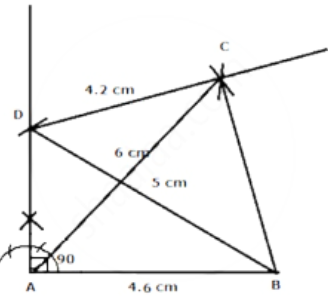
Construct a quadrilateral $\text{ABCD}$ in which $AB = 4.6\ cm, BD = 5\ cm, AC = 6\ cm, CD = 4.2\ cm$ and $\angle A = 90^\circ $
Answer

$AB = 4.6\ cm, BD = 5\ cm, AC = 6\ cm, CD = 4.2\ cm$ and $\angle A = 90^\circ $
Image
Steps of construction:
$1)$Draw a line segment $AB = 4.6\ cm$
$2)$With $A$ as centre, draw a ray making an angle of $90^\circ $ with $AB$
$3)$With $B$ as centre and radius equal to $5\ cm$ cut an arc on the ray from $A$ and mark it as $D.$
$4)$With $D$ as centre and radius $4.2\ cm$ cut an arc on right side of $AD.$
$5)$With $A$ as centre and radius $6\ cm$ cut an arc which meets the arc from $D$ at point $C.$
$6)$Join $BC.$
$7)\text{ABCD}$ is the required quadrilateral.

Need a full question paper?

Generate a complete, print-ready paper with questions like this in minutes — across 16+ boards, with answer keys.
Start Generating Free

Similar questions

$AD$ is drawn perpendicular to base $BC$ of an equilateral $\triangle ABC$. Given $BC = 10 \ cm$, find the length of $AD$, correct to $1$ place of decimal.
Solve the following equations graphically $:\ 3y = 5 - x , 2x = y + 3$
Calculate the amount and compound interest to the nearest rupee on $Rs.42000$ for $2$ years at $8\%$ per annum, interest being payable half$-$yearly.
On a certain sum of money, the difference between the compound interest for a year, payable half$-$yearly, and the simple interest for a year is $Rs. 180/-$ Find the sum lent out, if the rate of interest in both the cases is $10\ \%\ $ per annum.
The denominator of a fraction is greater than its numerator by 9 . If 7 is subtracted from both, its numerator and denominator, the fraction becomes $\frac{2}{3}$. Find the original fraction.
Simplify the following:$\sqrt[3]{x^4 y^2} \div \sqrt[6]{x^5 y^{-5}}$
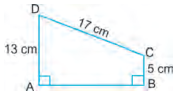
In the given figure, ABCD is a trapezium in which $AD =13 cm, BC =5 cm, CD =17 cm$ and $\angle A =\angle B =90$.
Calculate :
(i) AB
(ii) Area of trap. ABCD .
Image
$375$ persons can be accommodated in a room whose dimensions are in the ratio of $6 : 4 : 1.$ Calculate the area of the four walls of the room if the each person consumes $64\ m^3$ of air.
A farmer was having a field in the form of a parallelogram ABCD. He divided the field into several parts by taking a point X on the side CD and joining it to vertices A and B. The farmer sowed wheat and pulses in equal portions of the field separately.
Based on the above information, answer the following questions:
Q.1. By joining XA and XB, the field has been divided into how many parts?
(a) 2 (b) 3 (c) 4 (d) 5
Q.2. The shapes of the parts obtained above are:
(a) triangles
(b) rectangles
(c) one triangle two squares
(d) none of these
Q.3. Area of $\triangle XAB$ is equal to:
(a) area of parallelogram ABCD
(b) $\frac{1}{2}$ area of parallelogram ABCD
(c) area of $\triangle ADX +$ area of $\triangle BCX$
(d) both (b) and (c)
Q.4. $\triangle ABX$ and parallelogram ABCD are:
(a) On the same base DC
(b) On the same base AB and between the same parallels BC and AD .
(c) On the same base AB and between the same parallels AB and CD .
(d) On the same base CD and between the same parallels AB and CD .
Q.5. If instead of taking point $X$ on side $C D$, the farmer takes a point $Y$ on side $B C$ and joins YA and YD, then:
(a) area of $\triangle ADY =$ area of $\triangle ABY +$ area of $\triangle DCY$
(b) area of $\triangle ADY =\frac{1}{3}$ area of parallelogram ABCD
(c) area of $\triangle ADY =$ area of $\triangle ABY$ (d) area of $\triangle ADY =$ area of $\triangle DCY$
$\text{ABCD}$ is a trapezium with $AB \| DC$. A line parallel to $AC$ intersects $AB$ at point $M$ and $BC$ at point $N$.Prove that: area of $\triangle ADM =$ area of $\triangle ACN.$