Question
Construct a rectangle in which one of the diagonals divides the opposite angles into 50° and 40°.
Answer

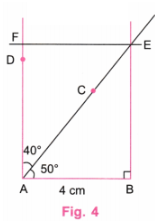
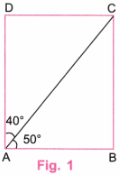
We shall draw a rectangle of the form shown in Fig. 1.
Image
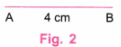
Step 1. Using a ruler, draw a line AB equal to 4 cm, say. (Fig. 2.)
Image
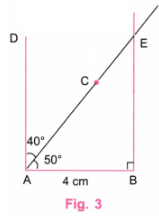
Step 2. Using a protractor, mark dots C and D at angles 50° and 90° (50° + 40°), keeping the central point of the protractor at A. (Fig. 3)
Image
Step 3. Using a protractor, draw a perpendicular line to AB at B and let it intersect the extended line AC at E. (Fig 3)
Step 4. Using a protractor, draw a perpendicular line to BE at E and let it intersect the extended line AD at F. (Fig 4)
Image
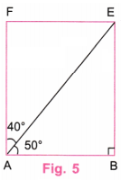
Step 5. Erase the extra lines in Fig. 4. (Fig. 5)
Image
Step 6. Fig. 5 is the required rectangle in which one of the diagonals divides the opposite angles into 50° and 40°.
Need a full question paper?

Generate a complete, print-ready paper with questions like this in minutes — across 16+ boards, with answer keys.
Start Generating Free

Similar questions

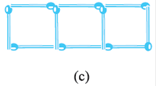
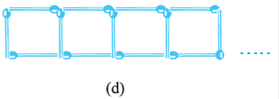
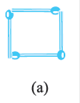
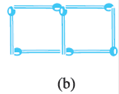
Look at the following matchstick pattern of squares (Fig.). The squares are not separate. Two neighbouring squares have a common matchstick. Observe the patterns and find the rule that gives the number of matchstick in terms of the number of squares. 
(Hint : If you remove the vertical stick at the end, you will get a pattern of Cs.)


Match the equivalent fractions:
$(a) \frac{250}{400}$ $i.\frac{2}{3}$
$(b) \frac{180 }{200}$ $ii. \frac{2}{5}$
$(c) \frac{660}{990}$ $iii.\frac{1}{2}$
$(d) \frac{180}{360}$ $iv. \frac{5}{8}$
$(e) \frac{220}{550}$ $v. \frac{9}{10}$
What part of a revolution have you turned through if you stand facing east and turn clockwise to face north?
Draw wherever possible, a rough sketch of
(a) a triangle with atleast two lines of symmetry and atleast two angles of symmetry.
(b) a triangle with only one line of symmetry but not having rotational symmetry.
(c) a quadrilateral with rotational symmetry but no reflection symmetry.
(d) a quadrilateral with reflection symmetry but not having rotational symmetry.
Draw a line segment of length $8.6\ cm.$ Bisect it and measure the length of each part.
If $A, B, C,$ divide $Rs. 1200$ in the ratio $2 : 3 : 5, $ then $B's$ share is:
Construct $\overline {AB}$ of length $7.8\ cm.$ From this cut off $\overline {AC}$ of length $4.7\ cm.$ Measure $\overline {BC}$.
This is a square with 8 cm sidelengths.
Image
Construct a “Square with Curves ”, taking a square of side 8 cm as shown in the figure.
Hint: Think where the tip of the compass can be placed to get all 4 arcs to bulge uniformly from each of the sides. Try it out!
Draw a line segment $AB$ of length $8\ cm.$ At each end of this line segment, draw a line perpendicular to $AB.$ Are these two lines parallel?
Draw $\angle\text{POQ}$ of measure $75^\circ $ and find its line of symmetry.