Questions

5 Marks Questions

Take a timed test

15 questions · self-marked practice — reveal the answer and mark yourself.

Question 15 Marks
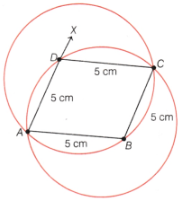
Is there a 4-sided figure in which all the sides are equal in length but is not a square? if such a figure exists, can you construct it?
View full question & answer
Question 25 Marks
Construct a bigger house in which all the sides are of length 7 cm.
Answer
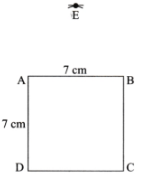
First draw a square of side 7 cm, named as ABCD.
Image
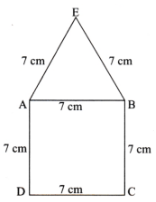
Now, using a compass draw arcs above the side AB of radius 7 cm from points A and B. Let the arcs intersect at point E.
Image
Joint A to E and B to E by straight lines
Image
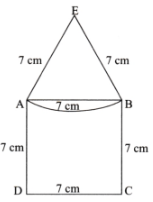
Now, take 7 cm radius in the compass and from E, draw the arc touching A and B as shown in the figure.
Image
View full question & answer
Question 35 Marks
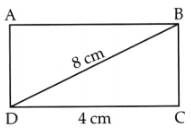
Construct a rectangle one of whose sides is 4 cm and the diagonal is of length 8 cm.
Answer
First, draw a rough diagram
Image
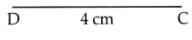
Step 1: The base CD measuring length 4 cm can be easily constructed.
Image
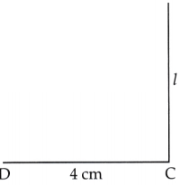
Step 2: Draw a perpendicular to line DC at the point C. Let us call this line l.
Image
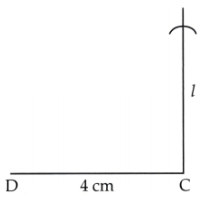
Step 3: Draw an arc of radius 8 cm with point D as the center.
Image
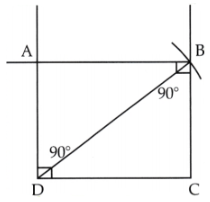
To locate the point B,
Step 4: Draw perpendiculars to DC and BC passing through D and B, respectively. The point where these lines intersect is the fourth point A.
Image
It satisfies all conditions of the rectangle.
View full question & answer
Question 45 Marks
Construct a rectangle in which one of the diagonals divides the opposite angles into 45° and 45°. What do you observe about the sides?
Answer
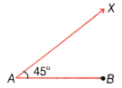
Draw a horizontal line segment AB. This will be one side of the rectangle.
Image
(i) At point A, use a protractor to measure and draw AX a 45° angle.
Image
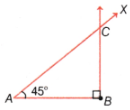
(ii) At point B, measure and draw a 90° angle. Draw a line segment BC extending from B at this angle meeting AX at C.
Image
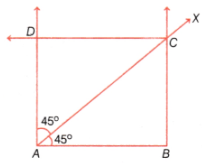
(iii) At Point A and C, Draw a 90° angle which meets at the point D.
Image
ABCD is the required rectangle. Here, diagonal AC divides the opposite angles A and C into 45° and 45°.
Observation You will notice that when the diagonals divide the opposite angles into 45° and 45°, so the sides of the rectangle will be equal, forming a square.
View full question & answer
Question 55 Marks
Construct a rectangle in which one of the diagonals divides the opposite angles into 50° and 40°.
Answer
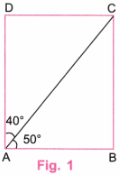
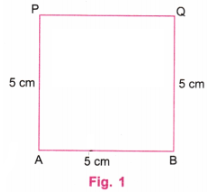
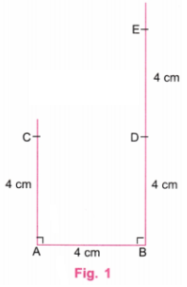
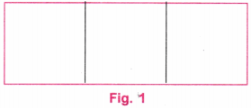
We shall draw a rectangle of the form shown in Fig. 1.
Image
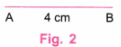
Step 1. Using a ruler, draw a line AB equal to 4 cm, say. (Fig. 2.)
Image
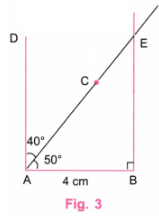
Step 2. Using a protractor, mark dots C and D at angles 50° and 90° (50° + 40°), keeping the central point of the protractor at A. (Fig. 3)
Image
Step 3. Using a protractor, draw a perpendicular line to AB at B and let it intersect the extended line AC at E. (Fig 3)
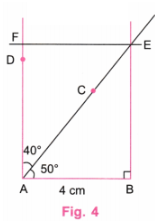
Step 4. Using a protractor, draw a perpendicular line to BE at E and let it intersect the extended line AD at F. (Fig 4)
Image
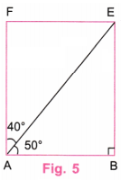
Step 5. Erase the extra lines in Fig. 4. (Fig. 5)
Image
Step 6. Fig. 5 is the required rectangle in which one of the diagonals divides the opposite angles into 50° and 40°.
View full question & answer
Question 65 Marks
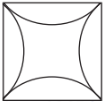
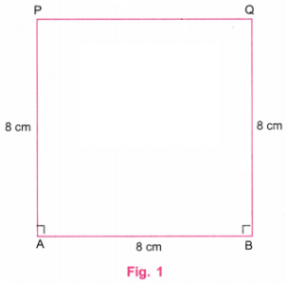
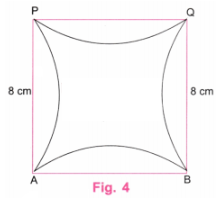
This is a square with 8 cm sidelengths.
Image
Construct a “Square with Curves ”, taking a square of side 8 cm as shown in the figure.
Hint: Think where the tip of the compass can be placed to get all 4 arcs to bulge uniformly from each of the sides. Try it out!
Answer
In the given figure, the centres of the four arcs are outside the square.
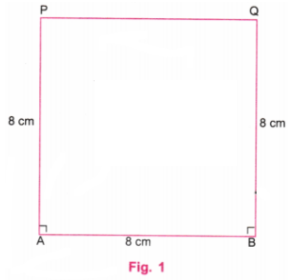
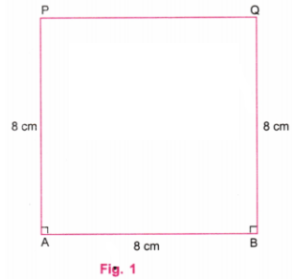
Step 1. Using a ruler, draw a line AB equal to 8 cm. Using a protractor, draw perpendicular lines at A and B. Using a ruler, mark point P on the perpendicular line at A such that AP = 8 cm. Using a ruler, mark point Q on the perpendicular line at B such that BQ = 8 cm. Join P and Q using a ruler. Erase the lines above P and Q. (Fig. 1)
Image
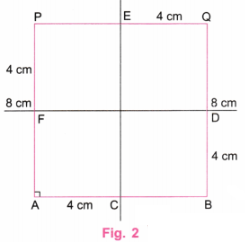
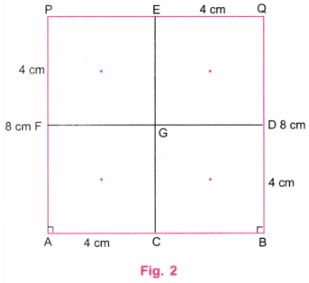
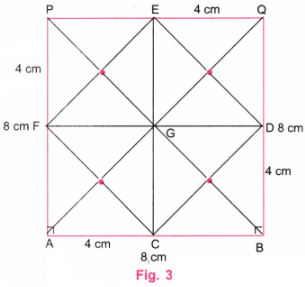
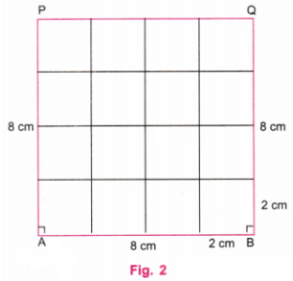
Step 2. Using a ruler, mark points C, D, E, and F such that AC = 4 cm, BD = 4 cm, QE = 4 cm, and PF = 4 cm. Join C and E and also D and F. Extend these lines outside the square. (Fig. 2)
Image
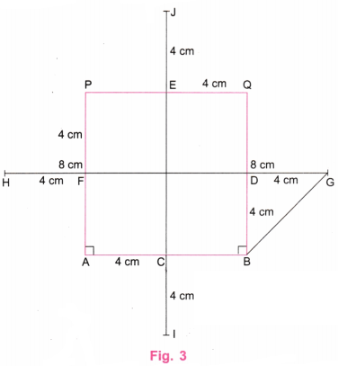
Step 3. Extend DF and take points G and H on it so that DG and FH are equal to 4 cm. Extend CE and take points I and J on it so that Cl and EJ are equal to 4 cm. The distance 4 cm can be taken slightly less than or greater than 4 cm. Join B and G. (Fig. 3)
Image
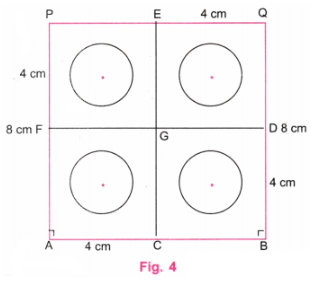
Step 4. With centres at G, H, I, and J and a radius equal to BG, draw four arcs inside the square as shown in the given figure. Erase the extra lines. (Fig. 4).
Image
Step 5. Fig. 4 is the required “Square with Curves” with the square of side 8 cm.
View full question & answer
Question 75 Marks
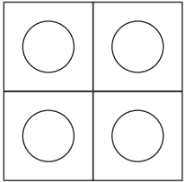
Construct a “Square with Four Holes” as shown in the given figure. Construct a “Square with Four Holes” as shown in the given figure.
Image
Answer
In the figure, the centre of a circle is the same as that of the corresponding square.
Step 1. Using a ruler, draw a line AB equal to 8 cm, say. Using a protractor, draw perpendicular lines at A and B. Using a ruler, mark point P on the perpendicular line at A such that AP = 8 cm. Using a ruler, mark point Q on the perpendicular line at B such that BQ = 8 cm. Join P and Q using a ruler. Erase the lines above P and Q. (Fig. 1)
Image
Step 2. Using a ruler, find points C, D, E, and F such that AC = 4 cm, BD = 4 cm, QE = 4 cm, and PF = 4 cm. Join C and E and also F and D. (Fig. 2)
Image
Step 3. Let G be the intersection of lines FD and CE. Find the centres of squares ACGF, CBDG, DQEG, and GEPF by joining their respective diagonals. (Fig. 3)
Image
Step 4. Erase the extra lines used for finding the centres of the smaller circles. With centre at centres of small squares, draw four circles of radius 1.3 cm, say. (Fig. 4)
Image
Step 5. Fig. 4 is the required “‘Square with Four Holes”.
View full question & answer
Question 85 Marks
Image
Observe that the circular hole is the same as the centre of the square.
Construct a “Square with a Hole” as shown in the given figure. The centre of the hole is the same as the center of the square.
Hint: Think where the centre of the circle should be.
Answer
The centre of a square is the point of intersection of its diagonals. This centre is also the centre of the hole in the figure.
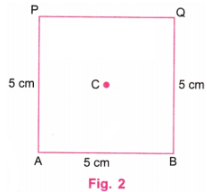
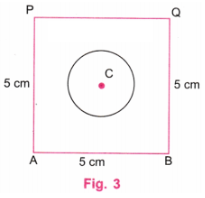
Step 1. Using a ruler, draw a line AB equal to 5 cm, say. Using a protractor, draw perpendicular lines at A and B. Using a ruler, mark point P on the perpendicular line at A such that AP = 5 cm. Using a ruler, mark point Q on the perpendicular line at B such that BQ = 5 cm. Join P and Q using a ruler. Erase the lines above P and Q (Fig. 1).
Image
Step 2. Draw diagonals AQ and BP using a ruler. Let the diagonals intersect at C. This point is the centre of the square ABQP. Erase the diagonals AQ and BP. (Fig. 2).
Image
Step 3. With centre at C and a radius of 1.5 cm, say, draw a circle using a compass. (Fig. 3)
Image
Step 4. Fig. 3 is the required “Square with a Hole”.
View full question & answer
Question 95 Marks
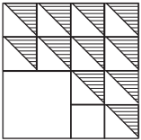
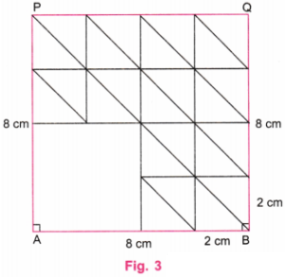
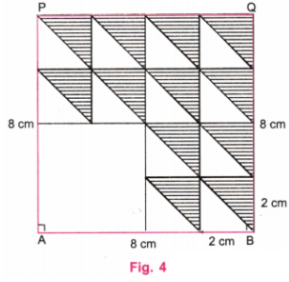
Construct the figure given below. Choose the measurement of your choice. Note that the larger 4-sided figure is square and so tire the smaller ones.
Image
Answer
Step 1. Using a ruler, draw a line AB equal to 8 cm. Because, 8 ÷ 4 = 2, we shall draw smaller squares of side 2 cm. Using a protractor, draw perpendicular lines at A and B. Using a ruler, mark point P on the perpendicular line at A such that AP = 8 cm. Using a ruler, mark point Q on the perpendicular line at B such that BQ = 8 cm. Join P and Q using a ruler. Erase the lines above P and Q (Fig. 1).
Image
Step 2. On the lines AB, BQ, QP, and PA, mark points at distances of 2 cm, using a ruler. Draw horizontal lines and vertical lines to get 16 squares. (Fig. 2)
Image
Step 3. From comer A, erase the inner sides of four squares to get a square of side 4 cm with one comer at A. Draw parallel diagonals of the remaining 12 small squares of side 2 cm each. (Fig. 3)
Image
Step 4. In the 12 small squares, draw horizontal lines in the portion above the diagonals. (Fig. 4)
Image
Step 5. Fig. 4 is the required figure having 12 small squares in a square.
View full question & answer
Question 105 Marks
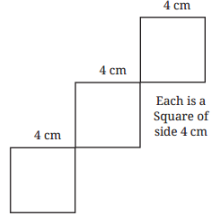
Construct the ‘Falling Squares” figure shown below:
Image
Make sure that the squares are aligned the way they are shown. Now, try this.
Image
Answer
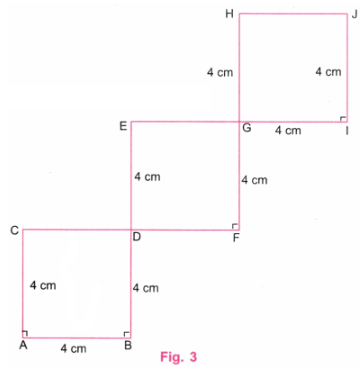
In the given figure, there are three falling squares and the side of each square is 4 cm.
Step 1. Using a ruler, draw a line AB equal to 4 cm. Using a protractor, draw perpendicular lines at A and B.
Using a ruler, mark point C on a perpendicular line at A such that AC = 4 cm.
Using a ruler, mark points D and E on a perpendicular line at B such that BD = 4 cm and DE = 4 cm. (Fig. 1)
Image
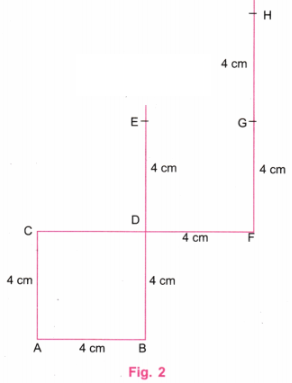
Step 2. Join C and D. Produce CD to F such that DF = 4 cm. Using a protractor, draw a perpendicular line at F. Using a ruler, mark points G and H on a perpendicular line at F such that FG = 4 cm and GH = 4 cm. (Fig. 2).
Image
Step 3. Join E and G. Produce EG to I such that GE = 4 cm. Using a protractor, draw a perpendicular line at I. Using a ruler, mark point J on the perpendicular line at I such that IJ = 4 cm. Join H and J. Erase extra lines in the figure. (Fig. 3).
Image
Step 4. Fig. 3 is the required figure of three “falling squares” each of side 4 cm.
View full question & answer
Question 115 Marks
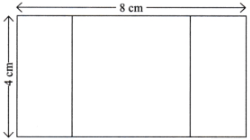
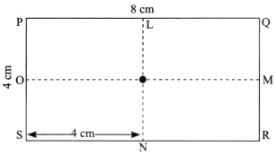
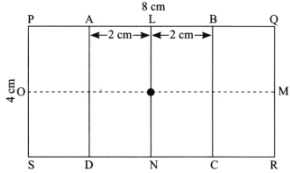
Construct a rectangle of sides 8 cm and 4 cm. How will you construct a square inside, as shown in the figure, such that the centre of the square is the same as the centre of the rectangle ?
Image
Hint.
Draw a rough figure. What will be the sidelength of the square? What will be the distance between the comers of the square and the outer rectangle?
Answer
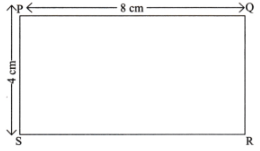
Draw a rectangle PQRS of sides 8 cm and 4 cm.
Image
Next, draw lines LN and MO from the midpoints of opposite sides such that they intersect side PQ at L, QR at M, RS at N, and PS at O respectively.
Image
Since the centre of square and rectangle is same and the width of rectangle is 4 cm, so we draw a square of side 4 cm with the centre of rectangle and named as ABCD.
Image
∴ The side length of the square is 4 cm and the distance between the comers of the square and the outer rectangle = PL – AL = 4 cm – 2 cm = 2 cm.
View full question & answer
Question 125 Marks
Give the lengths of the sides of a rectangle that cannot be divided into: (Page 201)
(i) Two identical squares
(ii) Three identical squares.
Answer
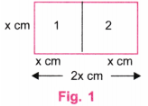
(i) Let the smaller side of a rectangle be x cm. If the larger side of the rectangle is 2x cm (x cm + x cm), then this rectangle can be divided into two identical squares of side x cm. (Fig. 1)
Image
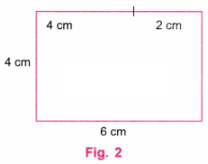
Let us consider a rectangle of sides 4 cm and 6 cm. Here, 6 is not equal to 8 (4 + 4), so, it cannot be divided into two identical squares as shown in Fig. 2
Image
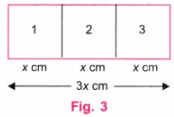
(ii) Let the smaller side of a rectangle be x cm. If the larger side of the rectangle is 3x cm (x cm + x cm + x cm), then this rectangle can be divided into three identical squares of side x cm. (Fig. 3)
Image
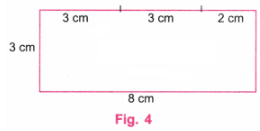
Let us consider a rectangle of sides 3 cm and 8 cm. Here, 8 is not equal to 9 (3 + 3 + 3), so, it cannot be divided into three identical squares as shown in Fig. 4.
Image
View full question & answer
Question 135 Marks
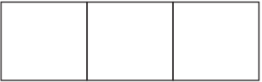
Construct a rectangle that can be divided into 3 identical squares.
Image
Answer
We shall draw a rectangle of the form shown in Fig. 1.
Image
Step 1. Let us keep the vertical side of the rectangle to 3 cm. Since the rectangle is to be divided into three identical squares, the length of the rectangle must be 3 cm + 3 cm + 3 cm = 9 cm.
Step 2. Using a ruler, draw a line AB equal to 9 cm. (Fig. 2).

Image
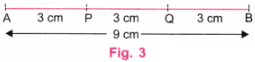
Step 3. Using a ruler, find points P and Q on AB such that AP = 3 cm and PQ = 3 cm. Here, QB is also 3 cm. (Fig. 3).
Image
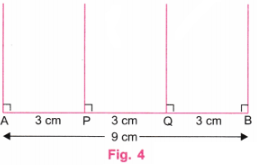
Step 4. Using a protractor, draw perpendicular lines at A, P, Q, and B. (Fig. 4).
Image
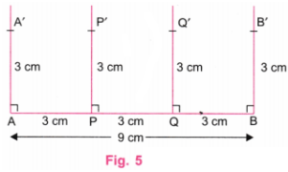
Step 5. Using a ruler, mark points A’, P’, Q’, and B’ on perpendiculars at A, P, Q, and B respectively such that AA’ = PP’ = QQ’ BR’ = 3 cm. (Fig. 5).
Image
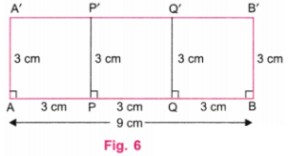
Step 6. Join A’ and P’, P’ and Q’, and Q’ and B’ using a ruler. Erase the lines above A’, P’, Q’, and B’. (Fig. 6).
Image
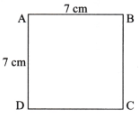
Step 7. ABB’A’ is the required rectangle which is divided into 3 identical squares APP’A’, PQQ’P’, and QBB’Q’.
View full question & answer
Question 145 Marks
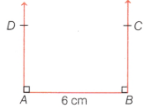
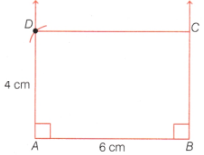
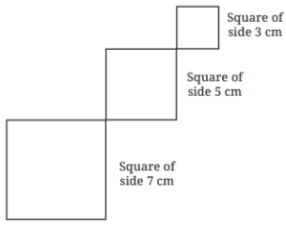
Draw a rectangle with sides of length 4 cm and 6 cm. After drawing, check if it satisfies both the rectangle properties.
Answer
Rectangle with sides 4 cm and 6 cm.
Steps
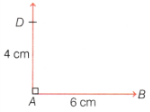
(i) Draw a,straight line AB = 6 cm using a ruler.
Image
(ii) Place the protractor on point A and mark a 90° angle from AB.
(iii) Draw a line from A along this angle and measure AD 4 cm.
Image
(iv) Repeat the same process at point B to draw a line BC perpendicular to AB and also 4 cm long.
Image
(v) Join points D and C to complete the rectangle ABCD.
Image
(vi) Verify that AB and CD are equal as well as AD and BC and all angles are 90°.
View full question & answer
Question 155 Marks
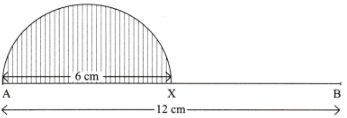
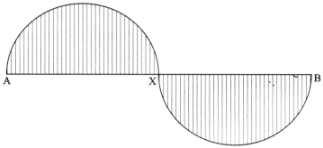
Take a central line of a different length and try to draw the wave on it.
Answer
Let us take AB to be the central line such that the length of AB is 12 cm. That is, AB = 12 cm.
Now, the first wave is drawn as a half circle, using the diameter half of the central line AB, i.e., the radius half 6 of AX = $\frac{6}{2} cm=3 cm 2$
Image
Now, the second wave is drawn as the half circle with radius half of XB = 6 cm, i.e., of 3 cm in opposite direction to the first wave.
Image
View full question & answer