Question
Construct a rhombus whose diagonals are of length $10\ cm$ and $6\ cm$.
Answer


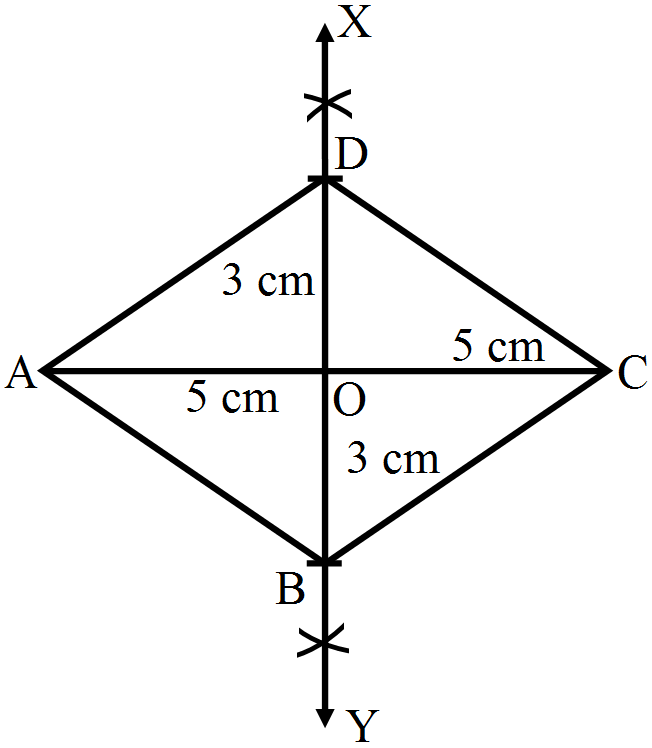
$1.$ Draw $\text{AC}$ equal to $10\ cm$.
$2.$ Draw $\text{XY,}$ the right bisector of $\text{AC}$, meeting it at $\text{O}$.
$3.$ With $O$ as centre and radius equal to half of the length of the other diagonal, i.e. $3\ cm$, cut $\text{OB = OD} = 3\ cm$.
$4.$ Join $\text{AB, AD}$ and $\text{CB, CD}$.

Need a full question paper?

Generate a complete, print-ready paper with questions like this in minutes — across 16+ boards, with answer keys.

Start Generating Free

Similar questions

Construct a quadrilateral $ABCD$ in which $AB = 2.9\ cm, BC = 3.2\ cm, CD = 2.7\ cm, DA = 3.4\ cm$ and $\angle\text{A}=70^\circ.$
A piece of ductile metal is in the form of a cylinder of diameter $1\ cm$ and length $11\ cm.$ It is drawn out into a wire of diameter $1\ mm.$ What will be the length of the wire so obtained?
In a rectangle $ABCD$, $AB = 25\ cm$ and $BC = 15$. In what ratio does the bisector of $\angle\text{C}$ divide $AB$?
Draw the graph for the following table of values, with suitable sales and Interest on deposits for a year on the axis.
Deposit $($in $₹)$ $1000$ $2000$ $3000$ $4000$ $5000$
Simple Interest $($in $₹)$ $80$ $160$ $240$ $320$ $400$
$i.$ Does the graph pass through the origin?
$ii.$ Use the graph to find the interest on $Rs. 2500$ for a year?
$iii.$To get an interest of $Rs. 280$ per year, how much money should be deposited?
$A$ can do a piece of work in $40$ days and $B$ in $45$ days. They work together for $10$ days and then $B$ goes away. In how many days will $A$ finish the remaining work?
Construct a frequency distribution table for the following marks obtained by $25$ students in a history test in class $\text{VIII}$ of a school: $9, 17, 12, 20, 9, 18, 25, 17, 19, 9, 12, 9, 12, 18, 17, 19, 20, 25, 9, 12, 17, 19, 19, 20, 9.$
$i.$ What is the range of marks?
$ii.$ What is the highest mark?
$iii.$ Which mark is occurring more frequently?
Diagram of the adjacent picture frame has outer dimensions $24 cm \times 28 cm$ and inner dimensions $16 cm \times 20 cm$. Find the area of each section of the frame, if the width of each section is same.
Image
Find the square roots of $121$ and $169$ by the method of repeated subtraction.
If a quadrilateral has four equal sides and one angle of $90^{\circ}$, will it be a square? Find the answer using geometric reasoning as well as by construction and measurement.
A car is travelling from city $P$ to city $Q$, which are $350\ km$ apart. The line graph given below describes the distances of the car from the city $P$ at different times.
Study the above graph and answer the questions given below:
$i.$ What information is given on the two axes?
$ii.$ From where and when did the car begin its journey?
$iii.$ How far dis the car go in the first hour?
$iv.$ How far did the car go during $(a)$ the $2^{nd}$ hour and $(b)$ the $3^{rd}$ hour?
$v.$ Was the speed same during first three hours? How do you know it?
$vi.$ Did the car stop for some during at any place? Justify your answer.
$vii.$ When did the car reach city $Q?$