Question
Construct a right-angled triangle ABC whose base BC is 6cm and the sum of the hypotenuse AC and other side AB is 10cm.
Answer


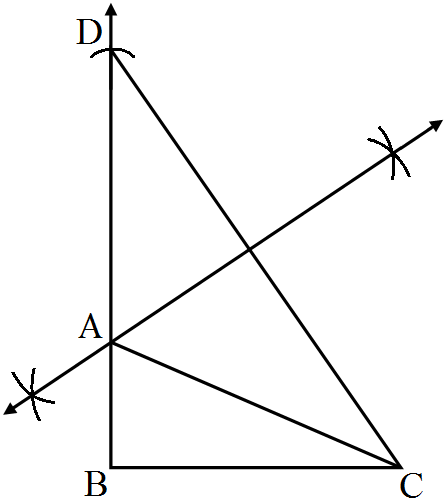
Steps of construction:
  1. Construct a line segment BC of 6cm.
  2. At the point B, draw $\angle\text{XBC}=90^\circ.$
  3. Keeping B as center and radius 10cm draw an arc which intersects XB at D.
  4. Join DC.
  5. Draw the perpendicular bisector of DC which intersects DB at A.
  6. Join AC.
Hence $\triangle\text{ABC}$ is the required triangle.

Need a full question paper?

Generate a complete, print-ready paper with questions like this in minutes — across 16+ boards, with answer keys.

Start Generating Free

Similar questions

Simplify:$\Big(\frac{\text{x}^{\text{a}+\text{b}}}{\text{x}^\text{c}}\Big)^{\text{a}-\text{b}}\Big(\frac{\text{x}^{\text{b}+\text{c}}}{\text{x}^\text{a}}\Big)^{\text{b}-\text{c}}\Big(\frac{\text{x}^{\text{c}+\text{a}}}{\text{x}^\text{b}}\Big)^{\text{c}-\text{a}}$
The marks scored by 55 students in a test are given below:
Marks
0-5
5-10
10-15
15-20
20-25
25-30
30-35
No. of students
2
6
13
17
11
4
2
Prepare a cumulative frequency table.
Find the cube of the following binomial expressions:$\frac{1}{\text{x}}+\frac{\text{y}}{3}$
If $\text{x}-\frac{1}{\text{x}}=7,$ find the value of $\text{x}^3-\frac{1}{\text{x}^3}.$
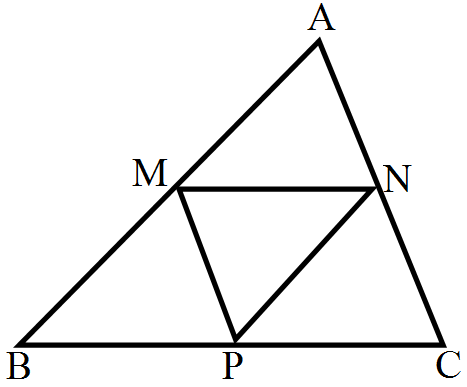
In figure, M, N and P are mid-points of AB, AC and BC respectively. If MN = 3cm, NP = 3.5cm and MP = 2.5cm, calculate BC, AB and AC.
The opposite sides of a quadrilateral are parallel. If one angle of the quadrilateral is 60°. Find the other angles.
Draw the graphs of the following linear equations on the same graph paper:
2x + 3y = 12, x - y = 1
Find the coordinates of the vertices of the triangle formed by the two straight lines and the y-axis. Also, find the area of the triangle.
Divide first polynomial by second polynomial and write the answer in the form ‘Dividend = Divisor x Quotient + Remainder’ :
$x^3 – 64; x – 4$
Prove that in a quadrilateral the sum of all the sides is geater than the sum of its diagonals.
Find the ratio between the total surface area of a cylinder to its curved surface area, given that height and radius of the tank are 7.5m and 3.5m respectively.