Question
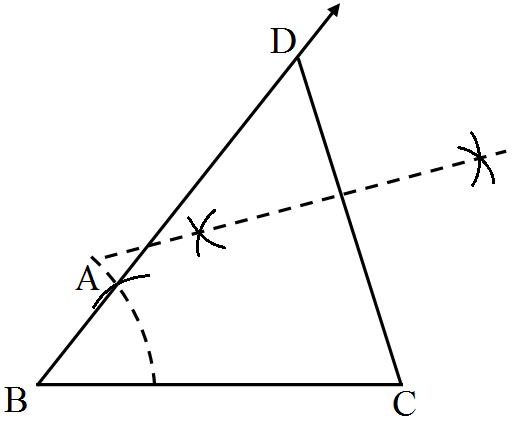
Construct a $\triangle\text{ABC}$ in which BC = 3.6cm, AB + AC = 4.8cm and $\angle\text{B}=60^\circ. $
Answer


Steps of Construction:
  1. Construct a line segment BC of 3.6cm.
  2. At the point B, draw $\angle\text{XBC}=60^\circ.$
  3. Keeping B as center and radius 4.8cm draw an arc which intersects XB at D.
  4. Join DC.
  5. Draw the perpendicular bisector of DC which intersects DB at A.
  6. Join AC.
Hence $\triangle\text{ABC}$ is the required triangle.

Need a full question paper?

Generate a complete, print-ready paper with questions like this in minutes — across 16+ boards, with answer keys.

Start Generating Free

Similar questions

Draw the graph of the equations given below. Also, find the coordinates of the points where the graph cuts the coordinate axes:
-x + 4y = 8
The number of runs scored by a cricket player in 25 innings is as follows:
26, 35, 94, 48, 82, 105, 53, 0, 39, 42, 71, 0, 64, 15, 34, 15, 34, 6, 71, 0, 64, 15, 34, 15, 34, 67, 0, 42, 124, 84, 54, 48, 139, 64, 47
  1. Rearrange these runs in ascending order.
  2. Determine the player, is highest score.
  3. How many times did the player not score a run?
  4. How many centuries did he score?
  5. How many times did he score more than 50 runs?
Prove that:$\frac{1}{1+\sqrt{2}}+\frac{1}{\sqrt{2}+\sqrt{3}}+\frac{1}{\sqrt{3}+\sqrt{4}}+\frac{1}{\sqrt{4}+\sqrt{5}}\\+\frac{1}{\sqrt{5}+\sqrt{6}}+\frac{1}{\sqrt{6}+\sqrt{7}}+\frac{1}{\sqrt{7}+\sqrt{8}}+\frac{1}{\sqrt{8}+\sqrt{9}}=2$
Draw a line segment of length 8.6cm. Bisect it and measure the length of each part.
Simplify:$\Big(\frac{\text{x}^{\text{a}+\text{b}}}{\text{x}^\text{c}}\Big)^{\text{a}-\text{b}}\Big(\frac{\text{x}^{\text{b}+\text{c}}}{\text{x}^\text{a}}\Big)^{\text{b}-\text{c}}\Big(\frac{\text{x}^{\text{c}+\text{a}}}{\text{x}^\text{b}}\Big)^{\text{c}-\text{a}}$
Draw a circle with centere at point O. Draw its two chords AB and CD such that AB is not parallel to CD. Draw the perpendicular bisectors of AB and CD. At what point do they intersect?
Represent $\sqrt{7.28}$ geometrically on the number line.
If $\text{x}-\frac{1}{\text{x}}=\frac{1}{2},$ then write the value of $4\text{x}^2+\frac{4}{\text{x}^2}.$
Why do we group data?
Find the values of n and $\overline{\text{X}}$ in the following case:$\sum\limits^\text{n}_{\text{i}=1}(\text{x}_\text{i}-10)=30$ and $\sum\limits^\text{n}_{\text{i}=1}(\text{x}_\text{i}-6)=150$