Question
Construct ∆PQR, in which PQ – PR = 2.4 cm, QR = 6.4 cm and ∠PQR = 55°.
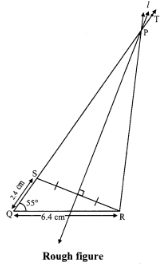
Answer


Image

Here, PQ – PR = 2.4 cm
∴ PQ > PR
As shown in the rough figure draw seg QR = 6.4 cm
Draw a ray QT making on angle of 55° with QR
Take a point S on ray QT, such that QS = 2.4 cm.
Now, PQ – PS = QS [Q-S-P]
∴ PQ – PS = 2.4 cm …(i)
Also, PQ – PR = 2.4 cm ….(ii) [Given]
∴ PQ – PS = PQ – PR [From (i) and (ii)]
∴ PS = PR
∴ Point P is on the perpendicular bisector of seg RS
∴ Point P is the intersection of ray QT and the perpendicular bisector of seg RS

Steps of construction:
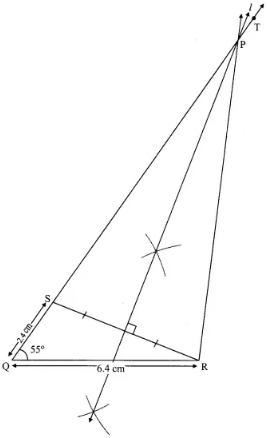
i. Draw seg QR of length 6.4 cm.
ii. Draw ray QT, such that ∠RQT = 55°.
iii. Take point S on ray QT such that l(QS) = 2.4 cm.
iv. Join the points S and R.
v. Draw perpendicular bisector of seg SR intersecting ray QT.
Name that point as P.
vi. Join the points P and R.
Hence, ∆PQR is the required triangle.

Image

Need a full question paper?

Generate a complete, print-ready paper with questions like this in minutes — across 16+ boards, with answer keys.
Start Generating Free

Similar questions

Prove that the diameter of a circle perpendicular to one of the two parallel chords of a circle is perpendicular to the other and bisects it.
Construct incircle and circumcircle of an equilateral ADSP with side 7.5 cm. Measure the radii of both the circles and find the ratio of radius of circumcircle to the radius of incircle.
The price of 3 chairs and 2 tables is ₹ 4500 and price of 5 chairs and 3 tables is ₹ 7000, then find the price of 2 chairs and 2 tables.
AB and AC are two chords of a circle of radius r such that AB = $2AC.$
If p and q are the distances of AB and AC from the centre then prove that $4q^2 = p^2 + 3r^2.$
Aarushi was driving a car with uniform speed of 60km/ h. Draw distance-time graph. From the graph, find the distance travelled by Aarushi in:
  1. $2\frac{1}{2}\text{ Hours}$
  2. $\frac{1}{2}\text{ Hour}$
AB and CD are respectively the smallest and largest sides of a quadrilateral ABCD. Show that $\angle\text{A}>\angle\text{C}$ and $\angle\text{B}>\angle\text{D}.$
ABCD is a parallelogram in which BC is produced to E such that CE = BC. AE intersects CD at F.
  1. Prove that $\text{ar}(\triangle\text{ADF})=\text{ar}(\triangle\text{ECF}).$
  2. If the area of $\triangle\text{DFB}=3\text{cm}^2,$ find the area of $||^{gm}ABCD$.
Prove that 3 + √5 is an irrational number.
Divide each of the following polynomials by synthetic division method and also by linear division method. Write the quotient and the remainder : $(2x^4 + 3x^3 + 4x – 2x^2) ÷ (x + 3)$
Construct ∆LMN, in which ∠M = 60°, ∠N = 80° and LM + MN + NL = 11 cm.