Question
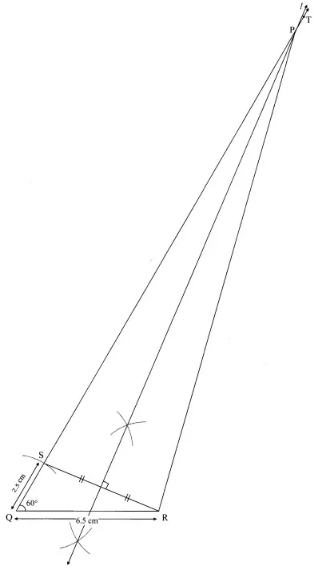
Construct ∆PQR, such that QR = 6.5 cm, ∠PQR = 60° and PQ – PR = 2.5 cm.

Answer


Here, PQ – PR = 2.5 cm
∴ PQ > PR
As shown in the rough figure draw seg QR = 6.5 cm
Draw a ray QT making on angle of 60° with QR
Take a point S on ray QT, such that QS = 2.5 cm.
Now, PQ – PS = QS [Q-S-T]
∴ PQ – PS = 2.5 cm ……(i) [Given]
Also, PQ – PR = 2.5 cm …..(ii) [From (i) and (ii)]
∴ PQ – PS = PQ – PR
∴ PS = PR
∴ Point P is on the perpendicular bisector of seg RS
∴ Point P is the intersection of ray QT and the perpendicular bisector of seg RS

Steps of construction:
i. Draw seg QR of length 6.5 cm.
ii. Draw ray QT, such that ∠RQT = 600.
iii. Mark point S on ray QT such that l(QS) = 2.5 cm.
iv. Join points S and R.
v. Draw perpendicular bisector of seg SR intersecting ray QT. Name the point as P.
vi. Join the points P and R.
Hence, ∆PQR is the required triangle.

Image

Need a full question paper?

Generate a complete, print-ready paper with questions like this in minutes — across 16+ boards, with answer keys.
Start Generating Free

Similar questions

The data is given for 62 students in a certain class regarding their mathematics marks out of 100. Take the classes 0 – 10, 10 – 20,… and prepare frequency distribution
table and cumulative frequency table more than or equal to type.
55. 60, 81, 90, 45, 65, 45, 52, 30, 85, 20, 10,
75, 95, 09, 20, 25, 39, 45, 50, 78, 70, 46, 64,
42. 58. 31, 82, 27, 11, 78, 97, 07, 22, 27, 36,
35, 40, 75, 80, 47, 69, 48, 59, 32, 83, 23, 17,
77, 45, 05, 23, 37, 38, 35, 25, 46, 57, 68, 45.
47,49
From the prcparcd table, answer the following questions :
i. How many students obtained marks 40 or above 40?
ii. How many students obtained marks 90 or above 90?
iii. How many students obtained marks 60 or above 60?
iv. What is the cumulative frequency of equal to or more than type of the class 0 – 10?
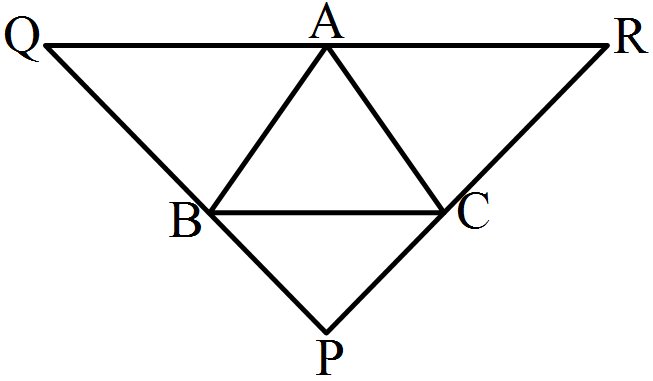
A $\triangle\text{ABC}$ is given. If lines are drawn through A, B, C, parallel respectively to the sides BC, CA and AB, forming $\triangle\text{PQR},$ as shown in the adjoining figure, show that $\text{BC}=\frac{1}{2}\text{QR}.$
P is any point on base BC of $\triangle\text{ABC}$ and D is the mid-point of BC. DE is drawn parallel to PA to meet AC at E. If $\text{ar}(\triangle\text{ABC})=12\text{cm}^2,$ then find area of $\triangle\text{EPC}.$
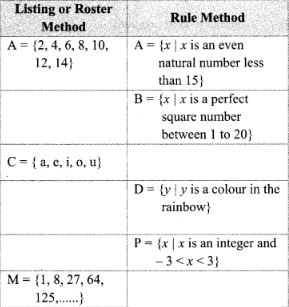
Fill in the blanks given in the following table
Image
If $p(x) = 5 - 4x + 2x^2$, find:
  1. $p(0)$
  2. $p(3)$
  3. $p(-2)$
On a graph paper, plot the points (0, 1), (1, 3), (2, 5). Are they collinear? If so, draw the line that passes through them.
i. Through which quadrants does this line pass ?
ii. Write the co-ordinates of the point at which it intersects the Y-axis.
iii. Show any point in the third quadrant which lies on this line. Write the co-ordinates of the point.
Construct ∆ABC, such that BC = 6 cm, ∠ABC = 100° and AC – AB = 2.5 cm.
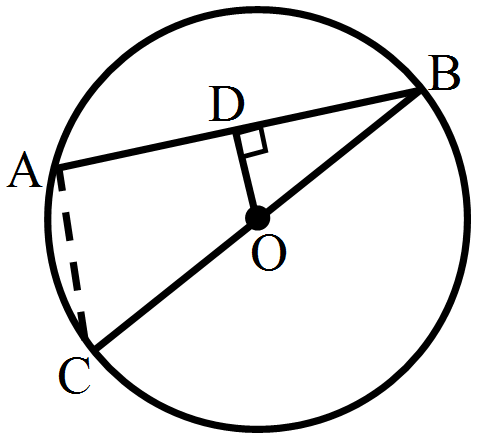
In the adjoining figure, OD is perpendicular to the chord AB of a circle with centre O. If BC is a diameter, show that AC || CD and AC = 2 × OD.
If $\frac{y}{b+c-a}=\frac{z}{c+a-b}=\frac{x}{a+b-c}$ then prove that $\frac{a}{z+x}=\frac{b}{x+y}=\frac{c}{y+z}$.
The line segments joining the midpoints M and N of parallel sides AB and DC respectively of a trapezium ABCD is perpendicular to both the sides AB and DC. Prove that AD = BC.