Question
Construct the angle with the help of ruler and compasses only:
$45^\circ $

Answer

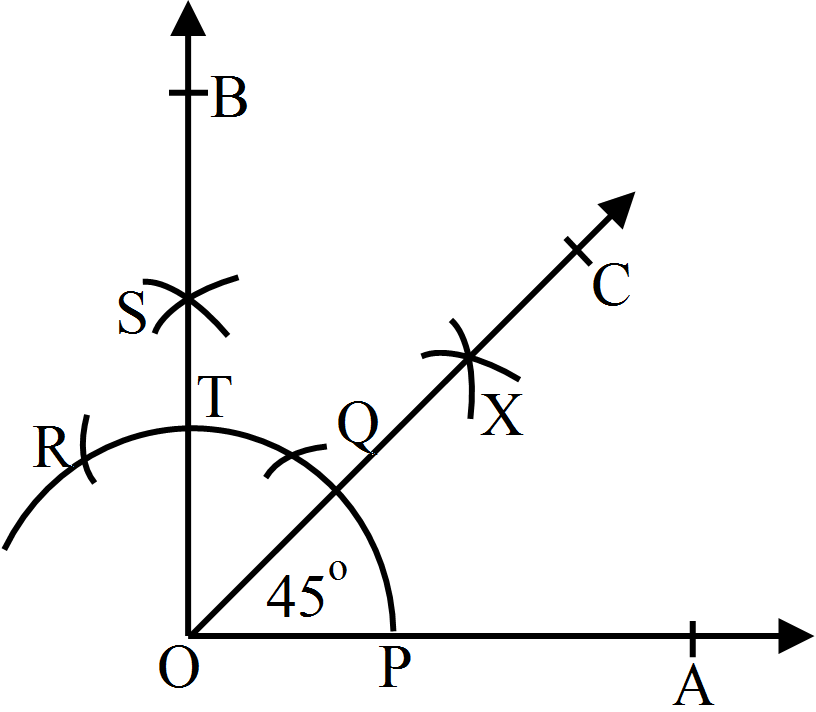
To construct an angle of $45^\circ ,$ construct an angle of $90^\circ $ and bisect it.
Construct the angle $\angle\text{AOB}=90^{\circ},$ where rays $OA$ and $OB$ intersect the arc at points $P$ and $T$ as shown in figure.
With $P$ and $T$ as centres and radius more than half of $PT, $ draw two arcs, which cut each other at $X$
Draw $OX$ and extend it to $C$ to form the ray $OC.$
$\angle\text{AOC}$ is the required angle of $45^\circ .$​​​​​​​

Need a full question paper?

Generate a complete, print-ready paper with questions like this in minutes — across 16+ boards, with answer keys.

Start Generating Free

Similar questions

Draw a circle with centre at point $O.$ Draw its two chords $AB$ and $CD$ such that $AB$ is not parallel to $CD$. Draw the perpendicular bisectors of $AB$ and $CD.$ At what point do they intersect$?$
Solve the following equation and verify the answer: $\text{2x}-\frac{1}{2}=3$
Solve the following equation and verify the answer: $3(x + 6) + 2(x + 3) = 64$
Catherine threw a dice 40 times and noted the number appearing each time as shown below :
$1$ $3$ $5$ $6$ $6$ $3$ $5$ $4$ $1$ $6$
$2$ $5$ $3$ $4$ $6$ $1$ $5$ $5$ $6$ $1$
$1$ $2$ $2$ $3$ $5$ $2$ $4$ $5$ $5$ $6$
$5$ $1$ $6$ $2$ $3$ $5$ $2$ $4$ $1$ $5$
Make a table and enter the data using tally marks. Find the number that appeared the maximum number of times.
A square piece of paper is folded in half. The square is then cut into two rectangles along the fold. Regardless of the size of the square, one of the following statements is always true. Which statement is true here?
(a) The area of each rectangle is larger than the area of the square.
(b) The perimeter of the square is greater than the perimeters of both the rectangles added together.
(c) The perimeters of both the rectangles added together are always $1 \frac{1}{2}$ times the perimeter of the square.
(d) The area of the square is always three times as large as the areas of both rectangles added together.
Draw a line segment of length $7\ cm.$ Draw its perpendicular bisector, using ruler and compasses.
Total number of students of a school in different years is shown in the following table:
Year
Number of students
$1996$
$400$
$1998$
$550$
$2000$
$450$
$2002$
$600$
$2006$
$650$
Represent the above data by a pictograph. Prepare a pictograph of students using one symbol an icon of a student to represent students and answer the following questions:
$i.\ $How many symbols represent total number of students in the year $2002$?
$ii.\ $How many symbols represent total number of students for the year $1998$?
Number of mobile phone users in various age groups in a city is listed below:
Age group (in years) Number of mobile users
$1-20$ $25000$
$21-40$ $40000$
$41-50$ $35000$
$61-80$ $10000$
Draw a bar graph to represent the above information.
How many little squares are there in each shape of the sequence of stacked squares? Which number sequence does this give? Can you explain, why?
Draw an angle and label it as $\angle\text{BAC}.$ Draw its bisector ray $AX$ and take a point $P$ on it. From $P$ draw line segments $PM$ and $PN,$ such that $\text{PM}\perp\text{AB}$ and $\text{PN}\perp\text{AC},$ where $M$ and $N$ are respectively points on rays $AB$ and $AC.$ Measure $PM$ and $PN.$ Are the two lengths equal$?$