Question
Draw a line segment of length $7\ cm.$ Draw its perpendicular bisector, using ruler and compasses.

Answer

Steps of construction are as follows:
Step I: Draw a line segment, $PQ = 7\ cm.$  Step II: With $P$ as centre and a convenient radius $($more than $\frac12\text{PQ})$, draw arc.
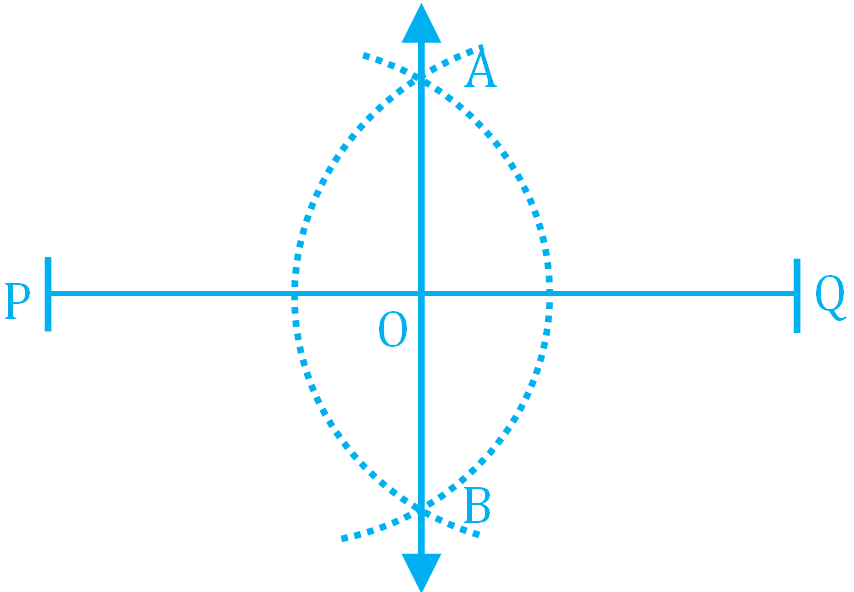
Step III: With $Q$ as centre and same radius, draw another arc, such that it intersects the previous arc at $A$ and $B.$ Step IV: Join $A $ and $B.$ Thus, $AB$ is perpendicular bisector of $PQ$ i.e. $OP = OQ = 3.5\ cm.$

Need a full question paper?

Generate a complete, print-ready paper with questions like this in minutes — across 16+ boards, with answer keys.


Start Generating Free

Similar questions

Construct the angle with the help of ruler and compasses only: $135^\circ $
Draw a line $D B$ and take a point $A$ on it between $D$ and $B$ draw ray $A C$. Verify by measurement that $\angle B A C$ and $\angle C A D$ are supplementary.
Find the least number of five digits that is exactly divisible by $16, 18, 24$ and $30.$
In Fig., name all rays with initial points as $A, B$ and $C$ respectively.
Image
(i) Is ray $\overrightarrow{A B}$ different from ray $\overrightarrow{A C}$ ?
(ii) Is ray $\overrightarrow{B A}$ different from ray $\overrightarrow{C A}$ ?
(iii) Is ray $\overrightarrow{C P}$ different from ray $\overrightarrow{C Q}$ ?
Draw an angle of measure $147^\circ $ and construct its bisector.
Use a pair of compasses and construct the following angles: $75^\circ $
Given $\overline{\text{AB}}$ of length $7.3\ cm$ and $\overline{\text{CD}}$ of length $3.4\ cm,$ construct a line segment $\overline{\text{XY}}$ such that the length of $\overline{\text{XY}}$ is equal to the difference between the lengths of $\overline{\text{AB}}$ and $\overline{\text{CD}}$. Verify by measurement.
Draw a line $l.$ Take a point $A,$ not lying on $l.$ Draw a line m such that $\text{m}\perp\text{l}$ and passing through $A.$ Using ruler and a set-square.
See the figure and find the ratio of number of circles to all the figures inside the rectangle.
8
Match the following columns on whole numbers:
S.No.
Column A
S.No.
Column B
$(a)$
$137 + 63 = 63 + 137$
$(i)$
Associativity of multiplication
$(b)$
$(16 \times 25)$ is a number
$(ii)$
Commutativity of multiplication
$(c)$
$365 \times 18 = 18 \times 365$
$(iii)$
Distributive law of multiplication over addition.
$(d)$
$(d) (86 \times 14) \times 25 = 86 \times (14 \times 25)$
$(iv)$
Commutativity of addition
$(e)$
$23 \times (80 + 5) = (23 \times 80) + (23 \times 5)$
$(v)$
Closure property for multiplication