Question
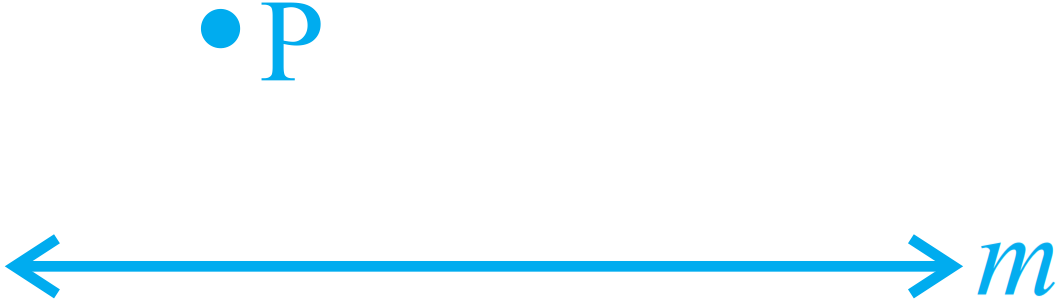
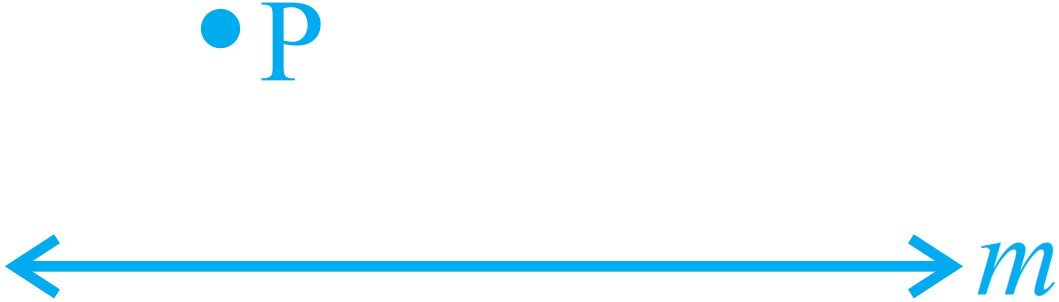
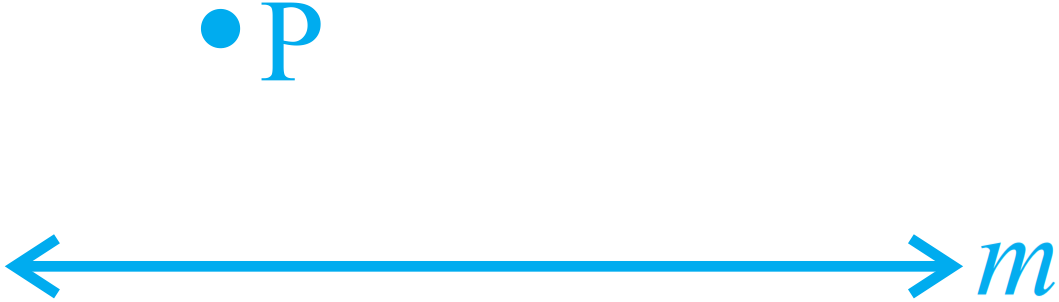
Copy Figure on your notebook and draw a perpendicular from $P$ to line $m,$ using $(i)$ set squares $(ii)$ Protractor $(iii)$ ruler and compasses. How many such perpendiculars are you able to draw$?$
Answer

 
We draw perpendicular to $m$ from $P,$ using
$I.\ $Set Squares:
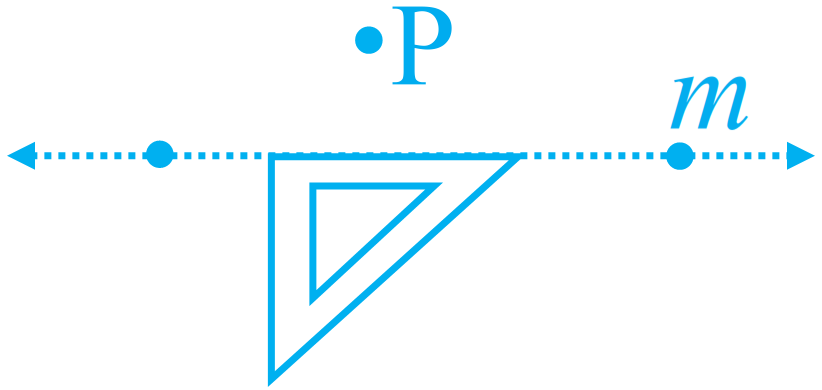
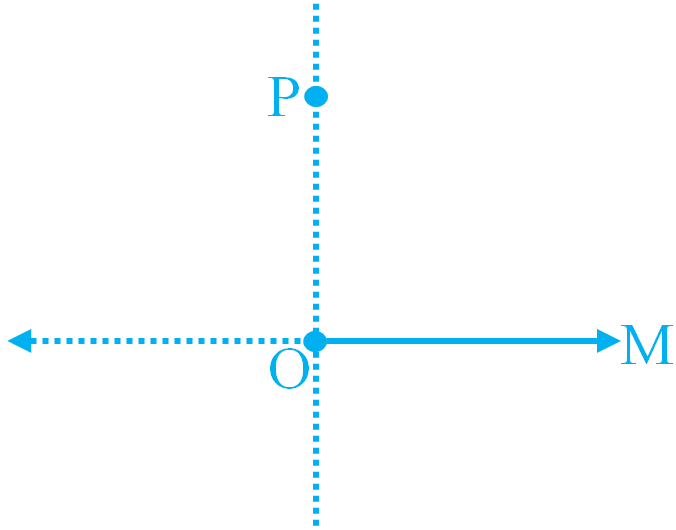
Step $I:$ Let $m$ be the given line and $P$ be a point outside $m.$ Now, extend line m on both the sides.

Step $II:$ Place a set square on $m,$ such that one arm of its right angle aligns along $m.$

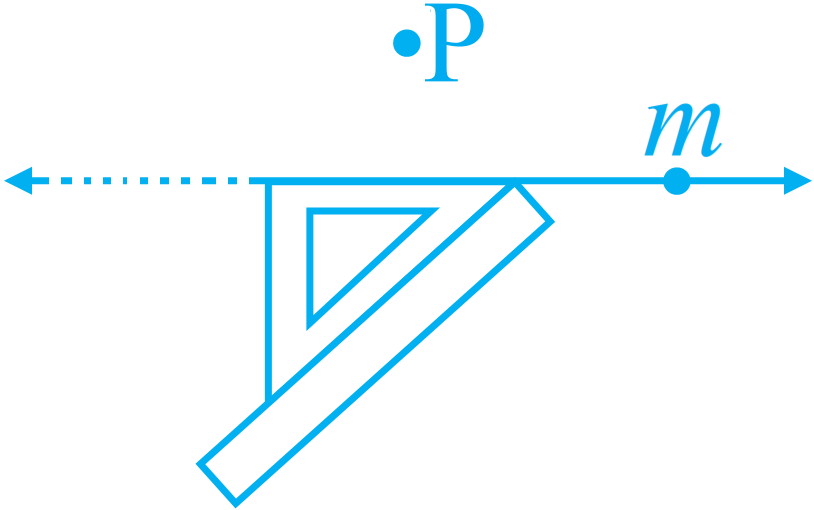
Step $III:$ Place a ruler along the edge opposite to the right angle of the set square.

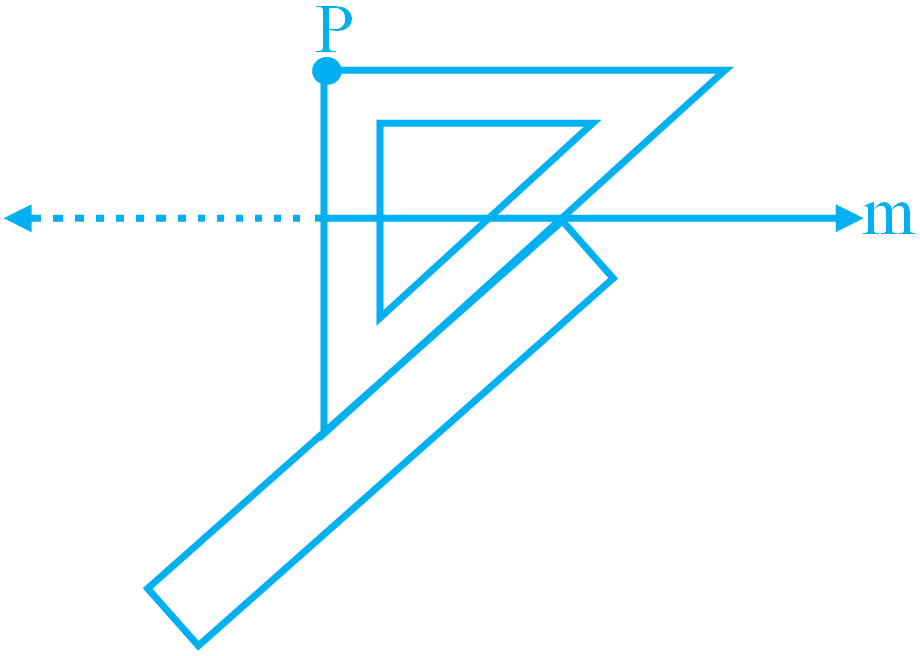
Step $IV:$ Hold the ruler fixed. Slide the set square along the ruler till the point $P$ touches the other arm of the set square.

Step $V:$ Join $PM$ along the edge through $P.$ Meeting $m$ at $O.$
Now, $\text{PO}\bot\text{m.}$

$II.\ $Protractor:
Step $I:$ Let $m$ be the given line and $P$ be a point outside $m.$

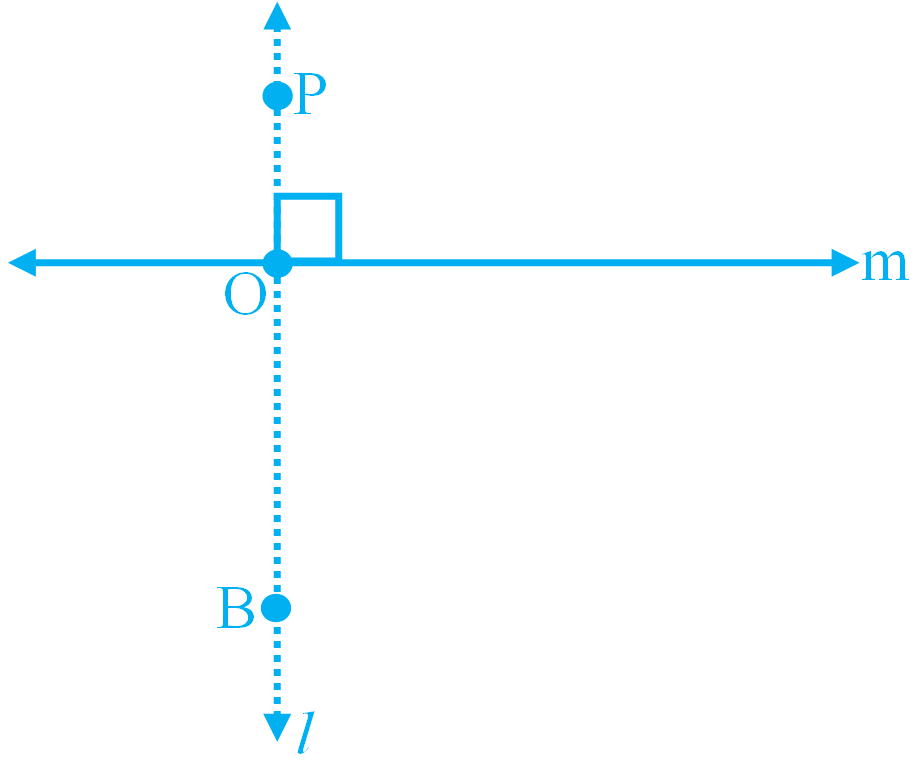
Step $II:$ Place the protractor on point $P,$ such that its centre coincides with point $P.$
Step $III:$ Mark a point $B$ against the $90^\circ$ mark on the protractor.
Step $IV:$ Remove the protractor and draw a line $l$ passing through $P$ and $B$ wich intersects line $m$ at $O.$
Then, $\text{PO}\bot\text{m}.$

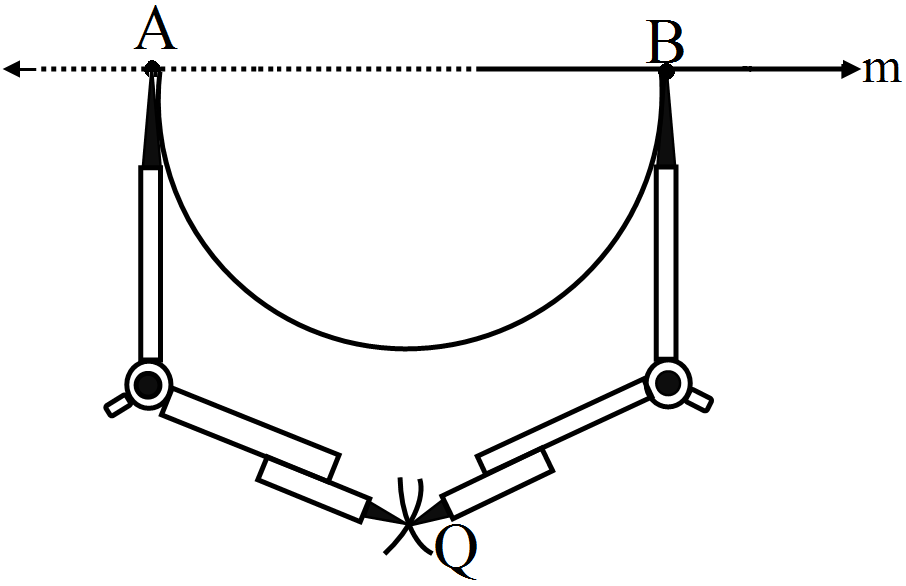
Ruler and Compass:
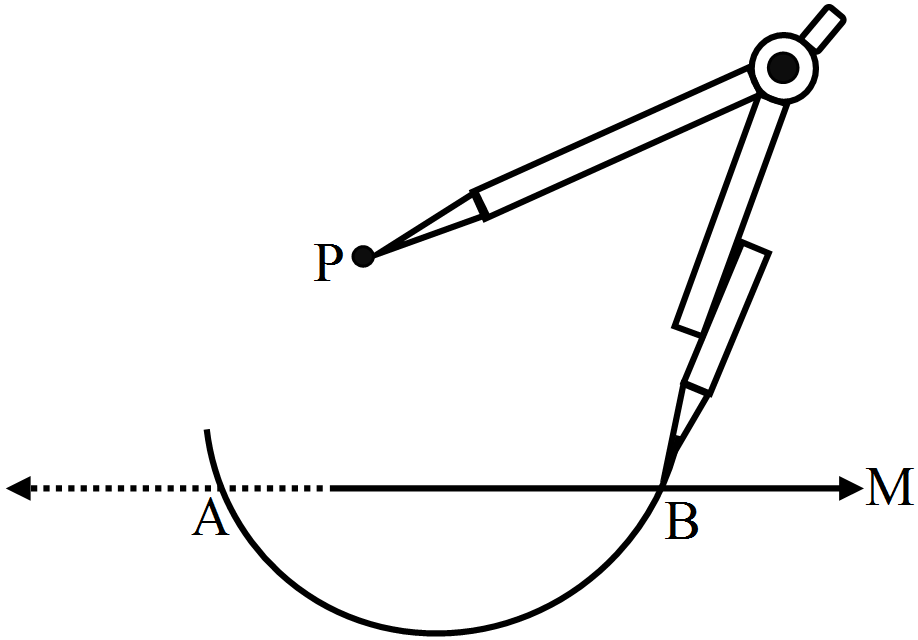
Step $I:$ Given, a line m and point $P,$ not it. Extend the given line in both derections.

Step $II:$ With $P$ as centre, draw an arc which intersects line m at two points $A$ and $B.$

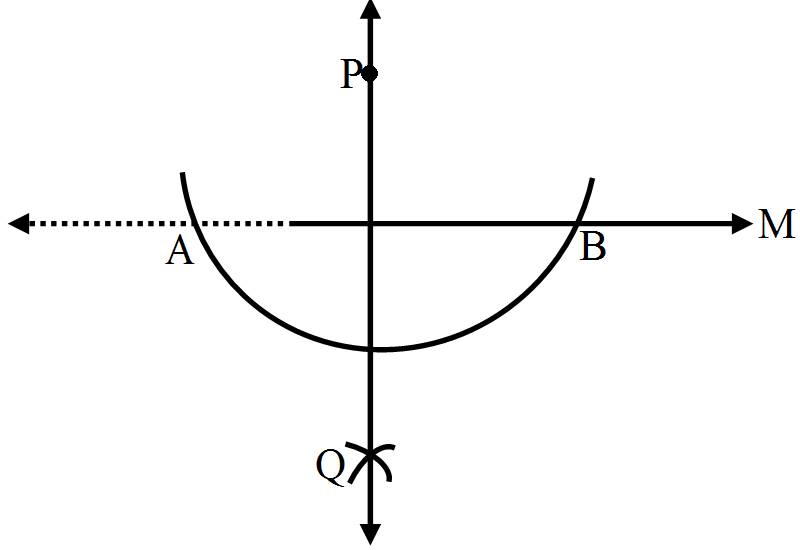
Step $III:$ With $A$ and $B$ as centres and the same redius draw two arcs which intersect at a point say $Q,$ on the other side.

Step $IV:$ Join $PQ.$​​​​​​​

Thus, $PQ$ is perpendicular to $m.$
We are able to draw one perpendicular line.
 

Need a full question paper?

Generate a complete, print-ready paper with questions like this in minutes — across 16+ boards, with answer keys.
Start Generating Free

Similar questions

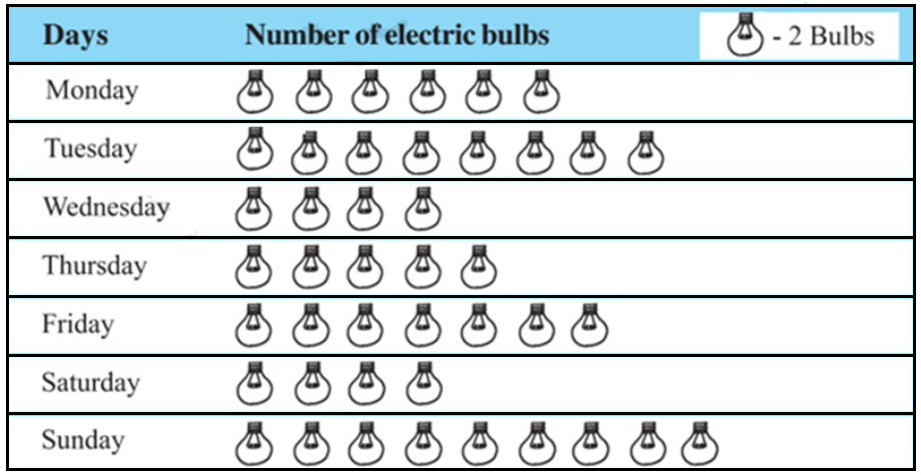
The sale of electric bulbs on different days of a week is shown below:

Observe the pictograph and answer the following questions:
$i.\ $How many bulbs were on Friday?
$ii.\ $On which day maximum number of bulbs were sold?
$iii.\ $If one bulb was sold at the rate of $Rs\ 10$, what was the total earning on sunday?
$iv.\ $Can you find out the total earning of the week?
$v.\ $If one big carton can hold $9$ bulbs. How many cartons were needed in the given week, more than $7$, more than $8$ or more than $9$?
Draw a line $AB.$ Take a point $P$ on it. Draw a line passing through $P$ and perpendicular to $AB.$
Arrange the following fractions in ascending order:$\frac{2}{3},\frac{5}{6},\frac{7}{9}\ \text{and}\ \frac{11}{18}$
Match the following statements:
  Column $A$   Column $B$
$i$ Line segment has $a$ at a point
$ii$ Two segments may intersect $b$ if they have equal lengths
$iii$ Two segments are congruent $c$ two end-point
$iv$ Line segment is $d$ portion of a line
Draw two acute angles and one obtuse angle without using a protractor. Estimate the measures of the angles. Measure them with the help of a protractor and see how much accurate is your estimate.
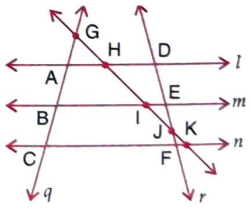
From Fig, write
Image
(i) all pairs of parallel lines.
(ii) all pairs of intersecting lines.
(iii) lines whose point of intersection is $I$.
(iv) lines whose point of intersection is $D$.
(v) lines whose point of intersection is $E$.
(vi) lines whose point of intersection is $A$.
(vii) collinear points
Rewrite each of the following numerals with proper commas, using the international place$-$value chart.
Also, write the number name in the international system.
$i.\ 735821$
$ii.\ 6057894$
$iii.\ 56943821$
$iv.\ 7502093$
$v.\ 89350064$
$vi.\ 9070300$
Draw an angle of $70^\circ$. Make a copy of it using only a straight edge and compasses.
The following table gives the route length (in thousand kilometers) of the Indian Railways in some of the years:
Year
$1960-61$
$1970-71$
$1980-81$
$1990-91$
$2000-01$
Route length (in thousand kilometres)
$56$
$60$
$61$
$74$
$98$
Represent the above data with the help of a bar graph.
Write the first four products of two numbers with difference 4 starting from in the following order: 
1, 2, 3, 4, 5, 6, ........
Identify the pattern in the products and write the next three products.