MCQ
Curie temperature is the temperature above which
  • A
    A paramagnetic material becomes ferromagnetic
  • A ferromagnetic material becomes paramagnetic
  • C
    A paramagnetic material becomes diamagnetic
  • D
    A ferromagnetic material becomes diamagnetic

Answer

Correct option: B.
A ferromagnetic material becomes paramagnetic
b
(b) At Curie temperature, there is a change from ferromagnetic to paramagnetic behaviour. Above this temperature, the paramagentic substance obeys Curie Weiss law, even those resistances which are not ferromagnetic but only paramagnetic also obey Curie Weiss law above the Curie temperature only.

Need a full question paper?

Generate a complete, print-ready paper with questions like this in minutes — across 16+ boards, with answer keys.
Start Generating Free

Similar questions

When an object possess electric charge then the object is said to be:
A $500\,\mu F$ capacitor is charged at a steady rate of $100\, \mu C/sec$. The potential difference across the capacitor will be $10\, V$ after an interval of.....$sec$
A charge of $4\,\mu C$ is to be divided into two. The distance between the two divided charges is constant. The magnitude of the divided charges so that the force between them is maximum, will be.
A proton is moves on circular path with its constant angular speed then correct relation between its magnetic moment and angular momentum 
Consider the situation of the previous problem. The force on the central charge due to the shell is:
A particle of mass M and charge Q moving with velocity $\vec{v}$ describes a circular path of radius R when subjected to a uniform transverse magnetic field of induction B. The work done by the field when the particle completes one full circle is
When $_3Li^7$ nuclei are bombarded by protons, and the resultant nuclei are $_4Be^8$, the emitted particles will be
On an average, the number of neutrons and the energy of a neutron released per fission of a uranium atom are respectively?
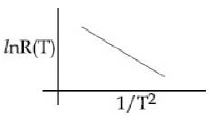
In an experiment, the resistance of a material is plotted as a function of temperature (in some range). As shown in the figure, it is a straight line. One may conclude that:
A biconvex lens forms a real image of an object placed perpendicular to its principal axis. Suppose the radii of curvature of the lens tend to infinity. Then the image would