MCQ
Curie temperature is the temperature above which:
  • A ferromagnetic material becomes paramagenetic.
  • B
    A paramagnetic material becomes diamagnetic.
  • C
    A ferromagnetic material becomes diamagnetic.
  • D
    A paramagnetic meterial becomes ferromagnetic.

Answer

Correct option: A.
A ferromagnetic material becomes paramagenetic.

Need a full question paper?

Generate a complete, print-ready paper with questions like this in minutes — across 16+ boards, with answer keys.
Start Generating Free

Similar questions

To observerve diffraction the size of an obstacle
The motion of planets in the solar system is an example of conservation of
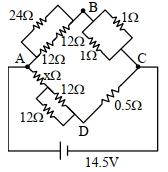
The value of unknown resistance $(x)$ for which the potential difference between $B$ and $D$ will be zero in the arrangement shown, is:
In displacement method, convex lens forms a real image of an object for its two different positions. If heights of the images in two cases be $24 \,cm$ and $6 \,cm$, then the height of the object is ........ $cm$
Two different coils have self-inductance $\mathrm{L}_1=8 \mathrm{mH} , \mathrm{L}_2=2 \mathrm{mH}$. The current in one coil is increased at a constant rate. The current in the second coil is also increased at the same rate. At a certain instant of time, the power given to the two coils is the same. At that time the current, the induced voltage and the energy stored in the first coil are $i_1,v_1$ and $W_1$ respectively. Corresponding values for the second coil at the same instant are $i_2,v_1$ and $W_2$ respectively. Then
The current density is a solid cylindrical wire of radius $R ,$ as a function of radial distance $r$ is given by $J ( r )= J _{0}\left(1-\frac{ r }{ R }\right) .$ The total current in the radial region $r =0$ to $r =\frac{ R }{4}$ will be
The energy stored in a 50 mH inductor carrying a current of 4 A will be
A radioactive nucleus $A$ has a single decay mode with half-life $\tau_A$. Another radioactive nucleus $B$ has two decay modes $1$ and $2$. If decay mode $2$ were absent, the half-life of $B$ would have been $\tau_A / 2$. If decay mode $1$ were absent, the half-life of $B$ would have been $3 \tau_A$. If the actual half life of $B$ is $\tau_B$, then the ratio $\tau_B / \tau_A$ is
Carbon, Silicon and Germanium atoms have four valence electrons each. Their valence and conduction bands are separated by energy band gaps represented by $(E_g)_C$, $(E_g)_{Si}$ and $(E_g)_{Ge}$ respectively. Which one of the following relationship is true in their case?
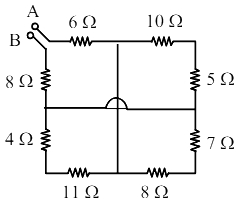
The equivalent resistance between $A$ and $B$ is: