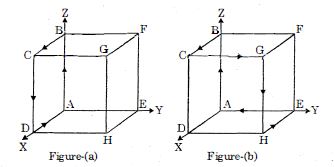
Current $I$ is flowing along the path $ABCDA$ consisting of four edges of a cube (figure $-a$), produces a magnetic field $B_0$ at the centre of the cube. Find the magnetic field $B$ produced at the center of the cube by a current $I$ flowing along the path of the six edges $ABCGHEA$ (figure $b$)
Medium
Download our app for free and get started
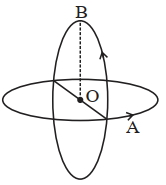
Imaging $3$ loops
$\mathrm{B}=\sqrt{\mathrm{B}_{0}^{2}+\mathrm{B}_{0}^{2}+\mathrm{B}_{0}^{2}}=\sqrt{3 \mathrm{B}}_{0}$ towards $\mathrm{F}$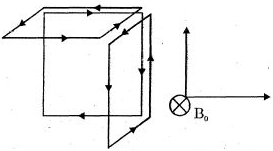

Download our appand get started for free
Experience the future of education. Simply download our apps or reach out to us for more information. Let's shape the future of learning together!No signup needed.*
Similar Questions
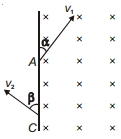
- 1A particle of charge $-q$ and mass $m$ enters a uniform magnetic field $\vec{B}$ at $A$ with speed $v_1$ at an angle $\alpha$ and leaves the field at $C$ with speed $v_2$ at an angle $\beta$ as shown. ThenView Solution
- 2Two ions have equal masses but one is singly ionized and second is doubly ionized. They are projected from the same place in a uniform transverse magnetic field with same velocity then:View Solution
$(a)$ Both ions will go along circles of equal radii
$(b)$ The radius of circle described by the single ionized charge is double of radius of circle described by doubly ionized charge
$(c)$ Both circle do not touches to each other
$(d)$ Both circle touches to each other - 3An electron, a proton and an alpha particle having the same kinetic energy are moving in circular orbits of radii $r_e,r_p$ and ${r_\alpha }$ respectively in a uniform magnetic field $B$. The relation between $r_e,r_p$ and $\;{r_\alpha }$ isView Solution
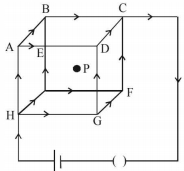
- 4A steady current is set up in a cubic network composed of wires of equal resistance and length $d$ as shown in figure. What is the magnetic field at the centre P due to the cubic networkView Solution
- 5Two insulated circular loop $A$ and $B$ radius ' $a$ ' carrying a current of ' $\mathrm{I}$ ' in the anti clockwise direction as shown in figure. The magnitude of the magnetic induction at the centre will be :View Solution
- 6View SolutionElectrons moving with different speeds enter a uniform magnetic field in a direction perpendicular to the field., time periods of rotation will be :
- 7The magnetic field at the centre of an equilateral triangular loop of side $2\,L$ and carrying a current $i$ isView Solution
- 8Two circular coils $P$ and $Q$of $100$ turns each have same radius of $\pi \mathrm{cm}$. The currents in $\mathrm{P}$ and $\mathrm{R}$ are $1 \mathrm{~A}$ and $2 \mathrm{~A}$ respectively. $\mathrm{P}$ and $\mathrm{Q}$ are placed with their planes mutually perpendicular with their centers coincide. The resultant magnetic field induction at the center of the coils is $\sqrt{\mathrm{x}} \mathrm{mT}$, where X=___.View Solution
$\left[\text { Use } \mu_0=4 \pi \times 10^{-7} \mathrm{TmA}^{-1}\right]$
- 9View SolutionA current loop in a magnetic field
- 10A particle of mass $m$ and charge $q$ moves with a constant velocity $v$ along the positive $x$ direction. It enters a region containing a uniform magnetic field $B$ directed along the negative $z$ direction, extending from $x = a$ to $x = b$. The minimum value of $v$ required so that the particle can just enter the region $x > b$ isView Solution