The magnetic field at the centre of an equilateral triangular loop of side $2\,L$ and carrying a current $i$ is
Diffcult
Download our app for free and get started
Magnetic field at $\mathrm{O}$ is
$\mathrm{B}=3\left[\frac{\mu_{0}}{4 \pi} \frac{\mathrm{i}}{\mathrm{r}}\left(\sin 60^{\circ}+\sin 60^{\circ}\right)\right]$
$\tan {30^\circ } = \frac{{\text{r}}}{{\text{L}}}\quad \Rightarrow {\text{r}} = \frac{{\text{L}}}{{\sqrt 3 }}\quad $
$ = 3\left( {\frac{{{\mu _0}}}{{4\pi }}} \right)\frac{{({\text{i}})}}{{\text{L}}}\left( {\frac{{\sqrt 3 }}{2}} \right)(\sqrt 3 ) \times 2$
$ = \frac{{9{\mu _0}{\text{i}}}}{{4\pi {\text{L}}}}$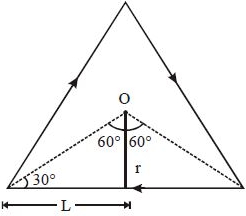

Download our appand get started for free
Experience the future of education. Simply download our apps or reach out to us for more information. Let's shape the future of learning together!No signup needed.*
Similar Questions
- 1Two wires each carrying a steady current $I$ are shown in four configurations in Column $I$. Some of the resulting effects are described in Column $II$. Match the statements in Column $I$ with the statements in Column $II$ and indicate your answer by darkening appropriate bubbles in the $4 \times 4$ matrix given in the $ORS$.View Solution
Column $I$ Column $II$ $(A)$ Point $P$ is situated midway between the wires. $Image$ $(p)$ The magnetic fields $(B)$ at $P$ due to the currents in the wires are in the same direction. $(B)$ Point $P$ is situated at the mid-point of the line joining the centers of the circular wires, which have same radii. $Image$ $(q)$ The magnetic fields $(B)$ at $P$ due to the currents in the wires are in opposite directions. $(C)$ Point $P$ is situated at the mid-point of the line joining the centers of the circular wires, which have same radii. $Image$ $(r)$ There is no magnetic field at $P$. $(D)$ Point $P$ is situated at the common center of the wires. $Image$ $(s)$ The wires repel each other. 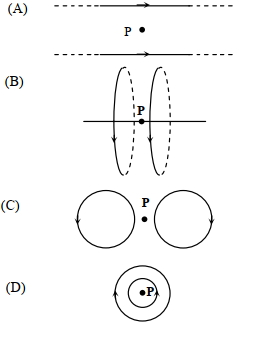
- 2The ammeter has range $1\, ampere$ without shunt. the range can be varied by using different shunt resistances. The graph between shunt resistance and range will have the natureView Solution
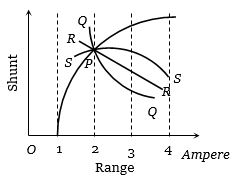
- 3Two ions of masses $4 \,{amu}$ and $16\, amu$ have charges $+2 {e}$ and $+3 {e}$ respectively. These ions pass through the region of constant perpendicular magnetic field. The kinetic energy of both ions is same. Then :View Solution
- 4Five very long, straight wires are bound together to form a small cable. Currents carried by the wires are ${I_1} = 20\,A,$ ${I_2} = - \,6\,A,$ ${I_3} = 12\,A,\,{I_4} = - 7\,A,\,{I_5} = 18\,A.$ The magnetic induction at a distance of $10\, cm$ from the cable isView Solution
- 5A particle having charge of $1 \,\,C$, mass $1 \,\,kg$ and speed $1 \,\,m/s$ enters a uniform magnetic field, having magnetic induction of $1$ $T,$ at an angle $\theta = 30^o$ between velocity vector and magnetic induction. The pitch of its helical path is (in meters)View Solution
- 6A long solenoid has $n$ turns per meter and current $I\, A$ is flowing through it. The magnetic field at the ends of the solenoid isView Solution
- 7Given below are two statements: One is labelled as Assertion $A$ and the other is labelled as Reason $R$.View Solution
Assertion $A:$ For measuring the potential difference across a resistance of $600\,\Omega$, the voltmeter with resistance $1000\,\Omega$ will be preferred over voltmeter with resistance $4000\,\Omega$.
Reason $R:$ Voltmeter with higher resistance will draw smaller current than voltmeter with lower resistance.
In the light of the above statements, choose the most appropriate answer from the options given below.
- 8A uniform current carrying ring of mass $m$ and radius $R$ is connected by a massless string as shown. A uniform magnetic field $B_0$ exist in the region to keep the ring in horizontal position, then the current in the ring is ($l =$ length of string)View Solution
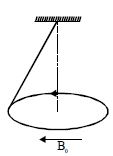
- 9If two protons are moving with speed $v=4.5 \times 10^{5} \,m / s$ parallel to each other then the ratio of electrostatic and magnetic force between themView Solution
- 10View SolutionTwo infinitely long parallel wires carry equal current in same direction. The magnetic field at a mid point in between the two wires is