Question
Current in the circuit is wattless, if.

Answer

Current in the circuit is wattless,
Because power $= i^2R,$ if $R = 0,$ then $P = 0.$

Need a full question paper?

Generate a complete, print-ready paper with questions like this in minutes — across 16+ boards, with answer keys.
Start Generating Free

Similar questions

Point charges $+4 q,-q$ and $+4 q$ are kept on the $X$-axis at points $x=0, x=a$ and $x=2$ a respectively:
If an electron jumps from 1st orbital to 3rd orbital, then it will(a) Absorb energy(b) Release energy(c) No gain of energy(d) None of these
   
   
A person wears glasses of power – 2.0 D. The defect of the eye and the far point of the person without the glasses will be(a) Nearsighted, 50 cm(b) Farsighted, 50 cm(c) Nearsighted, 250 cm(d) Astigmatism, 50 cm
       
The radius of a circle is stated as $2.12\ cm.$ Its area should be written as :
A small object is placed 10 cm infront of a plane mirror. If you stand behind the object 30 cm from the mirror and look at its image, the distance focused for your eye will be(a) 60 cm(b) 20 cm(c) 40 cm(d) 80 cm
       
If the frequency of EM radiations is halved then the energy of EM radiation will become:
Relation between critical angles of water and glass is
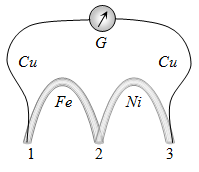
Three wires of copper, iron and nickel are joined to form three junctions as shown in Fig. When the temperature of junction $1$ is kept $50℃$ with the other two junctions at $0℃$, the sensitive galvanometer gives a deflection of $14$ divisions. When the temperature of junction $3$ is kept $50℃,$ with the other two junctions at $0℃,$ the galvanometer gives a deflection of $11$ divisions. Then the deflection given by the galvanometer, when temperature of the junction $2$ is kept at $50℃,$ with the other two junctions at $0℃,$ will be
Let $F_{pp,} F_{pn}$ and $F_{nn}$ denote the magnitudes of the net force by a proton on a proton, by a proton on a neutron and by a neutron on a neutron respectively. Neglect gravitational force. When the separation is $1\ fm:$
A steady electric current is flowing through a cylindrical conductor.