MCQ
Cyclohexane, a hydrocarbon floats on water because
  • A
    It is immiscible with water
  • B
    Its density is low as compared to water
  • C
    It is non-polar substance
  • It is immiscible and lighter than water

Answer

Correct option: D.
It is immiscible and lighter than water
d
(d) Cyclohexane, is immiscible and lighter than water. Hence, floats on the surface of water.

Need a full question paper?

Generate a complete, print-ready paper with questions like this in minutes — across 16+ boards, with answer keys.
Start Generating Free

Similar questions

Two atoms are said to be isobars if:
$C{H_3} - C{H_2} - Cl $  $ \xrightarrow{alcKOH} $ $A$, the product is
The compound having only primary hydrogen atoms is
Internal energy per mole of gas depends on
Excess of isobutane on reaction with $\mathrm{Br}_{2}$ in presence of light at $125^{\circ} \mathrm{C}$ gives which one of the following, as the major product?
.
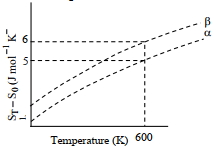
The entropy versus temperature plot for phases $\alpha$ and $\beta$ at 1 bar pressure is given. $S_{\mathrm{T}}$ and $S_0$ are entropies of the phases at temperatures $\mathrm{T}$ and $0 \mathrm{~K}$, respectively.

(image)

The transition temperature for $\alpha$ to $\beta$ phase change is $600 \mathrm{~K}$ and $C_{p, \beta}-C_{p, \alpha}=1 \mathrm{~J} \mathrm{~mol}^{-1} \mathrm{~K}^{-1}$. Assume $\left(C_{p, \beta}-C_{p, \alpha}\right)$ is independent of temperature in the range of 200 to $700 \mathrm{~K} . \mathrm{C}_{p, \alpha}$ and $C_{p, \beta}$ are heat capacities of $\alpha$ and $\beta$ phases, respectively.

($1$)The value of entropy change, $\mathrm{S}_\beta-\mathrm{S}_\alpha$ (in $\mathrm{J} \mathrm{mol}^{-1} \mathrm{~K}^{-1}$ ), at $300 \mathrm{~K}$ is. . . . . . .

[Use : $\ln 2=0.69$  Given : $S_\beta-S_\alpha=0$ at $\left.0 \mathrm{~K}\right]$

($2$) The value of enthalpy change, $\mathrm{H}_\beta-\mathrm{H}_\alpha$ (in $J$ mol ${ }^{-1}$ ), at $300 \mathrm{~K}$ is

Give the answer quetion ($1$) and ($2$)
The geometry with respect to the central atom of the following molecules are : 
$N(SiH_3)_3 ;\,\,\, Me_3N;\,\,\, (SiH_3)_3P$
In the transition of electron in an atom, its kinetic energy changes from $y$ to $y/4$. The change in $P.E$ will be :-
An ion which has $18$ electrons in the outermost shell is