MCQ
Davission and Germer experiment proved
  • A
    Wave nature of light
  • B
    Particle nature of light
  • C
    Both $(a)$ and $(b)$
  • Neither $(a)$ nor $(b)$

Answer

Correct option: D.
Neither $(a)$ nor $(b)$
d
(d) Davission and Germer proved the wave nature of electron by performing an experiment.

Need a full question paper?

Generate a complete, print-ready paper with questions like this in minutes — across 16+ boards, with answer keys.

Start Generating Free

Similar questions

Consider the following statements regarding the real images formed with a converging lens.

$I$. Real images can be seen only if the image is projected onto the screen.

$II$. The real image can be seen only from the same side of the lens as that on which the object is positioned.

$III$. Real images produced by converging lenses are not only laterally but also longitudinally inverted as with mirrors.

Which of the above statement(s) is/are incorrect?
When light is incident on a diffraction grating the zero order principal maximum will be
 
A current of $I$ $ampere$ is passed through a straight wire of length $2.0$ $metres$. The magnetic field at a point in air at a distance of $3$ $metres$ from either end of wire and lying on the axis of wire will be
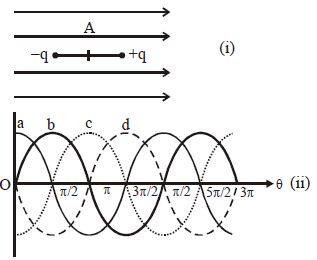
The electric dipole is situated in an electric field as shown in figure. The dipole and electric field vare both in the plane of paper. The dipole is rotated about an axis perpendicular to the paper at point $A$ in anticlockwise direction. If the angle of rotation is measured with respect to the direction of the electric field then the torque for different values of the angle of rotation $\theta $ will be as represented in Fig. $(ii)$
An α -particle is accelerated through a potential difference of 200V. The increase in its kinetic energy is
Isogonic lines on magnetic map will have
Two cells of $emfs$ $E_1$ and $E_2$ and internal resistances $r_1$ and $r_2$ are connected in parallel. The $emf$ and internal resistance of the equivalent source is
Light described at a place by the equation $\varepsilon = (100V/m)\, [sin(5 \times 10^{15} s^{-1})t + sin (8 \times 10^{15} s^{-1})t]$ falls on a metal surface having work function $2eV$. Calculate the maximum kinetic energy of the photo electrons............... $eV$
In Young's double slit experiment, the interference pattern obtained with white light will be:
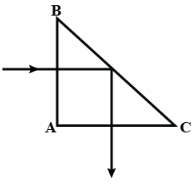
Light enters an isosceles right triangular prism at normal incidence through face $A B$ and undergoes total internal reflection at face $B C$ as shown below.The minimum value of the refractive index of the prism is close to