Question
Read the passage given below and answer the following questions:
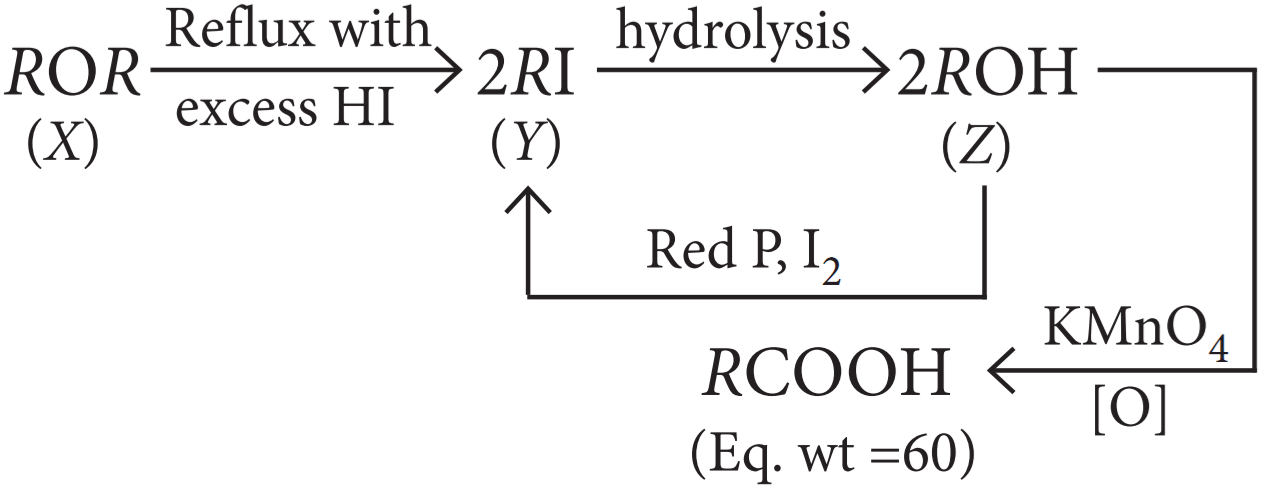
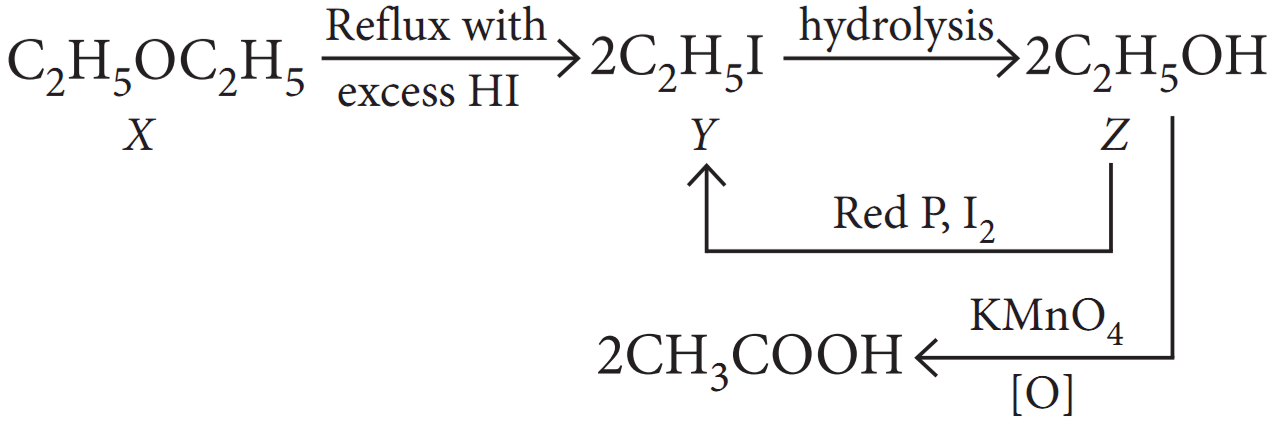
A compound (X) containing C, H and O is unreactive towards sodium. It also does not react with Schiff s reagent. On refluxing with an excess of hydroiodic acid, (X) yields only one organic product ( Y). On hydrolysis, (Y) yields a new compound (Z) which can be converted into (Y) by reaction with red phosphorus and iodine. The compound (Z) on oxidation with potassium permanganate gives a carboxylic acid. The equivalent weight of this acid is 60.
The following questions are multiple choice questions. Choose the most appropriate answer:
  1. The compound (X) is an:
  1. Acid.
  2. Aldehyde.
  3. Alcohol.
  4. Ether.
  1. The IUPAC name of the acid formed is:
  1. Methanoic acid.
  2. Ethanoic acid.
  3. Propanoic acid.
  4. Butanoic acid.
  1. Compound (Y) is:
  1. Ethyl iodide.
  2. Methyl iodide.
  3. Propyl iodide.
  4. Mixture of (a) and (b).
  1. Compound (Z) is:
  1. Methanol.
  2. Ethanol.
  3. Propanol.
  4. Butanol.
  1. Compound (X) on treatment with excess of Cl2 in presence of tight gives:
  1. $\propto-$ Chlorodiethyl ether.
  2. $\propto,\propto'-$ Dichlorodiethyl ether.
  3. Perchlorodiethyl ether.
  4. None of these.

Need a full question paper?

Generate a complete, print-ready paper with questions like this in minutes — across 16+ boards, with answer keys.

Start Generating Free

Similar questions

Two types of conductors are generally used, metallic and electrolytic. Free electrons are the current carrier in metallic and in electrolytic conductors, free ions. Specific conductance or conductivity of an electrolytic solution is given by

$\text{K}=\text{C}\times\frac{\text{l}}{\text{A}}$

where, $\text{C}\times\frac{1}{\text{R}}$ and $\frac{\text{l}}{\text{A}}=\text{G}^\star$ (cell constant)

Molar conductance $(\wedge_\text{m})$ and equivalent conductance $(\wedge_\text{e})$ of an electrolyte solution are calculated as

$\wedge_\text{m}=\frac{\text{K}\times1000}{\text{M}}$ or $\wedge_\text{e}=\frac{\text{K}\times1000}{\text{N}}$

where, M = molarity of solution and N is normality of solution. Molar conductance of strong electrolyte depends on the concentration.

$\wedge_\text{m}=\wedge^\circ_{\text{m}^-}\text{b}\sqrt{\text{C}}$

$\wedge^\circ_\text{m}=$ molar conductance at infinite dilution, b = constant, C = cone.of solution

In these questions (Q. No. i-iv), a statement of assertion followed by a statement of reason is given. Choose the correct answer out of the following choices.

  1. Assertion and reason both are correct statements and reason is correct explanation for assertion.
  2. Assertion and reason both are correct statements but reason is not correct explanation for assertion.
  3. Assertion is correct statement but reason is wrong statement.
  4. Assertion is wrong statement but reason is correct statement.
  1. Assertion: The molar conductivity of strong electrolyte decreases with increase in concentration.

Reason: At high concentration, migration ofions is slow.

  1. Assertion: The molar conductance of weak electrolyte at infinite dilution is equal to the sum of molar conductance of cations and anions.

Reason: Kohlrausch's law is applicable for strong electrolytes.

  1. Assertion: Equivalent conductance of all electrolytes increases with increasing concentration.

Reason: More number ofions are available per gram equivalent at higher concentration.

  1. Assertion: Specific conductance decreases with dilution whereas equivalent conductance increases.

Reason: On dilution, number of ions per millilitre decreases but total number ofions increases considerably.

  1. Assertion: The ratio of specific conductivity to the observed conductance does not depend upon the concentration of the solution taken in the conductivity cell.

Reason: Specific conductivity decreases with dilution whereas observed conductance increases with dilution.

Read the passage given below and answer the following questions:
The f-block elements are those in which the differentiating electron enters the (n -2)f orbital. There are two series of F-block elements corresponding to filling of 4f and 5f-orbitals. The series of 4f-orbitals is called lanthanides. Lanthanides show different oxidation states depending upon stability of f0, f7 and F14 configurations, though the most conunon oxidation states is +3. There is a regular decrease in size oflanthanides ions with increase in atomic number which is known as lanthanide contraction.
The following questions are multiple choice questions. Choose the most appropriate answer:
  1. The atomic numbers of three lanthanide elements X, Y and Z are 65, 68 and 70 respectively, their Ln3+ electronic configuration is:
  1. 4f8, 4f11, 4f13
  2. 4f11, 4f8, 4f13
  3. 4f0, 4f2, 4f11
  4. 4f3, 4f7, 4f9
  1. Lanthanide contraction is observed in:
  1. Gd
  2. At
  3. Xe
  4. Te
  1. Which of the following is not the configuration oflanthanoid?
  1. [Xe]4f106s2
  2. [Xe]4f15d16s2
  3. [Xe]4d145d106s2
  4. [Xe]4f75d16s2
  1. Name a member of the lanthanoid series which is well known to exhibit +4 oxidation state.
  1. Cerium (Z = 58)
  2. Europium (Z = 63)
  3. Lanthanum (Z = 57)
  4. Gadolinium (Z = 64
  1. Identify the incorrect statement among the following.
  1. Lanthanoid contraction is the accumulation of successive shrinkages.
  2. The different radii of Zr and Hf due to consequence of the lanthanoid contraction.
  3. Shielding power of 4f electrons is quite weak.
  4. There is a decrease in the radii of the atoms or ions as one proceeds from La to Lu.
Read the passage given below and answer the following questions:
Coordination compounds are formulated and named according to the IUPAC system.
Few rules for naming coordination compounds are:
  1. In ionic complex, the cation is named first and then the anion.
  2. In the coordination entity, the ligands are named first and then the central metal ion.
  3. When more than one type of ligands are present, they are named in alphabetical order of preference without any consideration of charge.
The following questions are multiple choice questions. Choose the most appropriate answer:
  1. The IUPAC name of the complex [Pt(NH3)3Br(NO2)Cl]Cl is:
  1. Triamminechlorobromonitroplatinum (IV) chloride.
  2. Triamminebromonitrochloroplatinum (IV) chloride.
  3. Triamminebromidochloridonitroplatinum (IV) chloride.
  4. Triamminenitrochlorobromoplatinum (IV) chloride.
  1. The IUPAC name of [Ni(CO)4] is:
  1. Tetracarbonylnickel (II).
  2. Tetracarbonylnickel (0).
  3. Tetracarbonylnickelate (II).
  4. Tetracarbonylnickelate (0).
  1. As per IUPAC nomenclature, the name of the complex [Co(H2O)4(NH3)2]Cl3 is:
  1. Tetraaquadiamminecobalt (II) chloride.
  2. Tetraaquadiamminecobalt (III) chloride.
  3. Diamminetetraaquacobalt (II) chloride.
  4. Diamminetetraaquacobalt (III) chloride.
  1. Which of the following represents correct formula of dichloridobis(ethane -1, 2-diamine)cobalt (III) ion?
  1. [CoCl2(en)]2+
  2. [CoCl2(en)2]2+
  3. [CoCl2(en)]+
  4. [CoCl2(en)2]+
  1. Correct formula of pentaamminenitro-O-cobalt (III) sulphate is:
  1. [Co(NO2)(NH3)5]SO4
  2. [Co(ONO)(NH3)5]SO4
  3. [Co(NO2)(NH3)4](SO4)2
  4. [Co(ONO)(NH3)4](SO4)2
Read the passage given below and answer the following questions:

The phenomenon of the flow of solvent through a semipermeable membrane from pure solvent to the solution is called osmosis.

Sometimes a pressure is applied to stop the process of osmosis, this is known as osmotic pressure. It is denoted by $\pi.$ Osmotic pressure is expressed as : $\pi=\text{CRT}$

Since, osmotic pressure depends upon the molar concentration of solution, therefore it is a colligative property.

A statement of assertion followed by a statement of reason is given. Choose the correct answer out of the following choices.

  1. Assertion and reason both are correct statements and reason is correct explanation for assertion.
  2. Assertion and reason both are correct statements but reason is not correct explanation for assertion.
  3. Assertion is correct statement but reason is wrong statement.
  4. Assertion is wrong statement but reason is correct statement.
  1. Assertion: If red blood cells were removed from the body and placed in pure water, pressure inside the cells increases.

Reason: The concentration of salt content in the cells increases.

  1. Assertion: The osmotic pressure of a solution obtained by mixing 100mL of 3.4% solution of urea and 100mL of 1.6% solution of cane sugar at 293K is 7.46 bar.

Reason: The total osmotic pressure will be equal to the sum of partial osmotic pressures.

  1. Assertion: When a solution is separated from the pure solvent by a semipermeable membrane, the solvent molecules pass through it from pure solvent side to the solution side.

Reason: Diffusion of solvent occurs from a region of high concentration to a region of low concentration solution.

  1. Assertion: Two solutions having same osmotic pressure at a given temperature are called isotonic solutions.

Reason: Osmotic pressure is not a colligative property.

  1. Assertion: The preservation of meat by salting and fruits by adding sugar protects against bacterial action.

Reason: A bacterium on salted meat or candid fruit loses water due to osmosis shrivels and ultimately dies.

Read the passage given below and answer the following questions
Few colligative properties are:
  1. Relative lowering of vapour pressure: depends only on molar concentration of solute (mole fraction) and independent of its nature.
  2. Depression in freezing point: it is proportional to the molal concentration of solution.
  3. Elevation of boiling point: it is proportional to the molal concentration of solute.
  4. Osmotic pressure: it is proportional to the molar concentration of solute
A solution of glucose is prepared with 0.052 g at glucose in 80.2 g of water.(KJ = 1.86K kg mol-1 and Kb = 5.2K kg mol-1)
The following questions are multiple choice questions. Choose the most appropriate answer:
  1. Molality of the given solution is.
  1. 0.0052m
  2. 0.0036m
  3. 0.0006m
  4. 1.29m
  1. Boiling point for the solution will be.
  1. 373.05K
  2. 373.15K
  3. 373.02K
  4. 373.02K
  1. The depression in freezing point of solution will be.
  1. 0.0187K
  2. 0.035K
  3. 0.082K
  4. 0.067K
  1. Mole fraction of glucose in the given solution is.
  1. 6.28 × 10⁻⁵
  2. 6.28 × 10⁻⁴
  3. 0.00625
  4. 0.00028
  1. If same amount of sucrose (C12 H22 O11) is taken instead of glucose, then.
  1. Elevation in boiling point will be higher.
  2. Depression in freezing point will be higher.
  3. Depression in freezing point will be lower.
  4. Both (a) and (b).
Number of molecules which must collide simultaneously to give product is called molecularity. It is equal to sum of coefficients of reactants present in stoichiometric chemical equation.

For reaction, m1A + m2B → Product

Molecularity = [m1 + m2]

ln complex reaction each step has its own molecularity which is equal to the sum of coefficients of reactants present in a particular step. Molecularity is a theoretical property. Its value is any whole number. Number of concentration terms on which rate of reaction depends is called order of reaction or sum of powers of concentration terms present in the rate equation is called order of reaction.

If rate equation ofreaction is: Rate $=\text{k}\cdot\text{C}^{\text{m}_1}_\text{A}\cdot\text{C}^{\text{m}_2}_\text{B}$

Then order of reaction = m1 + m2.

ln simple reaction, order and molecularity are same.

ln complex reaction, order of slowest step is the order ofover all reaction. This step is known as rate determining step. Order is an experimental property. Its value may be zero, fractional or negative.

The following questions are multiple choice questions. Choose the most appropriate answer:

  1. Higher order(> 3) reactions are rare due to:
  1. Shifting of equilibrium towards reactants due to elastic collisions.
  2. Loss of active species on collision.
  3. Low probability of simultaneous collision of all the reacting species.
  4. Increase in entropy and activation energy as more molecules are involved.
  1. The molecularity of the reaction:

$6\text{FeSO}_4+3\text{H}_2\text{SO}_4+\text{KClO}_3\rightarrow\text{KCl}+3\text{Fe}_2(\text{SO}_4)_3+3\text{H}_2\text{O}$ is:

  1. 6
  2. 10
  3. 3
  4. 7
  1. Which of the following statements is false in the following?
  1. Order of a reaction may be even zero.
  2. Molecularity of a reaction is always a whole number.
  3. Molecularity and order always have same values for a reaction.
  4. Order of a reaction depends upon the mechanism of the reaction.
  1. The rate of reaction, A + 2B → products, is given by the following equation:

$-\frac{\text{d}[\text{A}]}{\text{dt}}=\text{k}[\text{A}][\text{B}]^2$

If B is present in large excess, the order of the reaction is:

  1. Zero
  2. First
  3. Second
  4. Third
  1. The rate of the reaction, A + B + C → products, is given by $\text{r}=\frac{\text{d}[\text{A}]}{\text{dt}}=\text{k}[\text{A}]^\frac{1}{2}[\text{B}]^\frac{1}{3}[\text{C}]^\frac{1}{4}.$ The order of the reaction is:

  1. $\frac{1}{3}$​​​​​​​

  2. $\frac{1}{4}$

  3. $\frac{1}{2}$

  4. $\frac{13}{12}$

ln a reaction, the rates of disappearance of different reactants or rates of formation of different products may not be equal but rate of reaction at any instant of time has the same value expressed in terms of any reactant or product. Further, the rate of reaction may not depend upon the stoichiometric coefficients of the balanced chemical equation. The exact powers of molar concentrations of reactants on which rate depends are found experimentally and expressed in terms of 'order of reaction'. Each reaction has a characteristic rate constant depends upon temperature. The units of the rate constant depend upon the order of reaction.
The following questions are multiple choice questions. Choose the most appropriate answer:
  1. The rate constant of a reaction is found to be 3 × 10-3 mol-2 L2 sec-1. The order of the reaction is:
  1. 0.5
  2. 2
  3. 3
  4. 1
  1. ln the reaction, A + 3B → 2C, the rate of formation of C is:
  1. The same as rate of consumption of A.
  2. The same as the rate of consumption of B.
  3. Twice the rate of consumption of A.
  4. $\frac{3}{2}$ times the rate of consumption of B.
  1. Rate of a reaction can be expressed by following rate expression, Rate = k[A]2 [B], if concentration of A is increased by 3 times and concentration of B is increased by 2 times, how many times rate of reaction increases?
  1. 9 times
  2. 27 times
  3. 18 times
  4. 8 times
  1. The rate of a certain reaction is given by, rate = k[H+]n.The rate increases 100 times when the pH changes from 3 to 1. The order (n) of the reaction is:
  1. 2
  2. 0
  3. 1
  4. 1.5
  1. ln a chemical reaction A + 2B → products, when concentration of A is doubled, rate of the reaction increases 4 times and when concentration of B alone is doubled rate continues to be the same. The order of the reaction is:
  1. 1
  2. 2
  3. 3
  4. 4

Read the passage given below and answer the following questions:

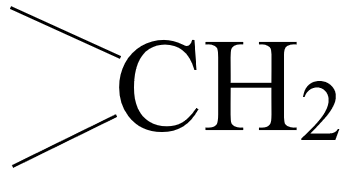
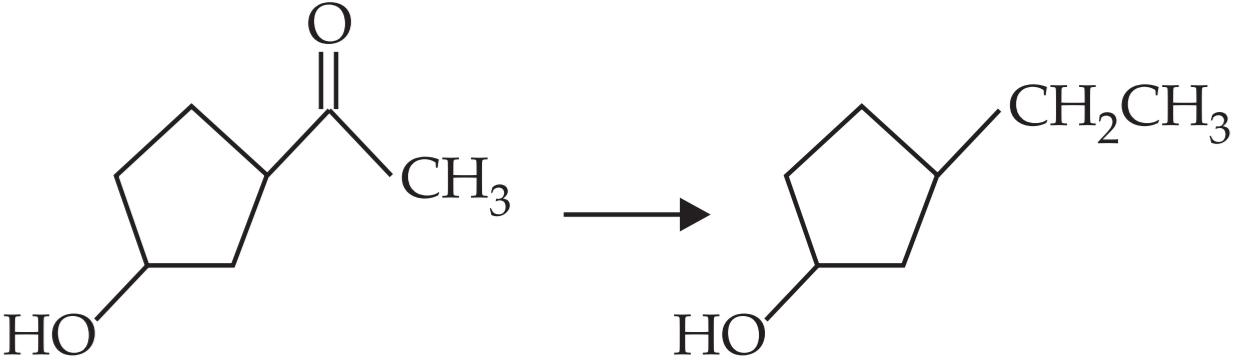
Aldehydes and ketones are reduced to primary and secondary alcohols respectively by NaBH4 or LiAlH4 as well as catalytic hydrogenation. The carbonyl group of aldehydes and ketones is reduced to  group on treatment with Zn-Hg and cone. HCl (Clemmensen reduction) or with hydrazine followed by NaOH or KOH in highly boiling solvent such as ethylene glycol (Wolff-Kishner reduction).Aldehydes differ from ketones in their oxidation reactions. Aldehydes are easily oxidised to carboxylic acids on treatment with HNO3, KMnO4, K2Cr2O7 etc. Even mild oxidising agents mainlyTollens' reagent and Fehling's solution also oxidise aldehydes. Ketones are generally oxidised under vigorous conditions i.e., strong oxidising agents and at elevated temperatures, to give mixture of carboxylic acids having lesser number of C-atoms than the parent ketone.
The following questions are multiple choice questions. Choose the most appropriate answer:

  1. Which of the following cannot be made by reduction of ketone or aldehyde with NaBH4 in methanol?
  1. 1-Butanol
  2. 2-Butanol
  3. 2-Methyl-1-propanol
  4. 2-Methyl-2-propanol
  1. The carbonyl compound producing an optically active product by reaction with LiAlH4 is:
  1. Propanone
  2. Butanone
  3. 3-pentanone
  4. Benzophenone
  1. A substance C4H10O (X) yields on oxidation a compound C4H8O which gives an oxime and a positive iodoform test. The substance X on treatment with cone. H2SO4 gives C4H8. The structure of the compound (X) is:
  1. CH3CH2CH2CH2OH
  2. CH3CH(OH)CH2CH3
  3. (CH3)3COH
  4. CH3CH- O - CH2CH3
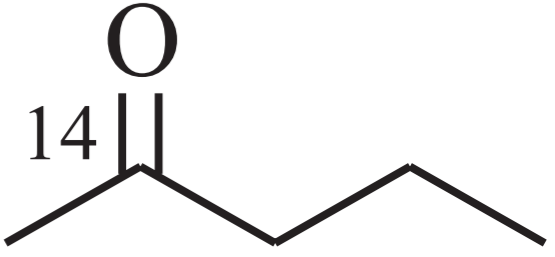
  1. In the oxidation of  by acidified K2Cr2O7, the products are:
  1. $\ \ \ \ \ \ \ \ \ \ \ \ \ \ \ \ \text{O}\\\ \ \ \ \ \ \ \ \ \ \ \ \ \ \ \ ||\\\text{CH}_3-\ ^\text{14}\text{C}-\text{OH}$ and $\text{CH}_3\text{CH}_2\text{COOH}$

  2. $\ \ \ \ \ \ \ \ \ \ \ \ \ \ \ \ \ \ \ \ \ \ \ \ \ \ \ \ \ \ \ \ \ \ \ \ \text{O}\\ \ \ \ \ \ \ \ \ \ \ \ \ \ \ \ \ \ \ \ \ \ \ \ \ \ \ \ \ \ \ \ \ \ \ \ \ \ ||\\\text{CH}_3(\text{CH}_2)_2\text{COOH}-\text{C}-\text{OH}$ and $ \ \ \ \ \ \ \ 14\\\text{CH}_3\text{CH}_2\text{COOH}$

  3. $\ \ \ \ \ \ \ \ \ \ \ \ \ \ \ \ \ \ \ \ \ \ \ \ \ \ \ \ \ \ \ \ \ \ \ \ \ \ \ \ \ \ 14\\\text{CH}_3\text{CH}_2\text{CH}_2\text{COOH}+\text{HCOOH}$

  4. None of these.

  1. The appropriate reagent for the following transformation is:

  1. $\text{Na}_2\text{NH}_2,^-\text{OH}$

  2. $\text{NaBH}_4$

  3. $\frac{\text{H}_2}{\text{Ni}}$

  4. $\text{AICl}_3$

Explain the structure of nucleic acid compounds.
What is fructose? Explain the structure of fructose.