Question
Define angular SHM. State the differential equation of angular SHM. Hence derive an expression for the period of angular SHM in terms of
(i) the torsion constant
(ii) the angular acceleration.
Answer


Definition : Angular SHM is defined as the oscillatory motion of a body in which the restoring torque responsible for angular acceleration is directly proportional to the angular displacement and its direction is opposite to that of angular displacement. The differential equation of angular SHM is $I \frac{d^2 \theta}{d t^2}+c \theta=0 \ldots$ (1)
where $I=$ moment of inertia of the
where $I$ = moment of inertia of the oscillating body,
$\frac{d^2 \theta}{d t^2}=$ angular acceleration of the body when its angular displacement is $\theta$, and $c =$ torsion constant of the suspension wire,
$
\therefore \frac{d^2 \theta}{d t^2}+\frac{c}{I} \theta=0
$
Let $\frac{c}{I}=\omega^2$, a constant. Therefore, the angular frequency, $\omega=\sqrt{c / I}$ and the angular acceleration,
$
a=\frac{d^2 \theta}{d t^2}=-\omega^2 \theta
$
The minus sign shows that the $\alpha$ and $\theta$ have opposite directions. The period $T$ of angular SHM is
$
T=\frac{2 \pi}{\omega}=\frac{2 \pi}{\sqrt{C / I}}=2 \pi \sqrt{\frac{I}{c}}
$
This is the expression for the period in terms of torque constant. Also, from Eq. (2),
$\omega=\sqrt{\left|\frac{\alpha}{\theta}\right|} \quad$
$=\sqrt{\text { angular acceleration per unit angular displacement }}$
$\therefore T=\frac{2 \pi}{\omega}=\frac{2 \pi}{\sqrt{|\alpha / \theta|}}$
$2 \pi$
$=\frac{2 \pi}{\sqrt{\text { angular acceleration per unit angular displacement }}}$

Need a full question paper?

Generate a complete, print-ready paper with questions like this in minutes — across 16+ boards, with answer keys.

Start Generating Free

Similar questions

Explain electrical resonance in an $\text{LC}$ parallel circuit. Deduce the expression for the resonant frequency of the circuit.
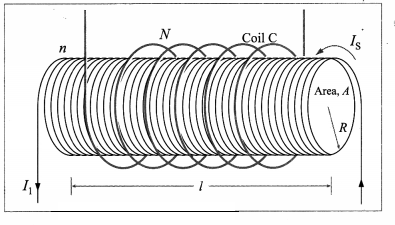
A long solenoid, of radius $R_f$ has $n$ turns per unit length. An insulated coil $C$ of IV turns is wound over it as shown. Show that the mutual inductance for the coil-solenoid combination is given by $M=\mu_0 \pi R^2 n N$.
Image
Derive an equation for the resultant wave produced due to superposition of two waves. Hence, state the expression for the amplitude of the resultant wave when two waves are
(1) in phase
(2) out of phase.
Draw the impedance triangle for a series LCR AC circuit and write the expressions for the impedance and the phase difference between the emf and the current.
Explain the inverse linear dependence of stopping potential on the incident wavelength in a photoelectric effect experiment.
The angular position of a rotating object is given by $\theta(t)=\left(1.55 t^2-7.75 t+2.87\right)$ rad, where $t$ is measured in second.
(i) When is the object momentarily at rest?
(ii) What is the magnitude of its angular acceleration at that time?
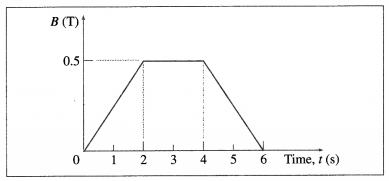
The magnetic field through a wire loop, of radius $12 \ cm$ and resistance $8.5 \Omega ,$ changes with time as shown in the graph below. The magnetic field is uniform and perpendicular to the plane of the loop. Calculate the $\text{emf}$ induced in the loop as a function of time. Hence, find the induced emf in the time interval $(a) t = 0$ to $t = 2 s\  (b) t = 2 s$ to $t = 4s\  (c) t = 4s$ to $t = 6s.$
Image
Derive the relation $\frac{V_{ S }}{V_{ p }}=\frac{N_{ S }}{N_{ p }}$ for a transformer. Hence, explain a step-up and a step-down trans-former. Also, show that $\frac{I_p}{I_{ S }}=\frac{N_{ S }}{N_{ p }}$###Derive expressions for the emf and current for a transformer in terms of the turns ratio.
Obtain the balancing condition in case of a Wheatstone’s network.
A short bar magnet is placed in an external magnetic field of 700 guass. When its axis makes an angle of 30° with the external magnetic field, it experiences a torque of 0.014 Nm. Find the magnetic moment of the magnet, and the work done in moving it from its most stable to most unstable position.