Question
Explain electrical resonance in an $\text{LC}$ parallel circuit. Deduce the expression for the resonant frequency of the circuit.
Answer

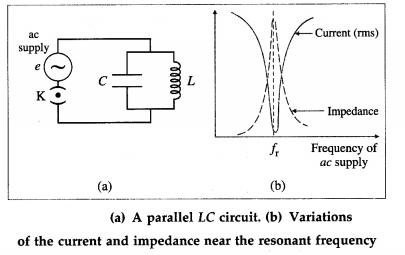
Consider a capacitor of capacitance $C,$ and an inductor of large self$-$inductance $L$ and negligible resistance, connected in parallel across a source of sinusoidally alternating emf from below figure. Let the instantaneous value of the applied emf be
$e = e_0 \sin ωt$
Image
Let $iL$ and $ic$ be the instantaneous currents through the inductor and capacitor respectively. As the current in the inductor lags behind the emf in phase by $\pi / 2$ radian,
$i_L=\frac{e_0}{X_{ L }} \sin \left(\omega t-\frac{\pi}{2}\right)=-\frac{e_0}{X_{ L }} \cos \omega t$
where $X_L$ is the inductive reactance.
As the current in the capacitor leads the emf by a phase angle of $\pi / 2$ radian,
$i c=\frac{e_0}{X_C} \sin (\omega t+\pi / 2)=\frac{e_0}{X_C} \cos \omega t$
where $X_c$ is the capacitive reactance.
The instantaneous current drawn from the source is
$i=i_L+i c=e_0\left(\frac{1}{X_C}-\frac{1}{X_{ L }}\right) \cos \omega t$
If $X_L=X_C, i=0$. Thus, no current is drawn from the source if $X_L=X_C$. In such a case, alternating current goes on circulating in the $\text{LC}$ loop, though no current is supplied by the source. This condition is called parallel resonance and the frequency of ac at which it occurs is called the resonant frequency $\left( f _{ r }\right)$.
The condition for resonance is
$X _{ L }= X _{ C }$
$\therefore \omega_{ r } L=\frac{1}{\omega_{ r } C } \therefore \omega_{ r }=\frac{1}{\sqrt{L C}}$
$\therefore$ Resonant frequency, $f_{ r }=\frac{\omega_{ r }}{2 \pi}=\frac{1}{2 \pi \sqrt{L C}}$
In practice, every inductor possesses some resistance and hence even at resonance, some current is drawn from the source. Also, the resonant frequency is different from that for zero resistence.
The resonance curve shows the variation of current $(i)$ and impedance with the frequency of the ac supply, from figure $(b).$ At resonance the current supplied by the source is minimum and the impedance of the circuit is maximum.
 

Need a full question paper?

Generate a complete, print-ready paper with questions like this in minutes — across 16+ boards, with answer keys.

Start Generating Free

Similar questions

Draw a neat, labelled energy level diagram for H atom showing the transitions. Explain the series of spectral lines for H atom, whose fixed inner orbit numbers are 3 and 4 respectively.
Explain the formulation of stationary waves by the analytical method. What are nodes and antinodes? Show that the distance between two successive nodes or antinodes is $\lambda/2.$
Explain the shape of a liquid drop on a solid surface in terms of interfacial tensions.
OR
Account for the angle of contact in terms of interfacial tensions.
OR
Draw diagram showing force due to surface tension at the liquid-solid, air-solid, air-liquid interface, in case of (i) a drop of mercury on a plane solid surface and (ii) a drop of water on a plane solid surface. Discuss the variation of angle of contact.
What is an adiabatic process ? Obtain expressions for the work done by a system (an ideal gas) in an adiabatic process. Also draw the corresponding P-V diagram.
In Young's double$-$slit experiment with slits of equal width, a point $P$ on the screen is at a distance equal to one$-$fourth of the fringe width from the central maximum. If the intensity at the central maximum is $I_0$ find the intensity at $P$.
Express the ideal gas equation in terms of the density of the gas.
Obtain an expression for the electric potential at a point due to an isolated point charge.
Derive an expression for the effective or equivalent capacitance (capacity) of a combination of a number of capacitors connected in series.
OR
Derive an expression for the effective capacitance of three capacitors connected in series.
Explain the terme sharpness of resonance and $Q$ factor (quality factor).
Consider a heavy string X and a light string Y joined together at point O. Explain what happens when a wave pulse
(1) travelling from the string X reaches the junction O
(2) travelling from the string Y reaches the junction O.