Question
Define angular velocity and angular acceleration. The total speed $V_1$ of a projectile at its greatest height is $\sqrt{\frac{6}{7}}$ of its speed $V_2$ when it is at half its greatest height. Show that the angle of projection is $30°$.

Answer

Angular Velocity: Angular velocity of an object in circular motion is defined as the time rate of change of is angular displacement. It is denoted by $\omega$ and is measured in radians per second $(rad.s^{-1})$.$\omega=\frac{\text{angular displacement}}{\text{Time}}=\frac{\theta}{\text{t}}=\frac{\text{d}\theta}{\text{dt}}$
Angular Acceleration: Angular acceleration of an object in circular motion is defined as the time rate of change of its angular velocity. It is denoted by 'a’ and measured in rad $s^{-2}$.
$\alpha=\frac{\text{angular velocity change}}{\text{time taken}}=\frac{\text{d}\omega}{\text{dt}}$
Numerical: Velocity at highest point $=\text{u}\cos\theta=\text{V}_1\ (\text{given})$
$\text{h}_\text{max}=\frac{\text{u}^2\sin^2\theta}{2\text{g}}$
Vertical velocity at $\frac{\text{h}_\text{max}}{2}=\text{V}_{2\text{y}}=\sqrt{\text{u}^2\sin^2\theta-2\text{g}\frac{\text{h}_\text{max}}{2}}$
$\text{V}_{2\text{y}}=\sqrt{\text{u}^2\sin^2\theta\Big(1-\frac{1}{2}\Big)}=\frac{\text{u}\sin\theta}{\sqrt{2}}$
$\text{V}_{2\text{x}}=\text{u}\cos\theta$
$\text{V}_2=\sqrt{\text{V}^2_{2\text{x}}+\text{V}^2_{2\text{y}}}$
$=\sqrt{\text{u}^2\cos^2\theta+\frac{\text{u}^2\sin^2\theta}{2}}$
Given, $\text{V}_1=\sqrt{\frac{6}{7}}\text{V}_2$
$\therefore\ \frac{\text{u}\cos\theta}{\text{u}\sqrt{\cos^2\theta+\frac{\sin^2\theta}{2}}}=\sqrt{\frac{6}{7}}$
Squaring both the sides
$\frac{\cos^2\theta}{\cos^2\theta+\frac{\sin^2\theta}{2}}=\frac{6}{7}$
$\frac{1}{1+\frac{\tan^2\theta}{2}}=\frac{6}{7}$
$1+\frac{\tan^2\theta}{2}=\frac{7}{6}\Rightarrow\ \frac{\tan^2\theta}{2}=\frac{7}{6}-1=\frac{1}{6}$
$\tan\theta=\sqrt{\frac{2}{6}}=\frac{1}{\sqrt{3}}$
$\therefore\ \theta=\tan^{-1}\Big(\frac{1}{\sqrt{3}}\Big)=30^\circ.$

Need a full question paper?

Generate a complete, print-ready paper with questions like this in minutes — across 16+ boards, with answer keys.
Start Generating Free

Similar questions

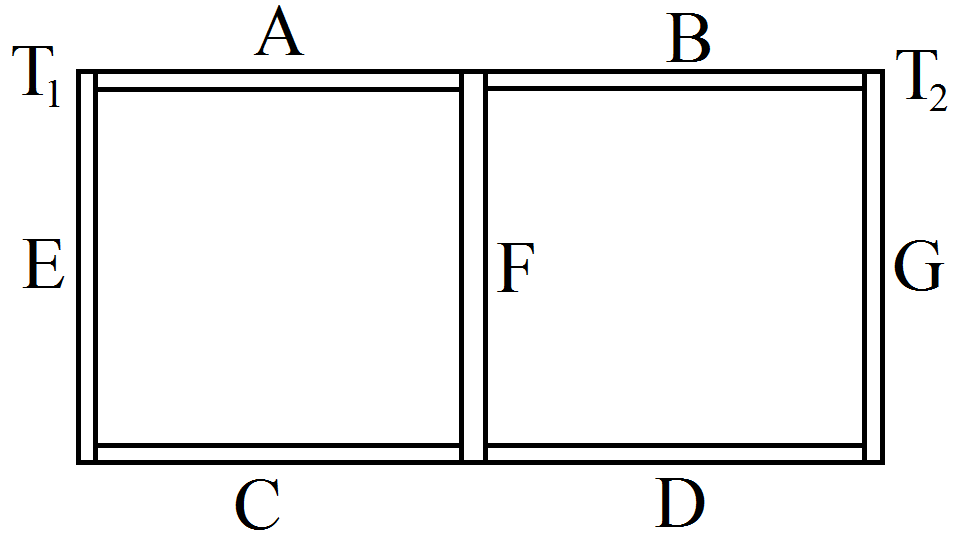
Seven rods $A, B, C, D, E, F$ and $G$ are joined as shown in figure. All the rods have equal cross-sectional area A and length l. The thermal conductivities of the rods are $K_A = K_c = K_0, K_B = K_D = 2K_0, K_E= 3K_0, K_F = 4K_0$, and $K_G = 5K_0$. The rod E is kept at a constant temperature $T_2$ and the rod G is kept at a constant temperature $T_2(T_2 > T_1)$.
  1. Show that the rod F has a uniform temperature $\text{T}=\frac{(\text{T}_1+2\text{T}_2)}{3}.$
  2. Find the rate of heat flowing from the source which maintains the temperature $T_2$.
Explain the difference between harmonic motion and simple harmonic motion. Explain the characteristics and types of simple harmonic motion. Also write differential equations with examples.
What are methods of reducing friction? Write these and explain. Or Explain what are the measures to reduce the effect of friction. Explain the usefulness of lurbicants
Two blocks of masses $400g$ and $200g$ are connected through a light string going over a pulley which is free to rotate about its axis. The pulley has a moment of inertia $1.6 \times 10^{-4}kg-m^2$ and a radius 2.0cm. Find:
  1. The kinetic energy of the system as the $400g$ block falls through $50cm$.
  2. The speed of the blocks at this instant.
Though the law gives women equal status in India, many people hold unscientific views on a woman’s innate nature, capacity and intelligence, and in practice give them a secondary status and role. Demolish this view using scientific arguments, and by quoting examples of great women in science and other spheres; and persuade yourself and others that, given equal opportunity, women are on par with men.
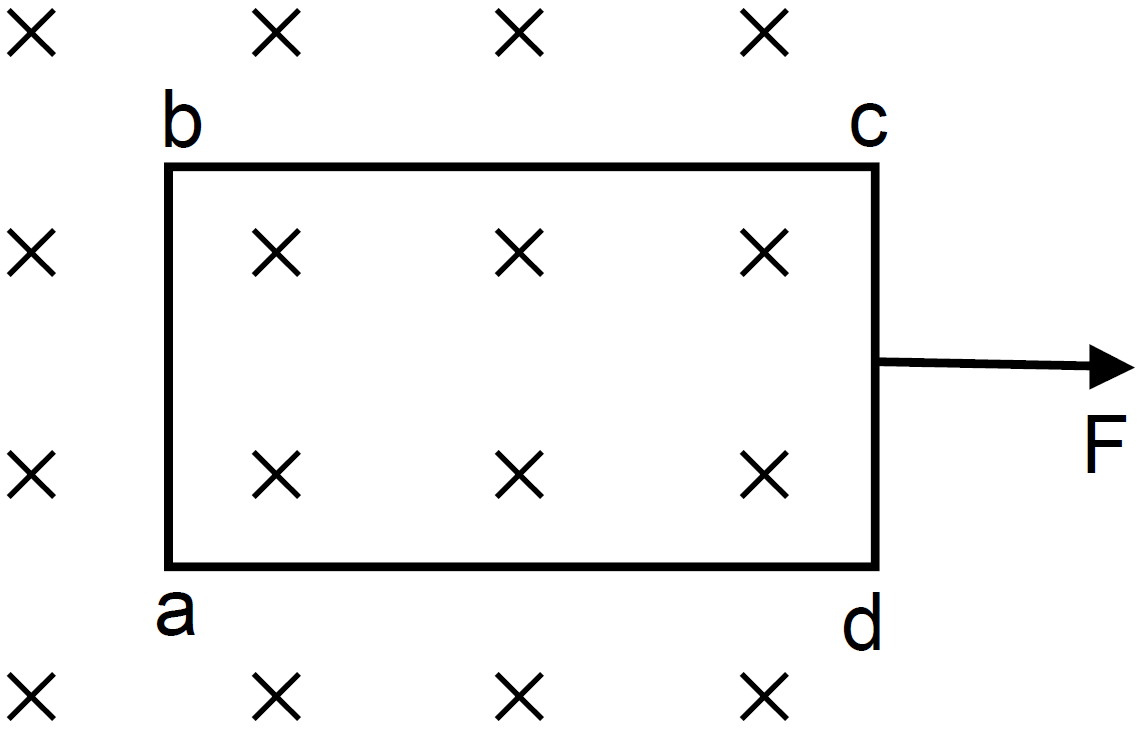
A rectangular frame of wire abcd has dimensions $32cm × 8.0cm$ and a total resistance of $2.0\Omega.$ It is pulled out of a magnetic field $B = 0.020T$ by applying a force of $3.2 \times 10^{-5}N$ (figure). It is found that the frame moves with constant speed. Find
  1. This constant speed.
  2. The emf induced in the loop.
  3. The potential difference between the points a and b.
  4. The potential difference between the points c and d.
Obtain an expression for the moment of inertia of a disc relative to its geometric axis.
A spaceship is stationed on Mars. How much energy must be expended on the spaceship to launch it out of the solar system? Mass of the space ship $=1000 \mathrm{~kg}$; mass of the sun $=2 \times 10^{30} \mathrm{~kg}$; mass of mars $=6.4 \times 10^{23} \mathrm{~kg}$; radius of mars $=3395 \mathrm{~km}$; radius of the orbit of mars $=2.28 \times 10^8 \mathrm{~km} ; G=6.67 \times 10^{-11} \mathrm{~N} \mathrm{~m}^2 \mathrm{~kg}^{-2}$.
A body of mass $2kg$ is resting on a rough horizontal surface. A force of $20N$ is now applied to it for $10$ seconds parallel to the surface. If the coefficient of kinetic friction between the surfaces in contact is $0.2$, calculate.
  1. Work done by the applied force in $10$ seconds.
  2. Change in kinetic energy of the object in $10$ seconds.
Take $g = 10 m/ s^2$
A servo voltage stabiliser restricts the voltage output to $220V ± 1\%$. If an electric bulb rated at $220V, 100W$ is connected to it, what will be the minimum and maximum power consumed by it?