Question
Explain the difference between harmonic motion and simple harmonic motion. Explain the characteristics and types of simple harmonic motion. Also write differential equations with examples.

Answer

SELF

Need a full question paper?

Generate a complete, print-ready paper with questions like this in minutes — across 16+ boards, with answer keys.
Start Generating Free

Similar questions

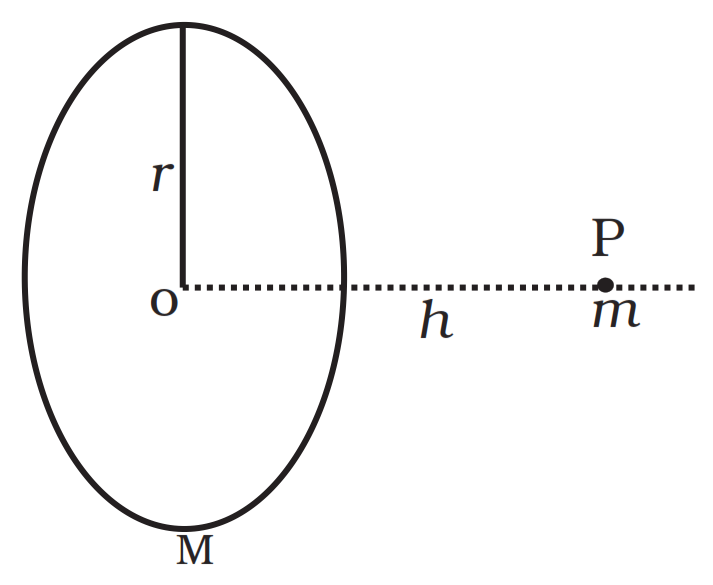
A mass m is placed at P a distance h along the normal through the centre O of a thin circular ring of mass M and radius r

If the mass is removed further away such that OP becomes 2h, by what factor the force of gravitation will decrease, if h = r?
In the HCl molecule, the separation between the nuclei of the two atoms is about $1.27\mathring{\text{A}}\big(1\mathring{\text{A}}= 10^{-10} \text{m}\big).$ Find the approximate location of the CM of the molecule, given that a chlorine atom is about 35.5 times as massive as a hydrogen atom and nearly all the mass of an atom is concentrated in its nucleus.
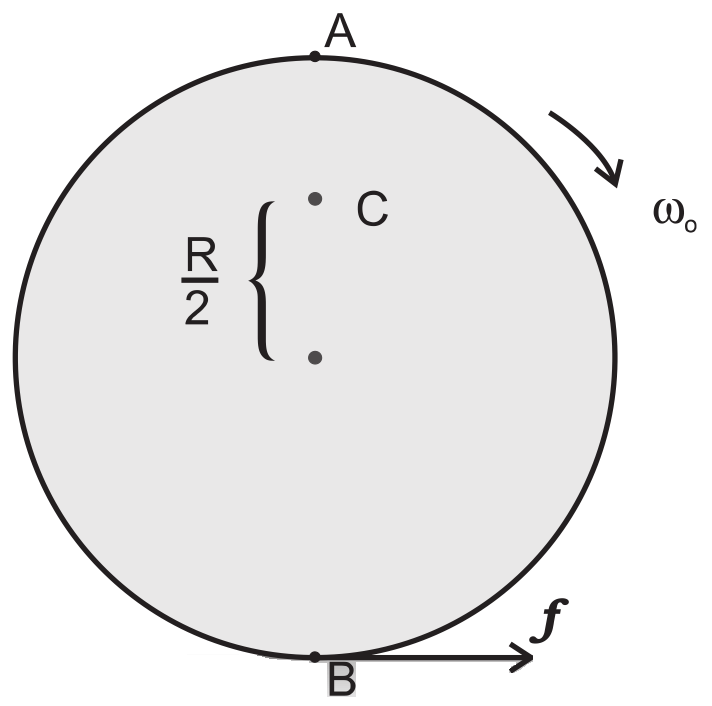
A disc rotating about its axis with angular speed $\omega_0$ is placed lightly (without any translational push) on a perfectly frictionless table. The radius of the disc is R. What are the linear velocities of the points A, B and C on the disc shown in will the disc roll in the direction indicated?
A body is in translational equilibrium under the action of coplanar forces. If the torque of these forces is zero about a point, is it necessary that it will also be zero about any other point?
A train starts from rest and moves with a constant acceleration of $2.0m/s^2$ for half a minute. The brakes are then applied and the train comes to rest in one minute. Find:
  1. The total distance moved by the train.
  2. The maximum speed attained by the train.
  3. The position(s) of the train at half the maximum speed.
A drop of water, $2 mm$ in diameter, falling from a height of $50 cm$ in a bucket generates sound which can be heard from the $5 m$ distance. Take all the gravitational energy difference as going into the sound form, the transformation being spread in time over $0.2 s$ . Deduce the average intensity and the amplitude of vibration at the listener's end. Given: density of air $=1.3 \mathrm{~kg} \mathrm{~m}^{-3}$, frequency of wave $=1000 \mathrm{~Hz}$ and $\mathrm{c}=350 \mathrm{~ms}^{-1}$ ?
Can $\text{L}_\alpha$ X-ray of one material have shorter wavelength than $\text{K}_\alpha$ X-ray of another?
Given below are observations on molar specific heats at room temperature of some common gases.
Gas Molar specific heat (Cv)
(cal $mo1^{–1} K^{–1}$)
Hydrogen 4.87
Nitrogen 4.97
Oxygen 5.02
Nitric oxide 4.99
Carbon monoxide 5.01
Chlorine 6.17
The measured molar specific heats of these gases are markedly different from those for monatomic gases. Typically, molar specific heat of a monatomic gas is 2.92 cal/ mol K. Explain this difference. What can you infer from the somewhat larger (than the rest) value for chlorine?
What do you mean by the term "equilibrium"? What are equilibrium of rest and equilibrium of motion? State the conditions for complete equilibrium of a body.
Two masses $8kg$ and $12kg$ are connected at the two ends of a light inextensible string that goes over a frictionless pulley. Find the acceleration of the masses, and the tension in the string when the masses are released.