Question
  1. Define Aufbau's principle.
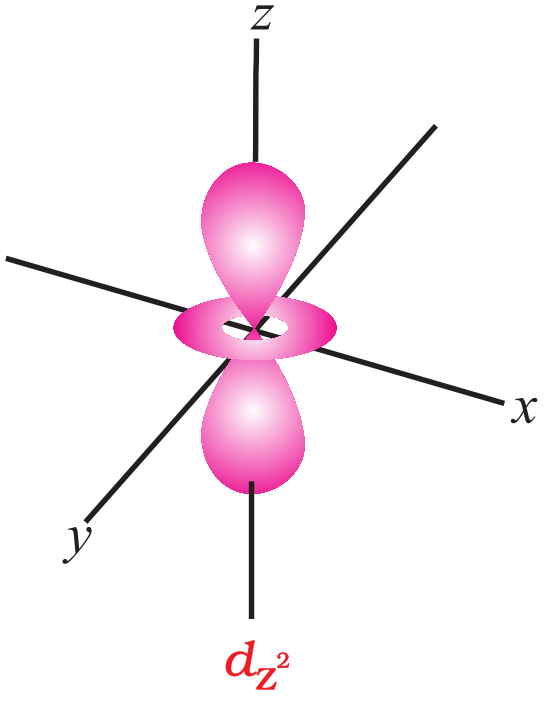
  2. Draw the shape of $\text{d}_{\text{z}^2}$ orbital.
  3. Which quantum number specify number of orbitals in a given subshell?
Answer

  1. Aufbau's principle: Electrons are filled in the orbitals in increasing order of energies in grand state.
  2.  
  1. Number of orbitals in gives subshell is decided by magnetic quantum number.

Need a full question paper?

Generate a complete, print-ready paper with questions like this in minutes — across 16+ boards, with answer keys.

Start Generating Free

Similar questions

A compound on analysis was found to contain C = 34.6%, H = 3.85%, and 0 = 61.55%. Calculate its empirical formula.
For the reaction, $\text{CH}_4(\text{g})+2\text{H}_2\text{S(g)}\rightleftharpoons\text{CS}_2\text{(g)}+4\text{H}_2(\text{g})$ at 1173K, the magnitude of the equilibrium constant, $K_c$​​​​​​​ is 3.6. For each of the following compositions, decide whether reaction mixture is at equilibrium. If it is not, decide in which direction the reaction should go?
  1. $[\text{CH}_4]=1.07\text{M},[\text{H}_2\text{S}]=1.20\text{M},[\text{CS}_2]$
$=0.90\text{M},[\text{H}_2]=1.78\text{M}$
  1. $[\text{CH}_4]=1.45\text{M},[\text{H}_2\text{S}]=1.29\text{M},[\text{CS}_2]$
$=1.25\text{M},[\text{H}_2]=1.75\text{M}$
Define electronegativity. How does it differ from electron gain enthalpy?
Choose the correct answer.
A reaction, A + B → C + D + q is found to have a positive entropy change. The reaction will be:
  1. Possible at high temperature.
  2. Possible only at low temperature.
  3. Not possible at any temperature.
  4. Possible at any temperature.
Calculate $\Delta_{\mathrm{f}} \mathrm{H}^{\circ}$ of HCl if bond energy of $\mathrm{H}-\mathrm{H}$ bond is $437 \mathrm{~kJ} \mathrm{~mol}^{-1}, \mathrm{Cl}-\mathrm{Cl}$ bond is $244 \mathrm{~kJ} \mathrm{~mol}^{-1}$ and $\mathrm{H}-\mathrm{Cl}$ is $433 \mathrm{~kJ} \mathrm{~mol}^{-1}$.
Give the number of electrons in the species $\text{H}^+_2,\text{H}_2$ and $\text{O}^+_2$
45.4L of dinitrogen reacted with 22.7L of dioxygen and 45.4L of nitrous oxide was formed. The reaction is given below:
$2 \mathrm{N}_2(\mathrm{g})+\mathrm{O}_2(\mathrm{g}) \rightarrow 2 \mathrm{N}_2 \mathrm{O}(\mathrm{g})$
Which law is being obeyed in this experiment? Write the statement of the law?
An ionic hydride of groups has sufficiently covalent character. It is used to form hydrides of other elements of group 13 which are useful reducing agent. Write the formula this hydride and its reaction with $\mathrm{B}_2 \mathrm{H}_6$ and $\mathrm{AlCl}_3$.
Using molecular orbital theory, compare the bond energy and magnetic character of $\mathrm{O}_2^{+}$and $\mathrm{O}_2^{-}$.
An ion with mass number 56 contains 3 units of positive charge and 30.4% more neutrons than electrons. Assign the symbol to this ion.