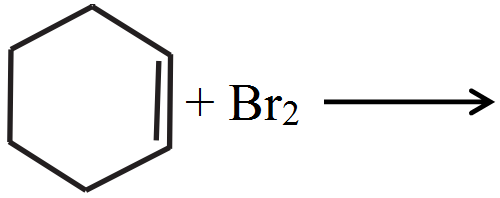
Question
For the reaction, $\text{CH}_4(\text{g})+2\text{H}_2\text{S(g)}\rightleftharpoons\text{CS}_2\text{(g)}+4\text{H}_2(\text{g})$ at 1173K, the magnitude of the equilibrium constant, $K_c$​​​​​​​ is 3.6. For each of the following compositions, decide whether reaction mixture is at equilibrium. If it is not, decide in which direction the reaction should go?
  1. $[\text{CH}_4]=1.07\text{M},[\text{H}_2\text{S}]=1.20\text{M},[\text{CS}_2]$
$=0.90\text{M},[\text{H}_2]=1.78\text{M}$
  1. $[\text{CH}_4]=1.45\text{M},[\text{H}_2\text{S}]=1.29\text{M},[\text{CS}_2]$
$=1.25\text{M},[\text{H}_2]=1.75\text{M}$

Answer

  1. $\text{CH}_4(\text{g})+2\text{H}_2\text{S(g)}\rightleftharpoons\text{CS}_2\text{(g)}+4\text{H}_2(\text{g})$
$\text{Q}_{\text{c}}=\frac{[\text{CS}_4][\text{H}_2]^4}{[\text{CH}_4][\text{H}_2\text{S}]^2}=\frac{[0.90][1.78]^4}{[1.07][1.20]^2}$
$=\frac{10.03\times0.9}{1.44\times1.07}=\frac{9.027}{1.54}$
$=5.86\text{ K}_{\text{c}}=3.6$
Since $Q_c > K_c$​​​​​​​, the equilibrium will shift in backward direction.
  1. $\text{Q}_{\text{c}}=\frac{[1.25][1.75]^4}{[1.45][1.29]^2}$
$=\frac{9.38\times1.25}{1.45\times1.66}=\frac{11.725}{2.407}=4.87$
Since $Q_c > K_c$​​​​​​​, the equilibrium will shift in backward direction.

Need a full question paper?

Generate a complete, print-ready paper with questions like this in minutes — across 16+ boards, with answer keys.

Start Generating Free

Similar questions

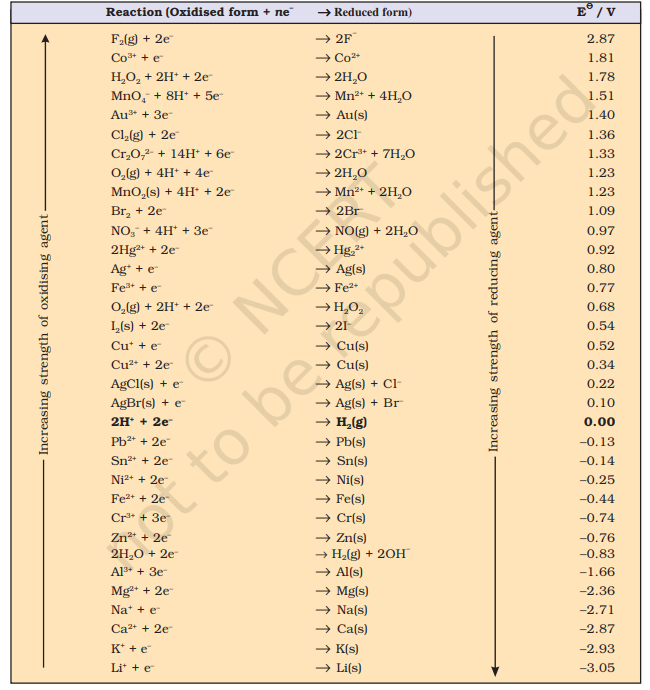
Using the standard electrode potentials given in the Table, predict if the reaction between the following is feasible:

$\mathrm{Ag}(\mathrm{s})$ and $\mathrm{Fe}^{3+}(\mathrm{aq})$.
Arrange the following:
  1. $\text{C}_6\text{H}_5\stackrel{+\ \ \ \ \ \ \ \ \ \ \ \ }{\text{CHCH}}_3, \text{C}_6\text{H}_5\stackrel{+\ \ \ \ \ \ \ \ \ \ \ \ }{\text{CHCH}}=\text{CH}_2,$ $\text{C}_6\text{H}_5\text{CH}_2\stackrel{+ \ \ \ }{\text{CH}}_2,\text{C}_6\text{H}_5\stackrel{+\ \ \ \ \ \ \ \ \ }{\text{C(CH}}_3)_2$ in order of increasing stability.
  2. $\text{CH}_3\text{CH}_2^+,\text{C}_6\text{H}_5\text{CH}_2^+,(\text{CH}_3)_3\text{C}^+,\text{CH}_2=\text{CHCH}_2^+$ in order of decreasing stability.
  3. $\text{HC}\equiv\text{C}^-,\text{CH}_2=\text{CH}^-,\text{CH}_3\text{CH}_2^-,\text{CH}^-_3,$ $(\text{CH}_3)_2\text{CH}^-,\text{C}_6\text{H}_5\text{CH}^-_2$ in order of increasing stability.
For the following reactions, complete and Identify the type of reactions:
  1. $\text{CH}_3-\text{CH}_2-\text{CH}_2\text{Br}+\text{KOH(alc.)}\overrightarrow{\ \ \ \ \ \ }$
  2. $\text{CH}_3-\text{CH}-\text{CH}_3+\text{KOH(aq)}\overrightarrow{ \ \ \ \ \ \ }\\ \ \ \ \ \ \ \ \ \ \ \ \ \ |\\ \ \ \ \ \ \ \ \ \ \ \ \ \text{Br}$
  3.  
Explain the structure of the $CO _2$ molecule.
Calculate the total number of electrons present in $1.6g$ of methane.
Copper dissolves in dilute nitric acid but not in dilute HCl. Explain.
1. Define reaction enthalpy.
2. How can you say that universe is going towards chaos?
3. Neither q nor W is a state function but $q + W$ is a state function. Explain why?
a. Consider the isoelectronic species, $\mathrm{Na}^{+}, \mathrm{Mg}^{2+}, \mathrm{F}^{-}$and $\mathrm{O}^{2-}$. What is the correct order of increasing length of their radii and why?
b. Si is semiconductor whereas ' C ' is non-metal, why?
Would you expect the second electron gain enthalpy of O as positive, more negative or less negative than the first? Justify your answer.
A man takes a diet equivalent to 10000kJ per day and does work, in expending his energy in all forms equivalent to 12500kJ per day. What is change in internal energy per day? If the energy lost was stored as sucrose (1632kJ per 100g), how many days should it take to lose 2kg of his weight? (Ignore water loss)