Question
Define centripetal acceleration. Give two examples.

Answer

Acceleration needed for a particle to undergo uniform circular motion is called 'centripetal acceleration'. It is directed along the radius of circular path towards its centre.

Two common examples are:

  1. An electron revolving around the nucleus of an atom in a uniform circular motion experiences a centripetal acceleration on account of Coulombian electrostatic force on electron due to nucleus.
  2. A satellite revolving around the earth in a circular orbit experiences a centripetal acceleration on account of gravitational force due to the earth.

Need a full question paper?

Generate a complete, print-ready paper with questions like this in minutes — across 16+ boards, with answer keys.
Start Generating Free

Similar questions

A solid sphere rolling on a rough horizontal surface with a linear speed v collides elastically with a fixed, smooth, vertical wall. Find the speed of the sphere after it has started pure rolling in the backward direction.
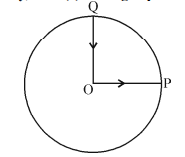
A cyclist starts from the centre O of a circular park of radius 1 km, reaches the edge P of the park, then cycles along the circumference, and returns to the centre along QO as shown in Fig. If the round trip takes 10 min, what is the (a) net displacement (b) average velocity, and (c) average speed of the cyclist?
Image
Explain why.
There is fall in temperature with increase in altitude.
Two exactly similar rain drops falling with terminal velocity of $(2)^{\frac13}\text{ms}^{-1}$ coalesce to form a bigger drop. Find the terminal velocity of the bigger drop.
A cricket ball of mass 150g is moving with a velocity of 12ms-1 and is hit by a bat so that the ball is turned back with a velocity of 20ms-1. The force of the blow acts for 0.01s. Find the average force exerted on the ball by the bat.
In Fizeau method of measuring the speed of light, the toothed wheel is placed in the focal plane of a converging lens. How would the experiment be affected if the wheel is slightly away from the focal plane?
The change in the value of g at a height h above the earth is same as at a depth d below it. If h and d are small as compared to the radius of the earth, what is the ratio $\Big(\frac{\text{h}}{\text{d}}\Big)?$
A batsman deflects a ball by an angle of $45^{\circ}$ without changing its initial speed which is equal to $54 km / h$. What is the impulse imparted to the ball? (Mass of the ball is 0.15 kg .)
Define the terms resultant or equivalent of two forces. Two forces F1 and F2 acting at an angle $\theta$ on a body simultaneously have a resultant F. Show that $\theta=\cos^{-1}\Big[\frac{(\text{F}_1^2+\text{F}_2^2+2\text{F}_1\text{F}_2\cos\theta)}{2\text{F}_1\text{F}_2}\Big]$
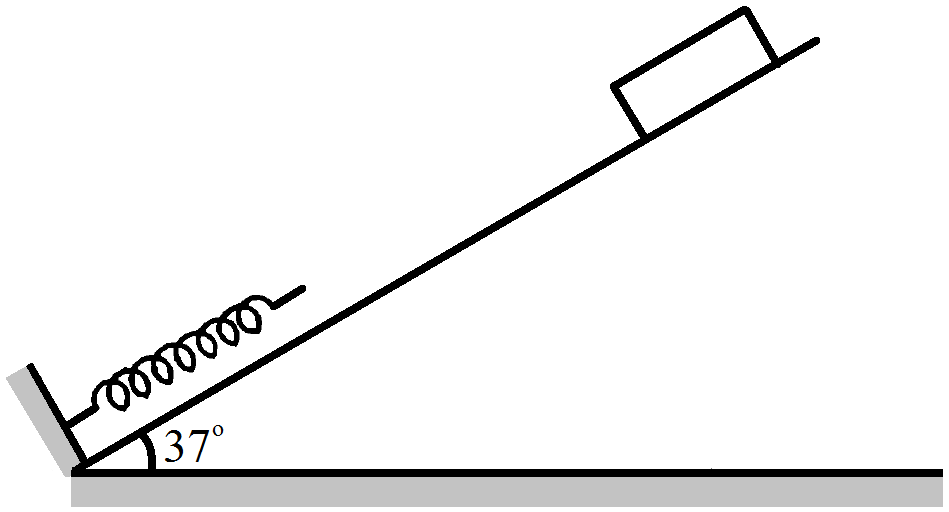
Figure shows a spring fixed at the bottom end of an incline of inclination 37°. A small block of mass 2kg starts slipping down the incline from a point 4.8m away from the spring. The block compresses the spring by 20cm, stops momentarily and then rebounds through a distance of 1m up the incline. Find.
  1. The friction coefficient between the plane and the block.
  2. The spring constant of the spring. Take g = 10m/s2.