Question
A batsman deflects a ball by an angle of $45^{\circ}$ without changing its initial speed which is equal to $54 km / h$. What is the impulse imparted to the ball? (Mass of the ball is 0.15 kg .)
Answer

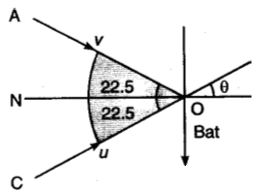
The ball struck by the bat is deflected back such that the total angle is $45^{\circ}$.
Image
Now, initial momentum of ball $= mu \cos \theta$
$
\begin{aligned}
& =\frac{0.15 \times 54 \times 1000 \times \cos 22.5}{3600} \\
& =0.15 \times 15 \times 0.9239 \text { along ON }
\end{aligned}
$
Final momentum of ball $=$ mucos $\theta$ along ON
Impulse $=$ change in momentum
$=\operatorname{mucos} \theta-(-m u c o s \theta)$
$=2 mucos \theta$
$=2 \times 0.15 \times 15 \times 0.9239$
i.e., Impulse $=4.16 kg ms ^{-1}$

Need a full question paper?

Generate a complete, print-ready paper with questions like this in minutes — across 16+ boards, with answer keys.
Start Generating Free

Similar questions

  1. If the successive overtones of vibrating string are 280Hz and 350Hz, what is the frequency of the fundamental note?
  2. If the amplitude of a sound wave is tripled, by how many dB will the intensity level increases?
Prove that gravitational potential difference is the work done in carrying a unit mass from one point to another.
Calculate the temperature which has same numeral value on celsius and Fahrenheit scale.
Give examples of a one-dimensional motion where:
The particle moving along positive x-direction comes to rest periodically and moves backward.
The sufrace tension and vapour pressure of water at 20°C is 7.28 × 10⁻²N m-1 and 2.33 × 10³ Pa, respectively. What is the radius of the smallest spherical water droplet which can form without evaporating at 20°C?
To maintain a rotor at a uniform angular speed of 200rad s-1, an engine needs to transmit a torque of 180Nm. What is the power required by the engine?
(Note: uniform angular velocity in the absence of friction implies zero torque. In practice, applied torque is needed to counter frictional torque). Assume that the engine is 100% efficient.
A uniform wire of resistance $100\Omega$ is melted and recast as a wire of length is double that of the original. What would be the resistance of the wire?
A steel wire of length 64cm weighs 5g. If it is stretched by a force of 8N, what would be the speed of a transverse wave passing on it?
The vector sum of a system of non-collinear forces acting on a rigid body is given to be non-zero. If the vector sum of all the torques due to the system of forces about a certain point is found to be zero, does this mean that it is necessarily zero about any arbitrary point?
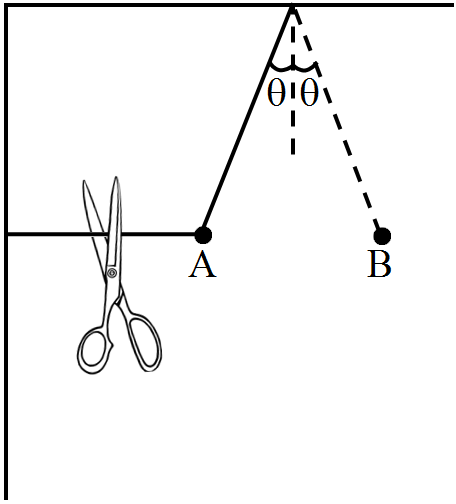
A ball is held at rest at position A in Fig., by two light strings. The horizontal string is cut and the ball starts swinging as a pendulum. Point B is the farthest to the right where the ball goes as it swings back and forth. What is the ratio of the tension in the supporting string in position B to its value at A before the horizontal string was cut?A ball is held at rest at position A in Fig., by two light strings. The horizontal string is cut and the ball starts swinging as a pendulum. Point B is the farthest to the right where the ball goes as it swings back and forth. What is the ratio of the tension in the supporting string in position B to its value at A before the horizontal string was cut?