Question 15 Marks
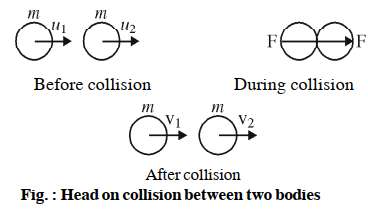
If an object of mass $M$ moving with velocity $\mu$ has a direct elastic collision with an other stable object of mass $m$ then prove that the energy loss of the object of mass $M$ and the result of its intial energy will be $\frac{4 m M }{( M +m)^2}$
Answer
View full question & answer→According to question, from the law of conservation of momentum,
$M u+m \times 0=Mv_1+m v_2$
Here $v_1$ and $v_2$ are the velocities of the object $M$ and stable object $m$ respectively.
$M u=Mv_1+m v_2$ .....(1)
By the low of collision,
$e=\frac{v_2-v_1}{u_1-u_2}$
But for elastic collision, $e=1$
$\therefore$
$1=\frac{v_2-v_1}{u-0}$
or
$\begin{aligned}
v_2-v_1 & =u \\
v_2 & =v_1+u
\end{aligned}$ .....(2)
Put the value of (2) in equation (1)
$\begin{aligned}
Mv_1+m\left(u+v_1\right) & =M u \\
\text { or } & Mv_1+m u+m v_1 \\
\text { or } & =M u \\
v_1(M+m) & =M u-m u \\
v_1(M+m) & =u(M-m)
\end{aligned}$ .....(3)
Energy dissipation of object of mass, M
$\begin{array}{l}
=\frac{1}{2} M u^2-\frac{1}{2} Mv_1^2 \\
=\frac{1}{2} M u^2\left(1-\frac{v_1^2}{u^2}\right)
\end{array}$
Energy dissipation of object and result of intial energy
$\begin{array}{l}
=\frac{\frac{1}{2} M u^2\left(1-\frac{v_1^2}{u^2}\right)}{\frac{1}{2} M u^2} \\
=\left(1-\frac{v_1^2}{u^2}\right) \\
=1-\left(\frac{M-m}{M+m}\right)^2 \times \frac{u^2}{u^2} \quad[\text { From eqn. (3)] } \\
=1-\left(\frac{M-m}{M+m}\right)^2 \\
=\frac{(M+m)^2-(M-m)^2}{(M+m)^2} \\
=\frac{(M+m+M-m)(M+m-M+m)}{(M+m)^2} \\
=\frac{2 M \times 2 m}{(M+m)^2}=\frac{4 M m}{(M+m)^2}
\end{array}$
$M u+m \times 0=Mv_1+m v_2$
Here $v_1$ and $v_2$ are the velocities of the object $M$ and stable object $m$ respectively.
$M u=Mv_1+m v_2$ .....(1)
By the low of collision,
$e=\frac{v_2-v_1}{u_1-u_2}$
But for elastic collision, $e=1$
$\therefore$
$1=\frac{v_2-v_1}{u-0}$
or
$\begin{aligned}
v_2-v_1 & =u \\
v_2 & =v_1+u
\end{aligned}$ .....(2)
Put the value of (2) in equation (1)
$\begin{aligned}
Mv_1+m\left(u+v_1\right) & =M u \\
\text { or } & Mv_1+m u+m v_1 \\
\text { or } & =M u \\
v_1(M+m) & =M u-m u \\
v_1(M+m) & =u(M-m)
\end{aligned}$ .....(3)
Energy dissipation of object of mass, M
$\begin{array}{l}
=\frac{1}{2} M u^2-\frac{1}{2} Mv_1^2 \\
=\frac{1}{2} M u^2\left(1-\frac{v_1^2}{u^2}\right)
\end{array}$
Energy dissipation of object and result of intial energy
$\begin{array}{l}
=\frac{\frac{1}{2} M u^2\left(1-\frac{v_1^2}{u^2}\right)}{\frac{1}{2} M u^2} \\
=\left(1-\frac{v_1^2}{u^2}\right) \\
=1-\left(\frac{M-m}{M+m}\right)^2 \times \frac{u^2}{u^2} \quad[\text { From eqn. (3)] } \\
=1-\left(\frac{M-m}{M+m}\right)^2 \\
=\frac{(M+m)^2-(M-m)^2}{(M+m)^2} \\
=\frac{(M+m+M-m)(M+m-M+m)}{(M+m)^2} \\
=\frac{2 M \times 2 m}{(M+m)^2}=\frac{4 M m}{(M+m)^2}
\end{array}$