Question
  1. Define current sensitivity of a galvanometer. Write its expression.
  2. A galvanometer has resistance $G$ and shows full scale deflection for current $Ig.$
  1. How can it be converted into an ammeter to measure current up to $I_0(I_0 > Ig)?$
  2. What is the effective resistance of this ammeter?
Answer

  1. Current sensitivity: It is defined as the amount of deflection produced per unit magnitude of current passes.
$\text{C}_\text{s}=\frac{\phi}{\text{I}}\text{ or }\text{C}_\text{s}=\frac{\text{NAB}}{\mu,}$
  1.  
  1.  

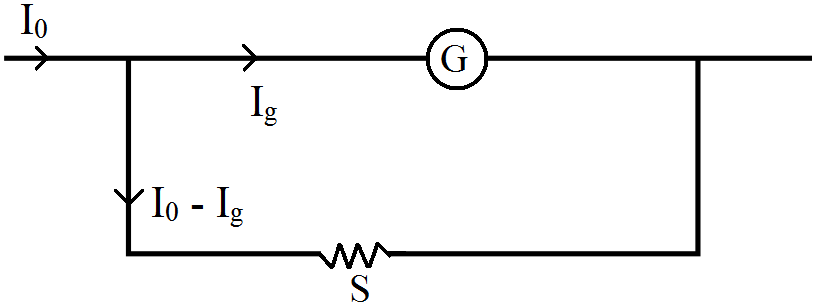
$(G)$ can be converted into an ammeter by connected a small stunt resistance parallel to $(G)$ coil so that,
$\text{IgG}=\big(\text{I}_0-\text{I}_\text{g}\big)\text{S}$
$\therefore\text{S}=\frac{\text{IgG}}{\text{I}_0-\text{I}_\text{g}}$
  1. Effective resistance of $(\text{A})\Rightarrow\frac{\text{GS}}{\text{G}+\text{S}}$

Need a full question paper?

Generate a complete, print-ready paper with questions like this in minutes — across 16+ boards, with answer keys.

Start Generating Free

Similar questions

A capacitor of unknown capacitance is connected across a battery of $V$ volts. The charge stored in it is $360 \mu C$. When potential across the capacitor is reduced by $120 V,$ the charge stored in it becomes $120 \mu C$.
Calculate:
  1. The potential $V$ and the unknown capacitance $C$.
  2. What will be the charge stored in the capacitor, if the voltage applied had increased by $120 V$?
Two identical coherent waves, each of intensity I, are producing an interference pattern. Find the value of the resultant intensity at a point of:
  1. Constructive interference.
  2. Destructive interference.
Figure shows two wave pulses at $t = 0$ travelling on a string in opposite directions with the same

wave speed $50\ cm/s$. Sketch the shape of the string at $t = 4\ ms, 6ms, 8\ ms,$ and $12\ ms.$
Magnetic moment of a small bar magnet is 0.24 newton metre tesla ${ }^{-1}$. Calculate magnetising field of the magnet at a distance of 10 cm from the centre of the magnet on its axis.
A convex lens made up of glass of refractive index 1.5 is dipped, in turn, in (i) a medium of refractive index 1.65, (ii) a medium of refractive index 1.33.
  1. Will it behave as a converging or a diverging lens in the two cases?
  2. How will its focal length change in the two media?
A 10cm long rod carries a charge of $+50\mu\text{C}$ distributed uniformly along its length. Find the magnitude of the electric field at a point 10cm from both the ends of the rod.
Two identically charged particles are fastened to the two ends of a spring of spring constant $100Nm^{-1}$ and natural length $10\ cm.$ The system rests on a smooth horizontal table. If the charge on each particle is $2.0 \times 10^{-8}C$, find the extension in the length of the spring. Assume that the extension is small as compared to the natural length. Justify this assumption after you solve the problem.
Explain with proper diagram, the application of a $p$ - $n$ junction diode as a halfwave rectifier.
An ammeter and a milliammeter are converted from the same galvanometer. Out of the two, which current measuring instrument has a higher resistance?
A mosquito is sitting on an $L.P.$ record disc rotating on a turn table at $33\frac{1}{3}$ revolutions per minute. The distance of the mosquito from the centre of the turn table is $10\ cm$. Show that the friction coefficient between the record and the mosquito is greater than $\frac{\pi^2}{81}.$ Take $g =10 m/s^2.$