Question
Explain with proper diagram, the application of a $p$ - $n$ junction diode as a halfwave rectifier.

Answer


Image
Image
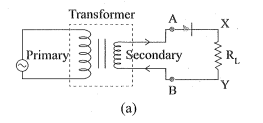
The circuit diagram for the half-wave rectifier is shown in the figure. One $p-n$ junction diode is required in the half wave rectifier circuit.
As shown in fig. (a), the primary coil of a step down transformer is connected to an A.C. source. The secondary coil of transformer is connected in series with the $p-n$ junction diode and load resistance $R_L$.
The secondary of a transformer supplies the desired ac voltage across terminals A and B. When A is positive the diode is forward biased and it conducts. So, some output voltage is obtained between two terminals of load resistance $R_L$.
When A is negative, the diode is reverse-biased and it does not conduct. The reverse saturation current of a diode is negligible and can be considered equal to zero for practical purposes.
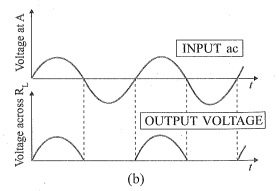
As shown in fig. (b), in the positive half cycle of ac there is a current through the load resistor $R _{ L }$ and we get an output voltage. Whereas there is no current in the negative half-cycle. In the next positive half cycle, again we get the output voltage.
Thus, the output voltage, though still varying, is restricted to only one direction and is said to be rectified. Since the rectified output of this circuit is only for half of the input ac wave so it is called the half-wave rectifier.

Need a full question paper?

Generate a complete, print-ready paper with questions like this in minutes — across 16+ boards, with answer keys.
Start Generating Free

Similar questions

Suppose a monochromatic X-ray beam of wavelength 100pm is sent through a Young's double slit and the interference pattern is observed on a photographic plate placed 40cm away from the slit. What should be the separation between the slits so that the successive maxima on the screen are separated by a distance of 0.1mm?
The intensity of sound from a point source is $1.0 \times 10^{-6}W/m^2$ at a distance of $5.0m$ from the source. What will be the intensity at a distance of $25m$ from the source?
A rectangular wire loop of sides $8\ cm$ and $2\ cm$ with a small cut is moving out of a region of uniform magnetic field of magnitude $0.3T$ directed normal to the loop. What is the emf developed across the cut if the velocity of the loop is $1 \ cms^{–1}$ in a direction normal to the:
  1. Longer side,
  2. shorter side of the loop?
For how long does the induced voltage last in each case?
The speed of sound in air is 332m/s. Is it advisable to define the length 1m as the distance travelled by sound in $\frac{1}{332}\text{s}$?
When a compass needle be placed at magnetic north pole, how would it behave? If a dip needle be placed at the place, how would it behave?
A wheel of moment of inertia $0.500\ kg-m^2$ and radius $20.0\ cm$ is rotating about its axis at an angular speed of $20.0\ rad/s.$ It picks up a stationary particle of mass $200g$ at its edge. Find the new angular speed of the wheel.
A particle of mass m moves on a straight line with its velocity varying with the distance travelled according to the equation $\text{v}=\text{a}\sqrt{\text{x}},$ where a is a constant. Find the total work done by all the forces during a displacement from x = 0 to x = d.
A Zener of power rating $1W$ is to be used as a voltage regulator. If zener has a breakdown of $5V$ and it has to regulate voltage which fluctuated between $3V$ and $7V,$ what should be the value of $Rs$ for safe operation $($Fig.$)$?
Distinguish between diamagnetic and ferromagnetic materials in respect of their (i) intensity of magnetisation (ii) behaviour in non-uniform magnetic field and (iii) susceptibility.
Is it easier to take out a nucleon from carbon or from iron? Fi-om iron or from lead?