Question
Define ecological pyramids and describe with examples, pyramids of number and biomass.

Answer

→ The trophic structure and function at successive trophic levels, i.e. (producers, herbivores, carnivores), may be graphically represented by means of ecological pyramids where the first or producer level constitutes the base of the pyramid and the successive levels, the tiers, making the apex.
→ Ecological pyramids are of three general types.
(A) Pyramid of Number
(B) Pyramid of Biomass
(C) Pyramid of Energy
→ Trophic level represents structure of an ecosystem is one kind of producer consumer arrangement.
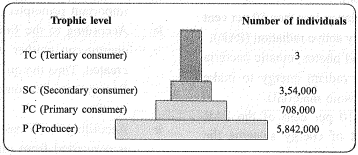
(A) Pyramid of number:
→ It shows the number of individual organisms at each trophic level. Producers occur in the largest number and top level carnivores are in the smallest number. Normally, the pyramids of numbers is upright.
Image
→ There are exceptions to this generalisation.
→ If you were to count the number of insects feeding on a big tree, the number pyramid is inverted. → For example, 50 parrot live on a banyan tree and 50 insects on each parrot.
(B) Pyramid of biomass:
→ It shows the total dry weight or the average biomass of organisms at a particular trophic level.
Image
→ The pyramid of biomass in sea is generally inverted.
→ Example, the biomass of fishes far exceeds that of phytoplankton.
(C) Pyramid of energy:
→ It shows the rate of energy flow and/or productivity at successive trophic levels. Pyramids of energy are always upright.
→ Pyramid of energy is always upright, can never be inverted, because when energy flows from a particular trophic level to the next trophic level, some energy is always lost as heat at each step.
Each bar in the energy pyramid indicates the amount of energy present at each trophic level in a given time or annually per unit area.
→ According to law of thermodynamics amount of available energy decreases during utilization.
Image
→ There are certain limitations of ecological pyramids.
→ Such as it does not take into account the same species belonging to two or more trophic levels.
→ It assumes a simple food chain, something that almost never exists in nature; it does not accommodate a food web.
→ Sparrow, when eats seed, pea and fruits then it is a primary consumer but when it eats insects and worms, its called secondary consumers. Saprophytes are not given any place in ecological
→ pyramids even though they play a vital role in the ecosystem.

Need a full question paper?

Generate a complete, print-ready paper with questions like this in minutes — across 16+ boards, with answer keys.

Start Generating Free

Similar questions

The size of a population for any species is not a static parameter. Explain.###Explain population growth###Explain in brief - population growth.
Write a note on Mechanism of DNA replication
Read the following and answer any four questions from (i) to (v) given below:

During copulation, semen is released by the penis into the vagina. 'The motile sperms swim rapidly, fuse with ovum in the ampullary region, resulting in fertilisation. Haploid nucleus of sperm fuse with that of ovum to form diploid zygote.

  1. In female genital tract, sperms are made capable of fertilising the egg. This phenomenon of sperm activation is called:
  1. Amphimixis.
  2. Cortical reaction.
  3. Capacitation.
  4. Acrosomal reaction.
  1. Select the correct sequence of various physical and chemical events that take place during fertilisation.
  1. Fusion of cortical granules with plasma membrane of secondary oocyte.
  2. Formation of fertilisation cone to receive sperm.
  3. Release of sperm lysin from acrosome.
  4. Mixing up of chromosomes of a sperm and an ovum.
  1. R → Q → P → S
  2. Q → S → R → P
  3. Q → R → S → P
  4. R → P → Q → S
  1. Assertion: Only one sperm can fertilise an ovum.

Reason: The secretion of acrosome help the sperm to enter into cytoplasm of ovum through zona pellucida and plasma membrane.

  1. Both assertion and reason are true, and reason is the correct explanation of assertion.
  2. Both assertion and reason are true, but reason is not the correct explanation of assertion.
  3. Assertion is true, but reason is false.
  4. Both assertion and reason are false
  1. What is the significance of fertilisation?
  1. It restores haploid number of chromosomes.
  2. It produces offspring genetically identical to parents.
  3. It initiates cleavage.
  4. Both (b) and (c).
  1. Site of fertilisation in humans is:
  1. Endometrium of uterine cavity.
  2. Ampullary isthmic junction of oviduct.
  3. Cervix of uterus.
  4. Infundibulum of fallopian tube.
Read the following text carefully and answer the questions that follow:
The following is the illustration of the sequence of ovarian events (a-i) in a human female.
Image
i. Identify the figure that illustrates ovulation and mentions the stage of oogenesis it represents. (1)
ii. Name the ovarian hormone and the pituitary hormone that have caused the above-mentioned event. (1)
iii. Explain changes that occur in the uterus simultaneously in anticipation. (2)
OR
Draw a labelled sketch of the structure of a human ovum prior to fertilization. (2)
Read the following text carefully and answer the questions that follow:
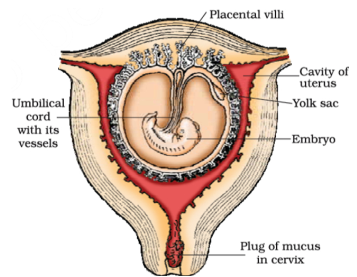
After implantation, finger-like projections appear on the trophoblast called chorionic villi which are surrounded by the uterine tissue and maternal blood. The chorionic villi and uterine tissue become interdigitated with each other and jointly form a structural and functional unit between the developing embryo (foetus) and the maternal body.
Image
i. Name the hormone crucial in parturition. Does the parturition signal originate from the mother or the fetus?(1)
ii. When and where do chorionic villi appear in humans? (1)
iii. Woman has conceived and implantation has occurred. Discuss the impact of progesterone and estrogen. (2)
OR
Fetal ejection reflex leads to parturition. Justify (2)
Bacteria cannot be seen with the naked eyes, but these can be seen with the help of a microscope. If you have to carry a sample from your home to your biology laboratory to demonstrate the presence of microbes with the help of a microscope, which sample would you carry and why?
Read the following text carefully and answer the questions that follow:
The process of formation of a mature female gamete is called oogenesis which is markedly different from spermatogenesis. A schematic representation of Oogenesis is shown below study the flow chart carefully.

Image
i. How is a primary oocyte different from a secondary oocyte? (1)
ii. Mention the changes taking place during the transition of a secondary follicle to Graafian follicle in the oogonia. (1)
iii. How many primary follicles are left in each ovary in a human female at puberty? (2)
OR
What happen to graafuan follicle after ovulation? (2)
Read the following and answer any four questions from (i) to (v) given below:

Regular change in temperature that occurs at specific intervals of time is called thennoperiodicity. It is of two types-diurnal and seasonal thermoperiodicity. Diumal periodicity refers to temperatures of day and night. It determines periods ofannual activity. In season periodicity different temperature prevails in different seasons of the year. 'Tiley favour different aspects of plant and animal life termed as phenology. For example in wheat, leaf growth requires a temperature of 10º-25ºC. Apple requires temperature below 7ºC for a period of 800 hrs before flowering and fruiting can occur. Low temperature is required for germination of some seeds as well as flowering in some plants. It also determines growth, reproduction, colour and morphology of animals. Both low and high temperature cause stress in organisms which is overcome by particular adaptations.

  1. Some plants require low temperature treatment for flowering. This phenomenon is known as:
  1. Photoperiodism.
  2. Vemalisation.
  3. Thermoperiodism.
  4. None of these.
  1. Animals found in arctic zones are called.
  1. microtherms
  2. Megatherms
  3. Mesotherms
  4. Hekistotherms
  1. Which of the following parts of wheat plant grows maximum in temperature around 10º-25ºC?
  1. Root
  2. Seeds
  3. Leaf
  4. Stem
  1. "Different temperatures prevail in different seasons of the year." It represents:
  1. Diurnal thermoperiodicity.
  2. Seasonal periodicity.
  3. Homeostasis.
  4. Thermoregulation.
  1. Assertion: Low and high temperature causes stress in organisms.

Reasons: Organisms show specific adaptations to overcome stressful condition.
  1. Both assertion and reason are true and reason is the correct explanation of assertion
  2. Both assertion and reason are true but reason is not the correct explanation of assertion.
  3. Assertion is true but reason is false.
  4. Both assertion and reason are false.
Origin and Evolution of Man:
Write a note Lac operon