Question
Write a note Lac operon

Answer

→ The elucidation of the lac operon was also a result of a close association between a geneticist, Francois Jacob and a biochemist, Jacque Monod.
→ They were the first to elucidate a transcriptionally regulated system.
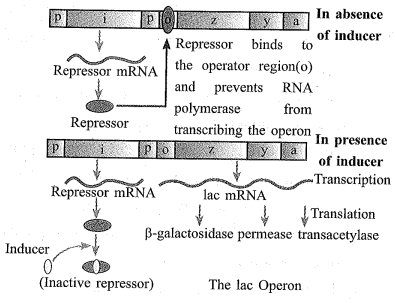
→ In lac operon (here lac refers to lactose), a polycistronic structural gene is regulated by a common promoter and regulatory genes.
→ Such arrangement is very common in bacteria and is referred to as operon.
→ The lac operon consists of one regulatory gene (the i gene here the term i does not refer to inducer, rather it is derived from the word inhibitor) and three structural genes (z, y, and a).
→ The i gene codes for the repressor of the lac operon.
→ The z gene codes for beta-galactosidase (β-gal), which is primarily responsible for the hydrolysis of the disaccharide, lactose into its monomeric units, galactose and glucose.
→ The y gene codes for permease, which increases permeability of the cell to ẞ-galactosides.
→ The a gene encodes a transacetylase.
→ Hence, all the three gene products in lac operon are required for metabolism of lactose. In most other operons as well, the genes present in the operon are needed together to function in the same or related metabolic pathway.
→ Inducer:
→ Lactose is the substrate for the enzyme beta- galactosidase and it regulates switching on and off of the operon. Hence, it is termed as inducer.
→ In the absence of a perferred carbon source such as glucose, if lactose is provided in the growth medium of the bacteria, the lactose is transported into the cells through the action of permease (Remember, a very low level of expression of lac operon has to be present in the cell all the time, otherwise lactose cannot enter the cells).
→ The lactose then induces the operon in the following manner.
→ The repressor of the operon is synthesised (all- the-time-constitutively) from the i gene. The repressor protein binds to the operator region of the operon and prevents RNA polymerase from transcribing the operon.
→ In the presence of an inducer, such as lactose or allolactose, the repressor is inactivated by interaction with the inducer.
→ This allows RNA polymerase access to the promoter and transcription proceeds. Essentially, regulation of lac operon can also be visualised as regulation of enzyme synthesis by its substrate.
→ Remember, glucose or galactose cannot act as inducers for lac operon.
→ Lac operon would remain expressed untill all the amount of lactose is converted to glucose & Galactose.
→ Regulation of lac operon by repressor is referred to as negative regulation. Lac operon is under control of positive regulation as well, but it is beyond the scope of discussion at this level.
Image

Need a full question paper?

Generate a complete, print-ready paper with questions like this in minutes — across 16+ boards, with answer keys.

Start Generating Free

Similar questions

Read the following and answer any four questions from (i) to (v) given below:

A desert lizard (an ectotherm) and a mouse (an endotherm) are placed inside a chamber at 15ºC and their body temperature [T(L) for the lizard and T(M) for the mouse] and metabolic rates [M(L) for lizard and M(M) for the mouse] are monitored.

  1. Which of the following is correct regardingT(L), M(L), T(M) and M(M)?
  1. T(L) and M(L) will fall while T(M) and M(M) will increase.
  2. T(L) and M(L) will increase while T(M) and M(M) will fall.
  3. T(L) and M(L) will fall, T(M) will remain same and M(M) will increase.
  4. T(L) and M(L) will remain same, T(M) and M(M) will decrease.
  1. It can be said that some animals in their evolutionary development preferred to be ectotherms than endotherms. Which of the following can be the best suited reason for it?
  1. The metabolic reactions of these organisms can occur at a very wide range of temperature.
  2. Maintaining homeostasis is an energetically expensive process.
  3. The enzymes of these organisms are functional at high temperatures.
  4. Both (b) and (c).
  1. Organisms that can maintain a constant internal temperature are called.
  1. Homoeothermic
  2. Poikilothermic
  3. Oligothennic
  4. Heterothennic
  1. An animal that survives at temperature of 10ºC and 40ºC both can be placed under the category of:
  1. Ectotherm.
  2. Endotherm.
  3. Modifiers.
  4. Migratory organisms.
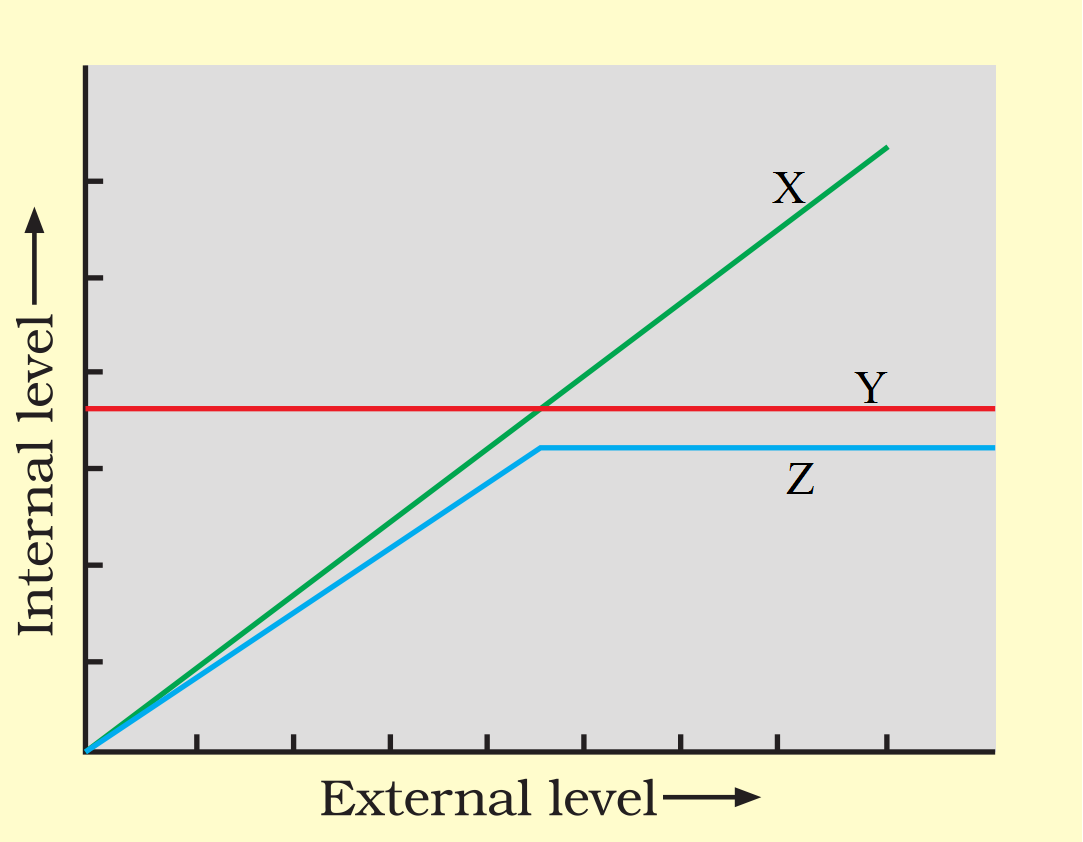
  1. Study the graph carefully and select the correct option.

  1. X could be desert lizard.
  2. Y could be mouse.
  3. Z could be desert lizard.
  4. Both (a) and (b).
Discuss the important measures that are useful in preventing and controlling the use of alcohol and drugs in youth.
Write a short note on endosperm development.
Read the following and answer any four questions from (i) to (v) given below:

Discovery of penicillin by Alexander Fleming in 1928 marked the beginning of the remarkable era in medical field. Penicillin was the first antibiotic extracted from Penicillium notatum. Antibiotics are used to treat bacterial diseases. These can be broad spectrum which can kill diverse group of disease causing bacteria and narrow spectrum which is effective only against one group of pathogenic strain. Antibiotics can act as bactericides or bacteriostatic. Bactericidal antibiotics kill bacteria by - disruption of cell wall synthesis (e.g., penicillin, cephalosporin, etc.), inhibition of SOS ribosome function (e.g.; erythromycin), inhibition of 30S ribosome function (e.g., streptomycin, neomycin), inhibition of amino acid-tRNA binding to ribosome (e.g., tetracyline). etc. Bacteriostatic antibiotics do not kill the bacteria rather they restrict the growth of bacteria. Penicillin belongs to $\beta$-lactum group of antibiotics and it inhibits bacterial cell wall synthesis by binding and inactivating protein. It inhibits transpeptidation of reaction and blocks cross-linking of the cell wall. It is used to treat tonsilitis, sore throat, gonorrhoea, rheumatic fever and some pneumonia types.

  1. The first antibiotic was extracted from a:
  1. Lichen.
  2. Fungus.
  3. Eubacteria.
  4. Acti-nomycetes.
  1. Which of the following kills bacteria by interfering SOS ribosome function?
  1. Cephalosporin.
  2. Erythromycin.
  3. Streptomycin.
  4. Neomycin.
  1. $\beta$-lactum group of antibiotics kill the bacterial pathogen by:
  1. Disruption of plasma membrane.
  2. Inhibition of translation of mRNA.
  3. Inhibition of translation of mRNA
  4. Inhibition of transcription of mRNA.
  1. Penicillin is not used to treat.
  1. Pneumonia.
  2. Tonsilitis.
  3. Rheumatic fever.
  4. Candidiasis.
  1. Assertion: Cephalosporins act by disruption of bacterial cell wall synthesis mechanism.

Reason: Cephalosporins are bacteriostatic antibiotics.

  1. Both assertion and reason are true and reason is the correct explanation of assertion.
  2. Both assertion and reason are true but reason is not the correct explanation of assertion.
  3. Assertion is true but reason is false.
  4. Both assertion and reason are false.
Polymerase chain reaction:
  1. Is a method of synthesising human protein from human DNA
  2. Uses restriction enzymes
  3. Can produce billions of copies of a DNA fragment
  4. Takes place naturally in bacteria
Read the following and answer any four questions from (i) to (v) given below:

Unlike animals, plants cannot runaway for their defence, therefore, they have evolved an astonishing variety of morphological and chemical defences against herbivores. Thorns are the most common morphological means of defence. Many plants produce and store chemicals that make the herbivore sick when they are eaten, inhibit feeding or digestion, disrupt its reproduction or even kill it. Some plants produce highly poisonous chemicals and that is why no cattle or goats browse on those plants. A wide variety of chemical substances that we extract from plants on a conunercial scale are produced by them actually as defence against grazers and browsers.

  1. Why you never see cattle or goats browsing on weed Calotropisl?
  1. It produces highly poisonous tannins.
  2. It produces quinine which is bitter in taste.
  3. It produces poisonous cardiac glycosides.
  4. It bears prickles.


  1. What could be the possible reason for invasive growth of the prickly pear cactus introduced in Australia?
  1. Absence of predators.
  2. New mycorrhizal association.
  3. Abundant water availability.
  4. All of these.
  1. Which of the following is most likely to sick by consuming chemicals produced by plants?
  1. Frog
  2. Goat
  3. Human
  4. Pigeon
  1. Plant evolve variety of morphological and chemical defences against.
  1. Prey
  2. Predator
  3. Commenal
  4. Mutualist
  1. Assertion: Some plant functions as predator in nature.

Reason: Phytoph ago us insects feed on plant sap.

  1. Both assertion and reason are true and reason is the correct explanation of assertion.
  2. Both assertion and reason are true but reason is not the correct explanation of assertion.
  3. Assertion is true but reason is false.
  4. Both assertion and reason are false.
Read the following and answer any four questions from S(i) to S(v) given below:

Rajat is a student of biotechnology. His professor tells him that for transformation with recombinant DNA the bacterial cells must be made capable of taking up DNA as DNA do not pass through membrane. While doing experiment in the lab, Rajat noticed that bacterial cells were not taking up the foreign DNA even after treating it with sodium ion. He asked his professor, the reason behind this. His professor explained that he should check the valency and charge of the ion that he is using for the treatment.

  1. It is difficult for DNA to pass through the membrane as
  1. It is a hydrophilic molecule.
  2. It is a hydrophobic molecule.
  3. It is a circular molecule.
  4. It changes its shape when it comes in contact with host cell.
  1. What type of ions are used for DNA mediated gene transfers?
  1. Divalent anions.
  2. Divalent cations.
  3. Monovalent cations.
  4. Monovalent anions.
  1. rDNA stands for,
  1. reduced DNA
  2. red DNA
  3. recombinant DNA
  4. related DNA.
  1. Which of the following statements with regard to DNA is correct?
  1. DNA is a positively charged molecule having two polynucleotide chains.
  2. Nitrogen bases of two polynucleotide chain form complementary pairs, i.e., A opposite G and T opposite C.
  3. Backbone of DNA chain is built up of alternate deoxyribose sugar and phosphate group.
  4. Both (a) and (c)
  1. Assertion: Competent host is essential for transformation with rDNA.

Reason: Transfer of DNA in a prokaryotic cell is called transfection.

  1. Both assertion and reason are true and reason is the correct explanation of assertion.
  2. Both assertion and reason are true but reason is not the correct explanation of assertion.
  3. Assertion is true but reason is false.
  4. Both assertion and reason are false.
Read the following and answer any four questions from (i) to (v) given below:
Wetlands are called Ramsar sites because the first international convention on their conservation was held in Ramsar in Iran in 1971. Wetlands or Ramsar sites are low lying marshy areas which get filled up during rains due to runoff and overflow from other water bodies. They are often considered to be waste lands which are used as dumping areas and filled up to recover land for various constructions activities. As a result, a large number of wetlands have disappeared.
  1. Select the incorrect match of wetland and its location.
 
Wetland
Location
(a)
Harike
Punjab
(b)
Chandra Tai
H.P.
(c)
Bhoj
M.P.
(d)
Ashtamudi
Odisha
  1. Migratory bird flamingo breeds in which of the following wetlands?
  1. Bhitarkanika Mangroves.
  2. Rann of Kutch.
  3. Harike.
  4. Chandra Tal.
  1. Which of the following is not an importance of wetlands?
  1. They are an important source of recharging groundwater.
  2. They provide protection from floods.
  3. They are good source of siltation and purification of water.
  4. None of these.
  1. Which of the following wetland ecosystem is highly acidic and has a accumulation of decomposed plants known as peat?
  1. Bog
  2. Mangrove
  3. Estuary
  4. Watershed
  1. The mangroves of Bhitarkanika are famous for:
  1. Rare migratory waterbirds.
  2. Nesting sites for endangered olive ridley turtles.
  3. Prawn cultivation.
  4. All of these.
Explain: Acquired Immunity.
How is a transgenic tobacco plant protected against Meloidogyne incognita? Explain the procedure.