Question
Define electric flux. Write its SI unit.
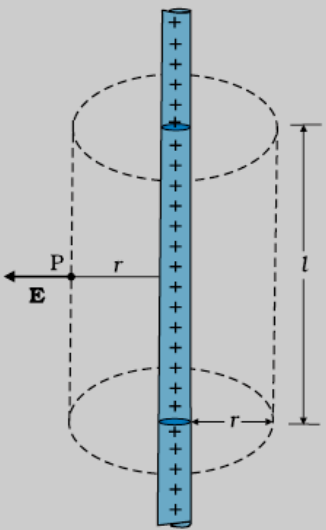
Using Gauss’s law, deduce an expression for electric field intensity due to an infinitely long straight uniformly charged wire.
Answer

The electric flux is defined as$\phi_E=\overrightarrow{E}.\overrightarrow{A}={EA}\cos\theta$
Its S.I unit is $(Nm^{2}C^{-1})$ The Gaussian surface is cylindrical and field is radial. At the cylindrical part of the surface, cylindrical part of the surface, $ \overrightarrow{E}$ is normal to the surface at every point and its magnitude is constant (since it depends only on r). By Gauss’s theorem : $ \oint \overrightarrow{E}.{d}\overrightarrow{S}=\frac{q}{\in_0}$$\therefore(2\pi{rl})=\frac{\lambda{l}}{\in_0}$
$\text{or}\text{ }\text{ } E=\frac{\lambda}{2\pi\in_0r}$

Need a full question paper?

Generate a complete, print-ready paper with questions like this in minutes — across 16+ boards, with answer keys.

Start Generating Free

Similar questions

Draw a plot showing the variation of binding energy per nucleon versus the mass number A. Explain with the help of this plot the release of energy in the processes of nuclear fission and fusion.
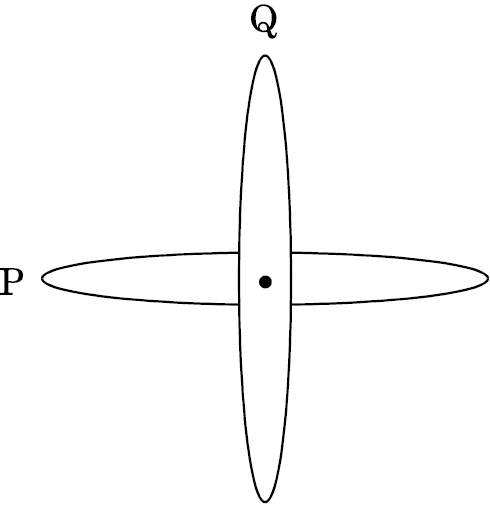
Two identical loops P and Q each of radius 5 cm are lying in perpendicular planes such that they have a common centre as shown in the figure. Find the magnitude and direction of the net magnetic field at the common centre of the two coils, if they carry currents equal to 3 A and 4 A respectively.
An electron and a proton possess equal kinetic energy. Which of these has the greater de Broglie wavelength?
Can two equipotential surfaces cut each other?
A charge of $20\mu\text{C}$ is placed on the positive plate of an isolated parallel-plate capacitor of capacitance $10\mu\text{F}.$ Calculate the potential difference developed between the plates.
  1. Define current sensitivity of a galvanometer. Write its expression.
  2. A galvanometer has resistance G and shows full scale deflection for current Ig.
  1. How can it be converted into an ammeter to measure current up to $I_0(I_0 > Ig)?$
  2. What is the effective resistance of this ammeter?
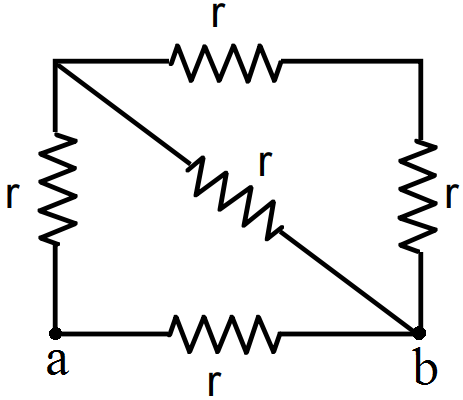
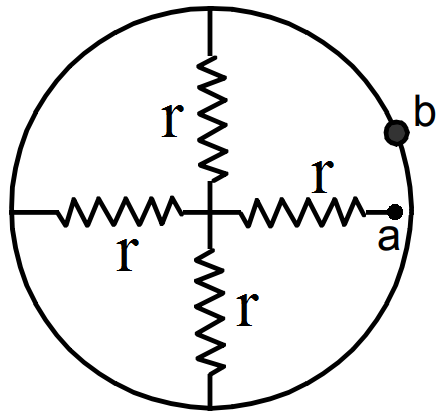
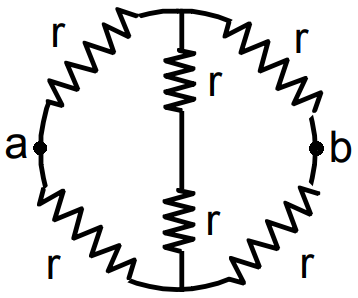
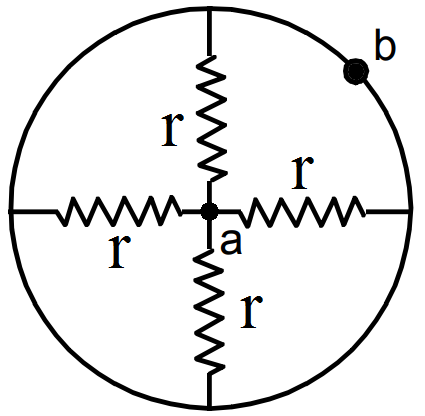
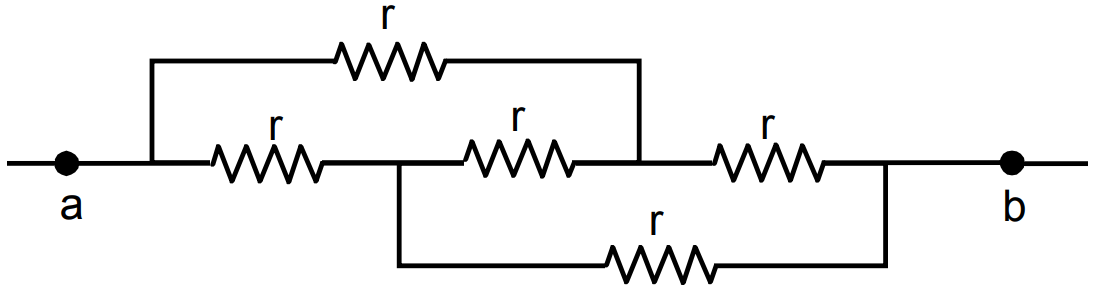
Find the equivalent resistances of the networks shown in the figure. between the points a and b.
  1.  
  1.  
  1.  
  1.  
  1.  
Whenever a photon is emitted by hydrogen in Balmer series, it is followed by another photon in Lyman series. What wavelength does this latter photon correspond to?
What is the radius of curvature of the parabola traced out by the projectile in the previous problem at a point where the particle velocity makes an angle $\frac{\theta}{2}$ with the horizontal?
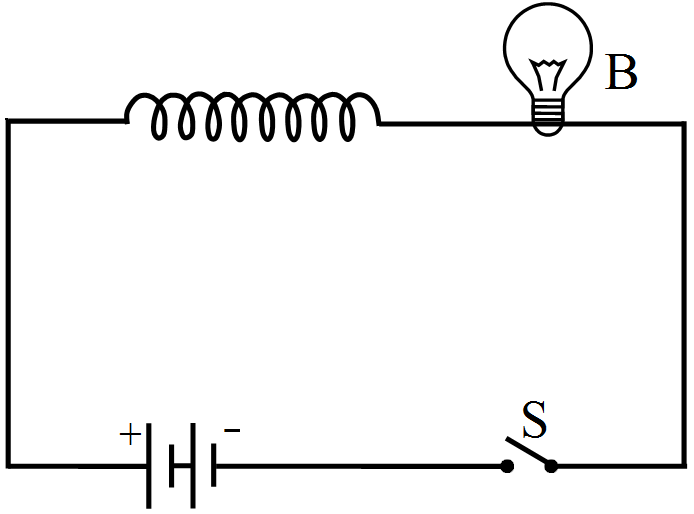
Figure shows a light bulb (B) and iron cored inductor connected to a dc battery through a switch (S).
  1. What will one observe when switch (S) is closed?
  2. How will the glow of the bulb change when the battery is replaced by an ac source of rms voltage equal to the voltage of dc battery? Justify your answer in each case.