Question
Define electric potential difference and prove that the electric potential at any point inside the electric field is equal to the ratio of the work W done in bringing a test charge from infinity to that point and the value of the test charge $q_0$.
Answer

SELF

Need a full question paper?

Generate a complete, print-ready paper with questions like this in minutes — across 16+ boards, with answer keys.

Start Generating Free

Similar questions

The radius of a gold nucleus $(Z = 79) $ is about $7.0 \times 10^{-15}m$. Assume that the positive charge is distributed uniformly throughout the nuclear volume. Find the strength of the electric field at:
  1. The surface of the nucleus.
  2. At the middle point of a radius. Remembering that gold is a conductor, is it justified to assume that the positive charge is uniformly distributed over the entire volume of the nucleus and does not come to the outer surface?
Two ideal gases have the same value of $\frac{\text{C}_\text{P}}{\text{C}_\text{V}}=\gamma.$ What will be the value of this ratio for a mixture of the two gases in the ratio $1 : 2?$
Find the maximum magnitude of the linear momentum of a photoelectron emitted when light of wavelength 400 run falls on a metal having work function 2.5eV.
An inductor of inductance 5.0H, having a negligible resistance, is connected in series with a $100\Omega$ resistor and a battery of emf 2.0V. Find the potential difference across the resistor 20ms after the circuit is switched on.
In a CE transistor amplifier there is a current and voltage gain associated with the circuit. In other words there is a power gain. Considering power a measure of energy, does the circuit voilate conservation of energy?
  1. With the help of the circuit diagram explain the working principle of a transistor amplifier as an oscillator.
  2. Distinguish between a conductor, a semiconductor and an insulator on the basis of energy band diagrams.
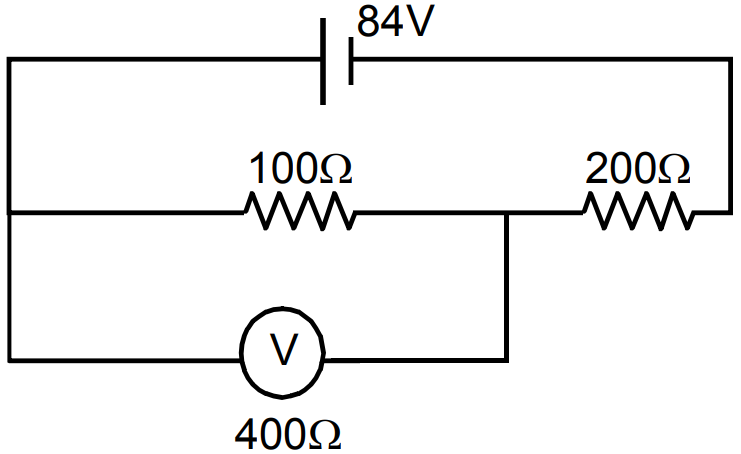
A voltmeter of resistance $400\Omega$ is used to measure the potential difference across the $100\Omega$ resistor in the circuit shown in the figure. (a) What will be the reading of the voltmeter? (b) What was the potential difference across $100\Omega$ before the voltmeter was connected?
Find the $rms$ speed of hydrogen molecules in a sample of hydrogen gas at $300K.$ Find the temperature at which the $rms$ speed is double the speed calculated in the previous part.
  1. Draw a ray diagram to show image formation when the concave mirror produces a real, inverted and magnified image of the object.
  2. Obtain the mirror formula and write the expression for the linear magnification.
  3. Explain two advantages of a reflecting telescope over a refracting telescope.
  1. Draw a labelled ray diagram to obtain the real image formed by an astronomical telescope in normal adjustment position. Defineits magnifying power.
  2. You are given three lenses of power 0.5 D, 4 D and 10 D to design a telescope.
  1. Which lenses should he used as objective and eyepiece? Justify your answer.
  2. Why is the aperture of the objective preferred to be large?