Question 15 Marks
What is capacitance of a conductor? What is its unit? Find the formula for capacitance of an isolated spherical conductor. Draw a graph between capacitance and radius. If a spherical conductor is placed in dielectric constant $\epsilon_r$, then what will be the effect on the value of capacitance?###If the area of each conducting plate of a parallel plate capacitor is A and the separation between them is $d$, then express the formula for its capacitance.
Answer
View full question & answer→In the figure two plates $P _1$ and $P _2$, are of the same size. Both the plates are fixed to two insulated stands parallel to each other. The medium between the plates is air or vacuum. In the figure, the $P _2$ plate is earthed.
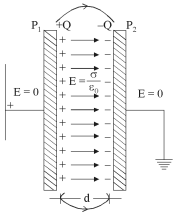
Let the area of each plate be A and the distance between them be $d$. By giving $+Q$ charge to plate $P_1$, due to induction $-Q$ charge is produced on the inner surface of plate $P_2$, and $+Q$ charge is produced on the outer surface. Since the outer surface of plate $P_2$ is connected to the earth, its positive charge goes into the earth.
Suppose the surface density of charge on each plate is $\sigma$, therefore the electric field at any point between the plates is
$ E=\frac{\sigma}{\varepsilon_0} $
Here $\epsilon_0$ is the electrical conductivity of vacuum. Area of each plate A and charge is Q.
Therefore, $ \sigma=\frac{Q}{A} $
On putting the value of $\sigma$ from equation (2) into equation (1)
$ E=\frac{Q}{\varepsilon_0 A} $
If the potential difference between the plates due to this electric field is V then :
$V = E \times d$
$V =\frac{ Q d}{\varepsilon_0 A}$
If the capacitance C of a parallel plate capacitor is : $ C=\frac{Q}{V} $
On putting the value of V from equation (4)
$C =\frac{ Q }{\frac{ Q d}{\epsilon_0 A}}=\frac{\varepsilon_0 A}{d}$
$C =\frac{ Q }{\frac{ Q d}{\epsilon_0 A}}=\frac{\varepsilon_0 A}{d}$
$C =\frac{\varepsilon_0 A}{d}$
Let the area of each plate be A and the distance between them be $d$. By giving $+Q$ charge to plate $P_1$, due to induction $-Q$ charge is produced on the inner surface of plate $P_2$, and $+Q$ charge is produced on the outer surface. Since the outer surface of plate $P_2$ is connected to the earth, its positive charge goes into the earth.
Suppose the surface density of charge on each plate is $\sigma$, therefore the electric field at any point between the plates is
$ E=\frac{\sigma}{\varepsilon_0} $
Here $\epsilon_0$ is the electrical conductivity of vacuum. Area of each plate A and charge is Q.
Therefore, $ \sigma=\frac{Q}{A} $
On putting the value of $\sigma$ from equation (2) into equation (1)
$ E=\frac{Q}{\varepsilon_0 A} $
If the potential difference between the plates due to this electric field is V then :
$V = E \times d$
$V =\frac{ Q d}{\varepsilon_0 A}$
If the capacitance C of a parallel plate capacitor is : $ C=\frac{Q}{V} $
On putting the value of V from equation (4)
$C =\frac{ Q }{\frac{ Q d}{\epsilon_0 A}}=\frac{\varepsilon_0 A}{d}$
$C =\frac{ Q }{\frac{ Q d}{\epsilon_0 A}}=\frac{\varepsilon_0 A}{d}$
$C =\frac{\varepsilon_0 A}{d}$