Question
In a CE transistor amplifier there is a current and voltage gain associated with the circuit. In other words there is a power gain. Considering power a measure of energy, does the circuit voilate conservation of energy?

Answer

Key concept: Different gain in CE transistor amplifier:
  1. Ac current gain: $\beta_\text{ac}=\Big(\frac{\Delta\text{i}_\text{c}}{\Delta\text{i}_\text{b}}\Big)\text{V}_\text{CE}=\text{constant}$
  2. dc current gain: $\beta_\text{dc}=\frac{\text{i}_\text{c}}{\text{i}_\text{b}}$
  3. Voltage gain: $\text{A}_\text{v}=\frac{\Delta\text{V}_0}{\Delta\text{V}_\text{i}}=\beta_\text{ac}\times\text{Resistance gain}$
  4. Power gain: $=\frac{\Delta\text{P}_0}{\Delta\text{P}_\text{i}}=\beta_\text{ac}^2\times\text{Resistance gain}$
The power gain is very high in CE transistor amplifier. In this circuit, the extra power required for amplified output is obtained from DC source. Thus, the circuit used does not violate the law of conservation.

Need a full question paper?

Generate a complete, print-ready paper with questions like this in minutes — across 16+ boards, with answer keys.
Start Generating Free

Similar questions

  1. Using Biot-Savart’s law, derive the expression for the magnetic field in the vector form at a point on the axis of a circular current loop.
  2. What does a toroid consist of ? Find out the expression for the magnetic field inside a toroid for N turns of the coil having the average radius r and carrying a current I. Show that the magnetic field in the open space inside and exterior to the toroid is zero.
Write the properties of charge. What is meant by charge conservation? Explain with example. What do you understand by charge quantization?
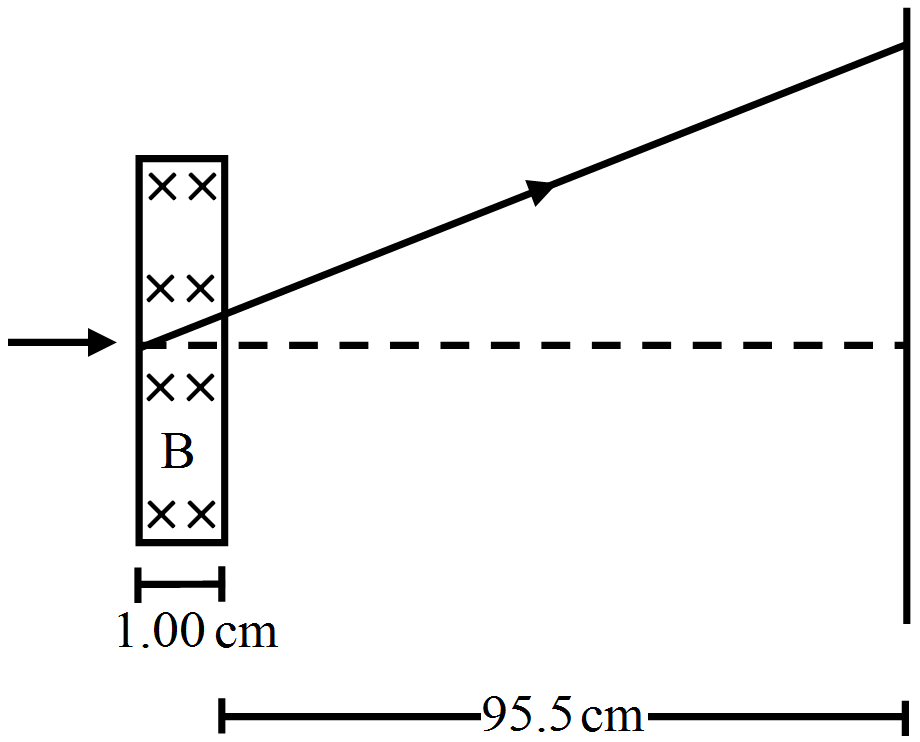
A narrow beam of singly charged potassium ions of kinetic energy $32keV$ is injected into a region of width $1.00\ cm$ with a magnetic field of strength $0.500T,$ as shown in the figure. The ions are collected at a screen $95.5\ cm$ away from the field region. If the beam contains isotopes of atomic weights $39$ and $41,$ find the separation between the points where these isotopes strike the screen. Take the mass of a potassium ion $= A (1.6 \times 10^{-27})kg,$ where $A$ is the mass number.
Two point charges $q_A=3 \mu C$and $q _{ B }=$$-3 \mu C$ are located 20 cm apart in vacuum.
(a) What is the electric field at the midpoint O of the line AB joining the two charges?
(b) If a negative test charge of magnitude $1.5 \times$$10^{-9} C$ is placed at this point, what is the force experi-enced by the test charge?
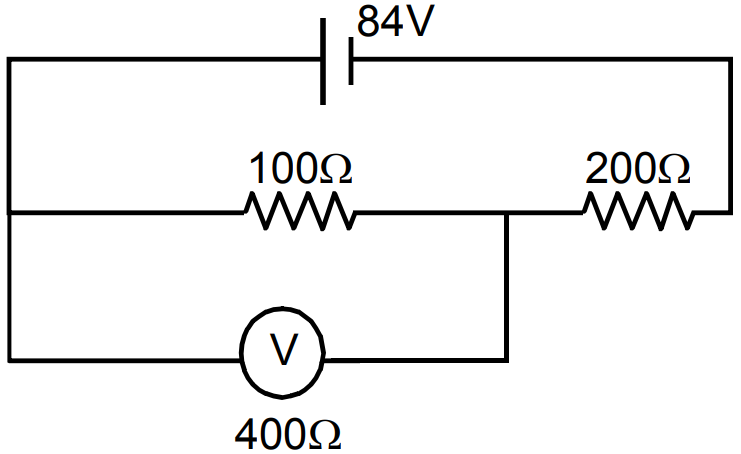
A voltmeter of resistance $400\Omega$ is used to measure the potential difference across the $100\Omega$ resistor in the circuit shown in the figure. (a) What will be the reading of the voltmeter? (b) What was the potential difference across $100\Omega$ before the voltmeter was connected?
Consider a $20W$ bulb emitting light of wavelength $5000\mathring{\text{A}}$ and shining on a metal surface kept at a distance $2\ m$. Assume that the metal surface has work function of $2eV$ and that each atom on the metal surface can be treated as a circular disk of radius $1.5\mathring{\text{A}}$.
  1. Estimate no. of photons emitted by the bulb per second. $[$Assume no other losses$]$
  2. Will there be photoelectric emission?
  3. How much time would be required by the atomc disk to receive energy equal to work function $(2eV)$?
  4. How many photons would atomic disk receive within time duration calculated in $(iii)$  above?
  5. Can you explain how photoelectric effect was observed instantaneously?
Hint: Time calculated in part $(iii)$ is from classical consideration and you may further take the target of surface area say $1\ cm^2$ and estimate what would happen?
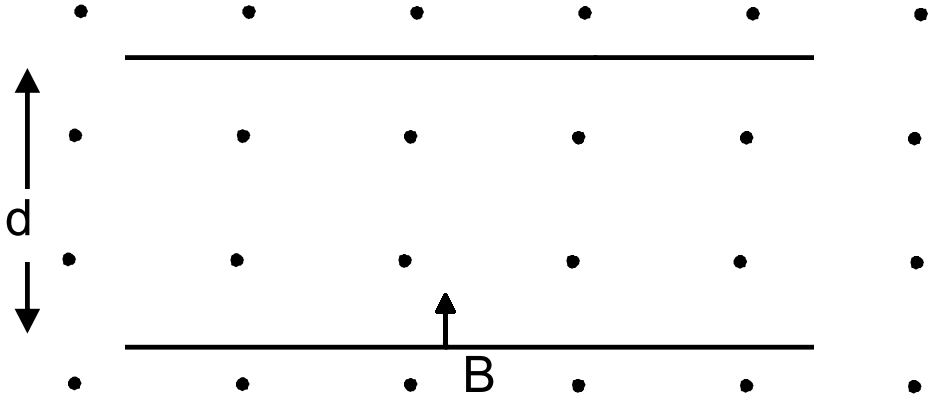
An electron is emitted with negligible speed from the negative plate of a parallel$-$plate capacitor charged to a potential difference $V.$ The separation between the plates is $d$ and $a$ magnetic field Bexists in the space, as shown in the figure. Show that the electron will fail to strike the upper plates if $\text{d}>\Big(\frac{2\text{m}_\text{e}\text{v}}{\text{eB}^2}\Big)^{\frac{1}{2}}.$
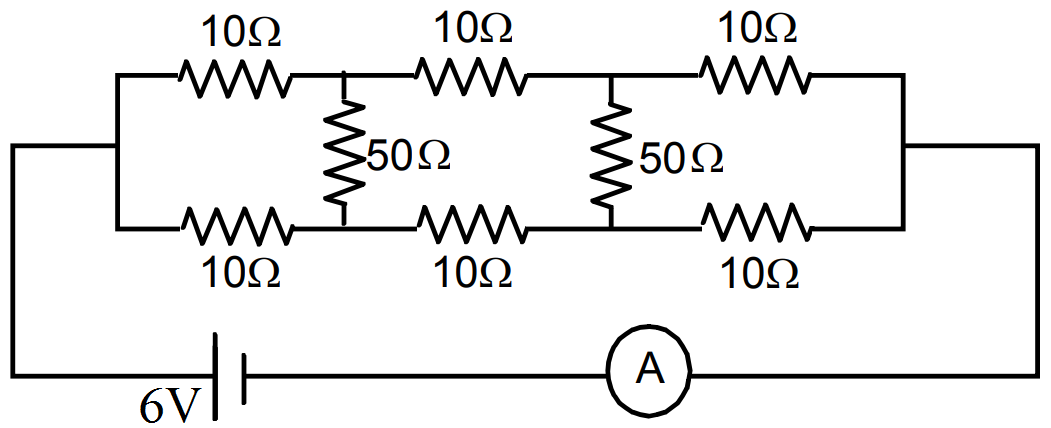
Find the current measured by the ammeter in the circuit shown in the figure.
A capacitor of capacitance C is connected to a battery of emf $\epsilon$ at t = 0 through a resistance R. Find the maximum rate at which energy is stored in the capacitor. When does the rate have this maximum value?
A wire of length $10\ cm$ translates in a direction making an angle of $60^\circ$ with its length. The plane of motion is perpendicular to a uniform magnetic field of $1.0T$ that exists in the space. Find the emf induced between the ends of the rod if the speed of translation is $20\ cm/s^{-1}.$