Question
Define environmental chemistry.

Answer

The environment around us is made up of chemical species which undergo chemical reactions constantly e.g., photosynthesis in plants, formation of ozone in stratosphere, etc. Environmental chemistry deals with the study of such reactions which take place in the origin, transport and life-cycle of chemical species in the environment.
Need a full question paper?

Generate a complete, print-ready paper with questions like this in minutes — across 16+ boards, with answer keys.

Start Generating Free

Similar questions

Explain why HCl is a gas and HF is a liquid.
1. Two ideal gases under the same pressure and temperature are allowed to mix in an isolated system.
What will be the sign of entropy change?
2. Water can be lifted into the water tank at the top of the house with the help of a pump. Then why is it not considered to be spontaneous?
3. What is the enthalpy change for an adiabatic process?
What happens:
  1. When $\mathrm{F}_2$ reacts with hot water
  2. Barium peroxide reacts with phosphoric acid
  3. Hydrogen peroxide reacts with ozone.
Write the chemical reacts involved.
  1. An orbital has n = 2, what are possible values of I and $m_l$?
  2. List the quantum numbers $m_l$ and I of electrons for 3d-orbital?
  3. Which of the following orbitals are possible?
2d, 1s, 2p, 3f
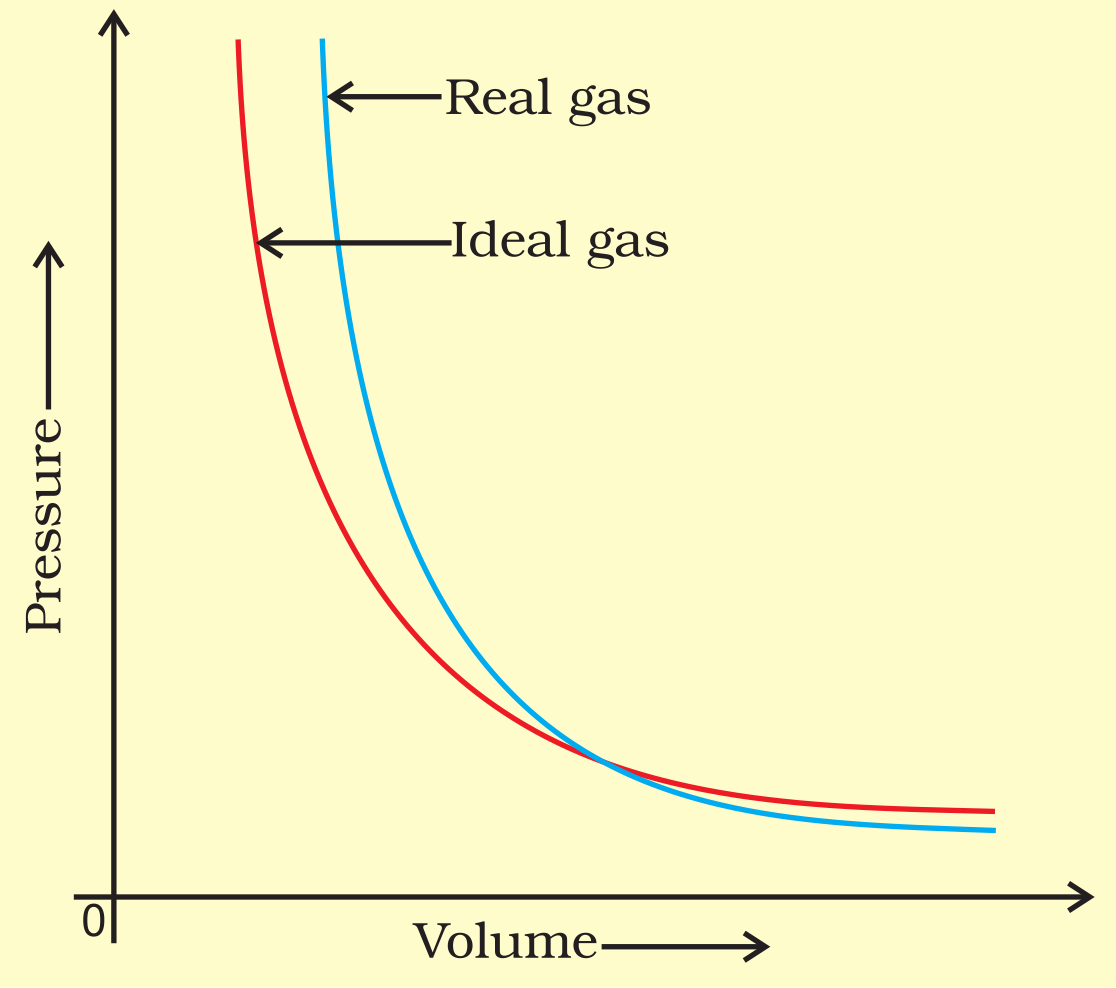
Pressure versus volume graph for a real gas and an ideal gas are shown in Fig. Answer the following questions on the basis of this graph.
  1. Interpret the behaviour of real gas with respect to ideal gas at low pressure.
  2. Interpret the behaviour of real gas with respect to ideal gas at high pressure.
  3. Mark the pressure and volume by drawing a line at the point where real gas behaves as an ideal gas.
Oxidation of sulphur dioxide into sulphur trioxide in the absence of a catalyst is a slow process but this oxidation occurs easily in the atmosphere. Explain how does this happen. Give chemical reactions for the conversion of $\mathrm{SO}_2$ into $\mathrm{SO}_3$.

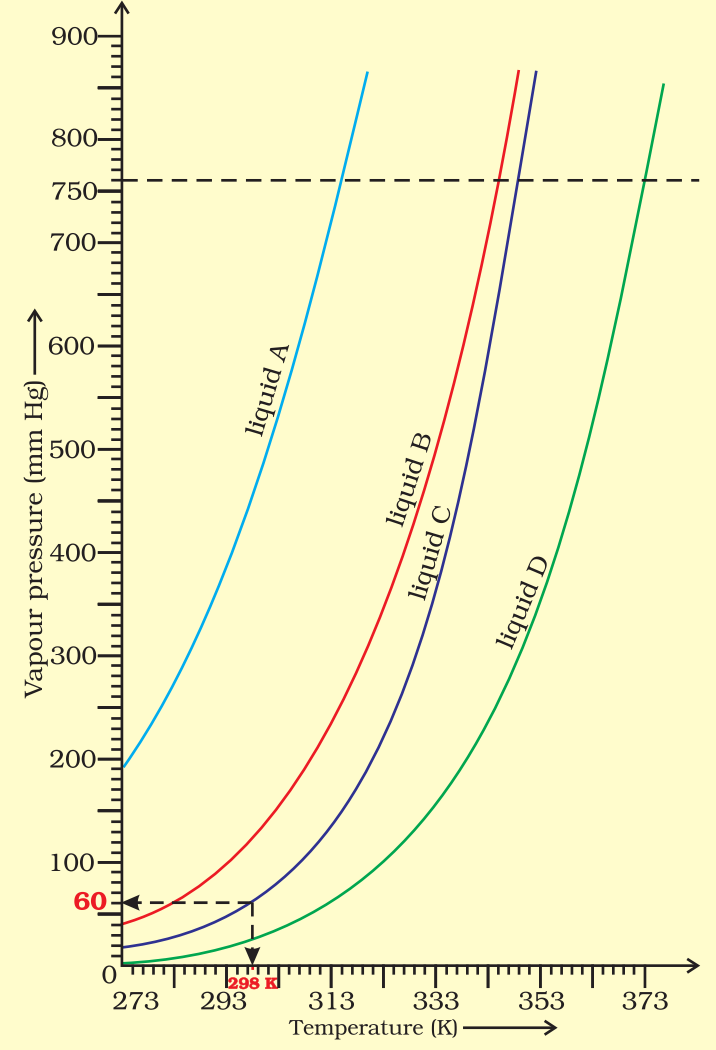
The variation of vapour pressure of different liquids with temperature is shown in Fig.
  1. Calculate graphically boiling points of liquids A and B.
  2. If we take liquid C in a closed vessel and heat it continuously. At what temperature will it boil?
  3. At high altitude, atmospheric pressure is low (say 60 mm Hg). At what temperature liquid D boils?
  4. Pressure cooker is used for cooking food at hill station. Explain in terms of vapour pressure why is it so?
If $\mathrm{K}_{\mathrm{w}}=49 \times 10^{-14}$, what will be neutral pH of $\mathrm{H}_2 \mathrm{O}$ ?
  1. How will you convert benzene into:
  1. Acetophenone?
  2. m-nitrochlorobenzene?
  1. Write the structures of products obtained by ozonolysis of pent-2-ene.
The electron energy in hydrogen atom is given by $\text{E}_{\text{n}}=\frac{ (–2.18 \times 10–18 )}{\text{n}^2}\text{J}.$ Calculate the energy required to remove an electron completely from the n = 2 orbit. What is the longest wavelength of light in cm that can be used to cause this transition?