Question
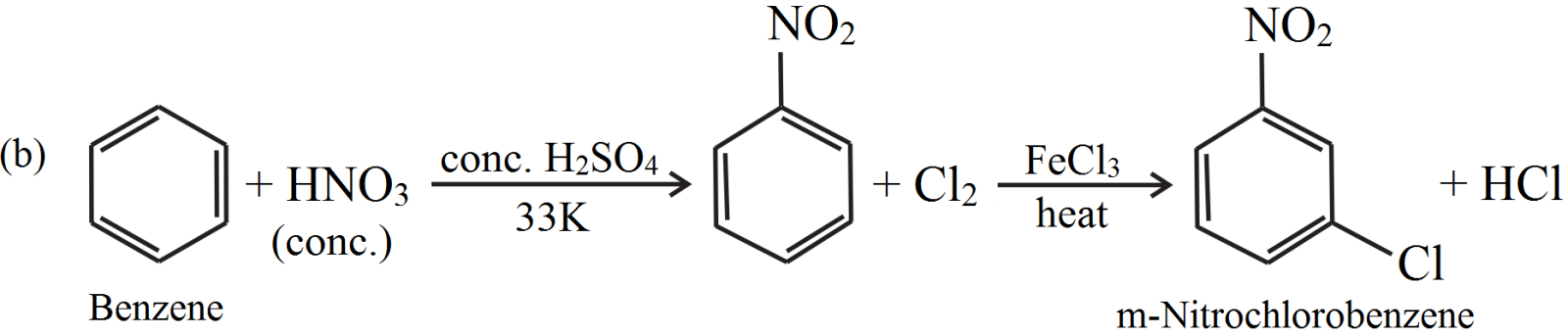
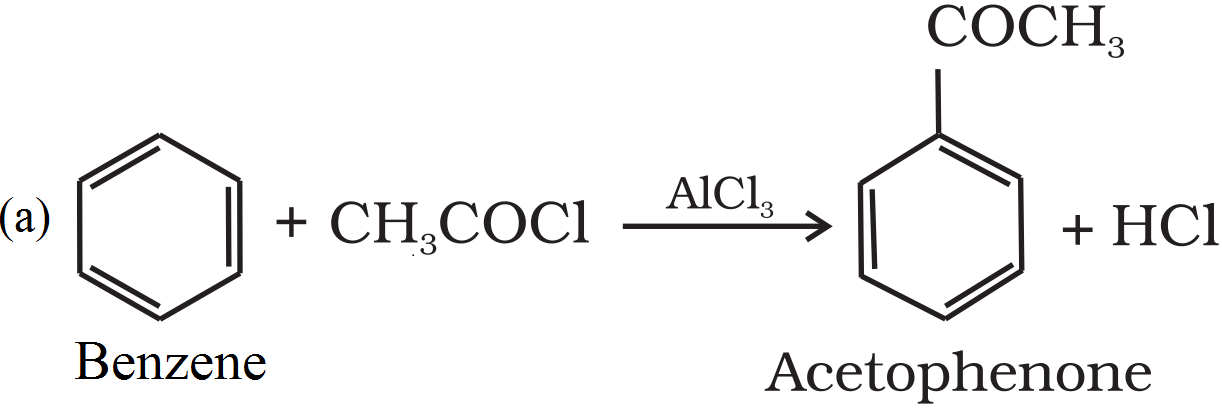
  1. How will you convert benzene into:
  1. Acetophenone?
  2. m-nitrochlorobenzene?
  1. Write the structures of products obtained by ozonolysis of pent-2-ene.
Answer


  1. $\text{CH}_3-\text{CH}=\text{CH}-\text{CH}_2-\text{CH}_3\xrightarrow[(\text{i})\ \text{Zn/H}_2\text{O}]{(\text{i})\ \text{O}_3}\\ \ \ \ \ \ \ \ \ \ \ \ \ \ \text{O}\\ \ \ \ \ \ \ \ \ \ \ \ \ \ ||\\\text{CH}_3-\text{C}-\text{H}+\text{CH}_3\text{CH}_2\text{CHO}\\\ \ \ \ \ \ \ \ \ _{\text{Ethanal}}\ \ \ \ \ \ \ \ \ \ \ \ \ \ _{\text{Propanal}}$

Need a full question paper?

Generate a complete, print-ready paper with questions like this in minutes — across 16+ boards, with answer keys.

Start Generating Free

Similar questions

Find out the number of wave made by a Bohr electron in one complete revolution in its 3rd orbit.
Which of the following species, do not show a disproportionation reaction and why?
$ClO ^{-}, ClO _2^{-}, ClO _3^{-}$and $ClO _4^{-}$
Also, write the reaction for each of the species that disproportionate.
  1. Classify the following processes as reversible or irreversible:
  1. Dissolution of sodium chloride.
  2. Evaporation of water at 373K and 1atm pressure.
  3. Mixing of two gases by diffusion.
  4. Melting of ice without rise in temperature.
  1. When an ideal gas expands in vacuum, there is neither absorption nor evolution of heat. Why?
How will you calculate work done on an ideal gas in a compression, when the change in pressure is carried out in infinite steps?
What would be the SI unit for the quantity $\text{pV}^2\text{T}^2/\text{n}$?
The arrangement of orbitals on the basis of energy is based upon their (n + l) value. Lower the value of (n + l), lower is the energy. For orbitals having same values of (n + l), the orbital with lower value of n will have lower energy.
  1. Based upon the above information, arrange the following orbitals in the increasing order of energy.
  1. 1s, 2s, 3s, 2p
  2. 4s, 3s, 3p, 4d
  3. 5p, 4d, 5d, 4f, 6s
  4. 5f, 6d, 7s, 7p
  1. Based upon the above information, solve the questions given below:
  1. Which of the following orbitals has the lowest energy?
4d, 4f, 5s, 5p
  1. Which of the following orbitals has the highest energy?
5p, 5d, 5f, 6s, 6p
Similar to electron diffraction, neutron diffraction microscope is also used for the determination of the structure of molecules. If the wavelength used here is 800pm, calculate the characteristic velocity associated with the neutron.
A man takes a diet equivalent to 10000kJ per day and does work, in expending his energy in all forms equivalent to 12500kJ per day. What is change in internal energy per day? If the energy lost was stored as sucrose (1632kJ per 100g), how many days should it take to lose 2kg of his weight? (Ignore water loss)
How does $Cu_2O$ act as both oxidant and reductant? Explain with proper reactions showing the change of oxidation numbers in each example.
  1. In the following redox reactions, identify the oxidation and reducing agents:
  1. $\text{H}_3\text{PO}\text{(aq)}+2\text{HgCl}_2+2\text{H}_2\text{O}\text{(aq)}\\ \xrightarrow{ \ \ \ \ }\text{H}_3\text{PO}_4\text{(aq)}+2\text{Hg(l)}+4\text{HCl(aq)}$
  2. $\text{O}_2\text{(g)}+\text{PtF}_6\text{g}\xrightarrow{ \ \ \ \ }\text{O}_2^+[\text{PtF}_6]^\ominus\text{(s)}$
  1. Why does $H_2S$ acts as reducing agent only whereas $SO_2$​​​​​​​ acts as bot oxidant as wells as rductant?