Question
Define enzymes. How do enzymes differ from ordinary chemical catalysts?

Answer

Ans. Enzymes are naturally occurring simple or conjugate proteins acting as specific catalysts in cell processes. The enzyme facilitates a biochemical reaction by providing alternative lower activation energy pathways thereby increasing the rate of reaction.Enzymes are different from ordinary chemical catalysts in following ways:
  1. They are highly specific in their action, i.e., each enzyme can catalyse only a specific type of reaction.
  2. Enzymes can speed up reactions to the extent of about ten million times.
  3. Enzymes function at a moderate temperature (about 310K) and moderate pH (6-8).
  4. Even a small quantity of an enzyme can catalyse the reaction of a large quantity of the substrate. This is because in chemical reactions the catalyst (enzyme) is regenerated after the reaction.

Need a full question paper?

Generate a complete, print-ready paper with questions like this in minutes — across 16+ boards, with answer keys.
Start Generating Free

Similar questions

Discuss in detail DNA and RNA.
Attempt any five of the following:
(a) Aldopentoses named ribose and 2-deoxyribose are found in nucleic acids. What is their relative configuration?
(b) What are the three components of nucleic acids?
(c) Name the sugar present in milk. How many monosaccharide units are present in it? What are such oligosaccharides called?
(d) Is nucleotide and nucleoside the same? What are their roles?
(e) Why cannot vitamin C be stored in our body?
(f) During curdling of milk, what happens to sugar present in it?
(g) Account for the following:
a. There are 5-OH groups in glucose.
b. Glucose is a reducing sugar

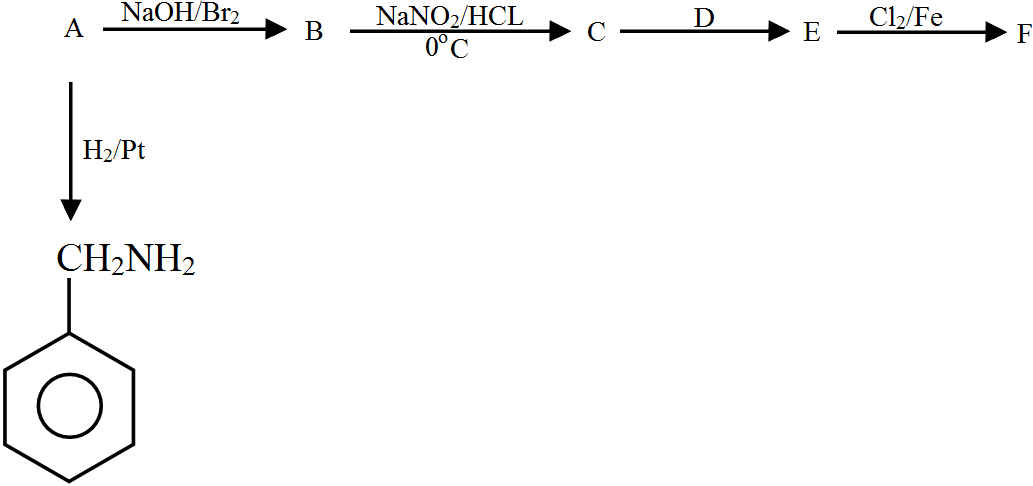
Write the structures of reagents/ organic compounds (A to F) in the following sequence of reactions:
Match the laws given in Column I with expresions given in Column II.
  Column I   Column II
i. Raoult’s law a. $\Delta\text{T}_\text{f}=\text{K}_\text{f}\text{m}$
ii. Henry’s law b. $\pi=\text{CRT}$
iii. Elevation of boiling point c. $\text{p}=\text{x}_1\text{p}^0_1+\text{x}_2\text{p}^0_2$
iv. Depression in freezing point d. $\Delta\text{T}_\text{b}=\text{K}_\text{b}\text{m}$
v. Osmotic pressure e. $\text{p}=\text{K}_\text{H}\cdot\text{x}$
Explain oxidation and reduction reactions of carbonyl compounds.
Explain the various methods of determining the order of a reaction.
  1. Account for the following:
  1. $BiH_3$ is the strongest reducing agent in Group $15$ elements hydrides.
  2. $Cl_2​​​​​​​$​​​​​​​ acts as a bleaching agent.
  3. Noble gases have very low boiling points.
  1. Draw the structures of the following:
  1. $H_4P_2O_7$
  2. $XeOF_4$​​​​​​​
$[NIC14]^{2-}$ is paramagnetic while $[Ni(CO)_4]$ is diamagnetic though both are tetrahedral. Why?
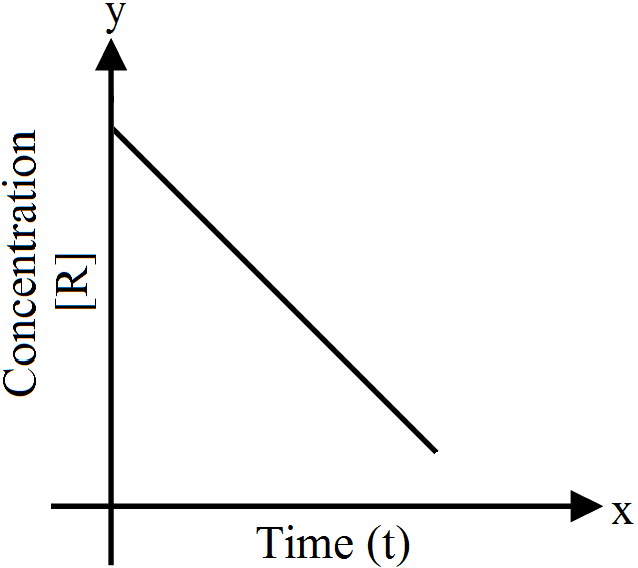
Consider the reaction $\text{R}\xrightarrow{\ \ \text{k}\ \ } \text{P}.$ The change in concentration of $R$ with time is shown in the following plot:
  1. Predict the order of the reaction.
  2. Derive the expression for the time required for the completion of the reaction.
  3. What does the slope of the above line indicate?
  1. Account for the following:
    1. Acidic character increases from HF to HI.
    2. There is large difference between the melting and boiling points of oxygen and sulphur.
    3. Nitrogen does not form pentahalide.
  1. Draw the structures of the following:
  1. $ClF_3$
  2. $XeF_4$