Question
Discuss in detail DNA and RNA.

Answer

self

Need a full question paper?

Generate a complete, print-ready paper with questions like this in minutes — across 16+ boards, with answer keys.
Start Generating Free

Similar questions

Using Valence bond theory, explain the following in relation to the paramagnetic complex $[Mn(CN)_6]^{3-}$
$a.$ type of hybridisation
$b.$ magnetic moment value
$c.$ type of complex $-$ inner, outer orbital complex
What are the similarities between lanthanoids and actinoids?
Explain the various uses of lanthanoids.

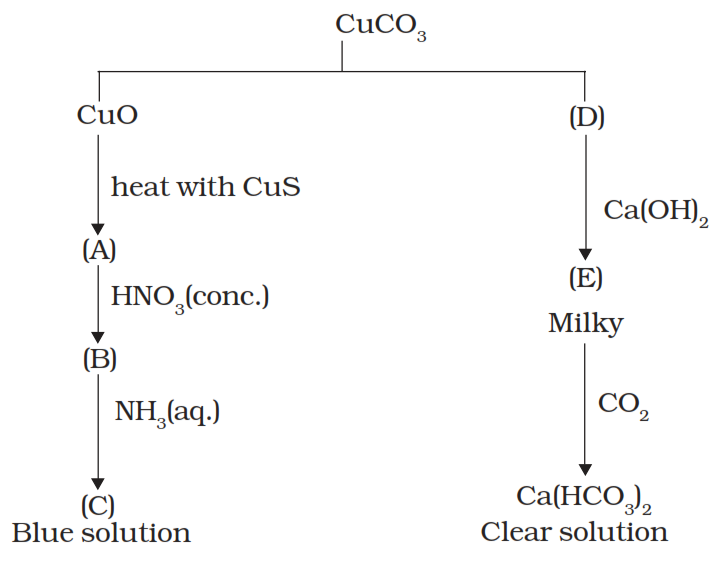
Identify $A$ to $E$ and also explain the reactions involved.
Match the property given in Column I with the element given in Column II.
 
Column I (Property)
 
Column II (Element)
(i)
Lanthanoid which shows $+4$ oxidation state
$(a)$
$Pm$
(ii)
Lanthanoid which can show $+2$ oxidation state
$(b)$
$Ce$
(iii)
Radioactive lanthanoid
$(c)$
$Lu$
(iv)
Lanthanoid which has $4f^7$ electronic configuration in +3 oxidation state
$(d)$
$Eu$
(v)
Lanthanoid which has $4f^{14}$ electronic configuration in +3 oxidation state
$(e)$
$Gd$
 
 
$(f)$
$Dy$
  1. Give reasons for the following:
i. $Mn ^{3+}$ is a good oxidizing agent.
ii. $E ^{\circ} m ^{2+} / M$ values are not regular for first row transition metals. (3d series)
iii. Although ' $F$ ' is more electronegative then ' O ', the highest Mn fluoride is $Mnf _4$, whereas the highest oxide is $Mn _2 O _7$.
  1. Complete the following equations:
$\text{2CrO}_{4}^{2}+\text{2H}^{+}\rightarrow$

$\text{KMnO}_{4}\xrightarrow{heat}$
Explain the oxidation of primary, secondary and tertiary alcohols.
Prove that the relative depression of vapour pressure is equal to the mole fraction of solute.
An aromatic compound ‘A’ on treatment with $CHCl_3 / KOH$ gives two compounds ‘B’ and ‘C’. Both B and C give the same product ‘D’ when distilled with zinc dust. Oxidation of D gives E having molecular formula $C_7H_6O_2$. The sodium salt of E on heating with sodalime gives F which may also be obtained by distilling A with zinc dust. Identify A to F.
  1. What are essential and non-essential amino acids? Give two examples of each.
  2. What are the two types of photosynthesis in green plants? Give the basic equations of photosynthesis.
  3. Mention the two products of glycolysis.