Question
Define lens and write its formula.

Answer

Any transparent medium surrounded by two surfaces, one of which or both surfaces are spherical is called lens. There are two types of lenses-(1) Convex lens (2) Concave lens.
The relationship between the distances of the object, the distance of the image and the focal length of the lens is called lens formula. i.e., $-\frac{1}{u}+\frac{1}{v}=\frac{1}{f}$.

Need a full question paper?

Generate a complete, print-ready paper with questions like this in minutes — across 16+ boards, with answer keys.
Start Generating Free

Similar questions

The instantaneous voltage from an ac source is given by $\text{E}=300\sin314\text{t};$ what is the rms voltage of the source.
Explain the crystal structure for an intrinsic semiconductor with proper diagram.
Answer the following questions:
A capacitor is used in the primary circuit of an induction coil.
A parallel plate capacitor with air between the plates has a capacitance of 8 pF. The separation between the plates is now reduced by half and the space between them is filled with a medium of dielectric constant 5. Calculate the value 
of capacitance of the capacitor in the second case.
A potential difference $V$ is applied across the ends of a conductor of length $L$ and diameter $D$. What will be the effect on drift velocity of charge carriers in the conductor when (i) V is made half (ii) L is doubled and (iii) D is made half?
A parallel beam of light of wavelength $500\ nm$ falls on a narrow slit and the resulting diffraction pattern is observed on a screen $1 m$ away. It is observed that the first minimum is at a distance of $2.5\ mm$ from the centre of the screen. Find the width of the slit.
Mention two important conclusions regarding the relation between electric field and electric potential.
Show that the electrostatic potential is constant throughout the volume of the conductor and has the same value (as inside) on its surface.
An electric dipole is held in a uniform electric field:
  1. Show that the net force acting on it is zero.
  2. The dipole is aligned parallel to the field. Find the work done in rotating it through the angle of $180^\circ.$
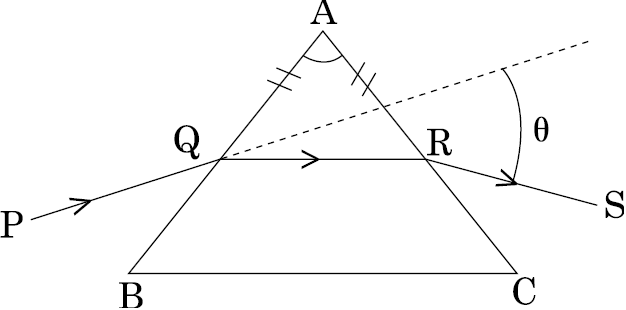
A ray $\text{PQ}$ incident on the refracting face $\text{BA}$ is refracted in the prism $\text{BAC}$ as shown in the figure and emerges from the other refracting face $\text{AC}$ as $\text{RS}$ such that $\text{AQ = AR}$. If the angle of prism $\text{A} = 60^\circ$ and refractive index of material of prism is$\sqrt{3}$, calculate angle $\theta.$