Define the phenomenon of total internal reflection.
Answer
Total Internal Reflection : When the value of the angle of incidence in a denser medium is increased slightly beyond the critical angle, then the entire incident light is reflected. According to the rules, it gets reflected and returns back to the denser medium. This phenomenon is called total internal reflection of light.
Write the definition of concave mirror and convex mirror.
Answer
Concave mirror : If the outer part is polished and light is reflected from the inner part, then it is called concave mirror. Convex mirror : If the inner part of a spherical mirror is polished and light is reflected from the outer part, then it is called a convex mirror.
When light travels from an optically denser medium to a rarer medium, why does the critical angle of incidence depend on the color of the light?
Answer
Refractive indices are different for different wavelengths of colour. $\mu=\frac{a+b}{\lambda^2}$, hence the value of critical angle $\sin i_c=\frac{i}{\mu}$ is also different for different colours.
Any transparent medium surrounded by two surfaces, one of which or both surfaces are spherical is called lens. There are two types of lenses-(1) Convex lens (2) Concave lens. The relationship between the distances of the object, the distance of the image and the focal length of the lens is called lens formula. i.e., $-\frac{1}{u}+\frac{1}{v}=\frac{1}{f}$.
The refractive index of the material of a convex lens is 1.5 and the radii of curvature of both its surfaces are equal. Prove that its focal length is equal to the radius of curvature.
Answer
$\frac{1}{f}=(n-1)\left(\frac{1}{R_1}-\frac{1}{R_2}\right)$ $\frac{1}{f}=(1.5-1)\left(\frac{1}{R_1}-\frac{1}{-R_2}\right)$ $\Rightarrow \quad \frac{1}{f}=0.5 \times\left(\frac{2}{ R }\right)=\frac{1}{ R }$ or $\quad$$\underline{f=R}$
The objective of a telescope is large and the eyepiece is small, whereas the objective of a microscope is small and the eyepiece is large. If a telescope is turned upside down, can it be used like a microscope? Can a microscope be used like a telescope in the same way?
Answer
Not. Because the difference in focal lengths of the lenses of a telescope is much greater than the difference in focal lengths of the lenses of a microscope. In this way, if the telescope is turned upside down and used like a microscope, its magnifying power will be very less. Similarly, if a microscope is turned upside down and used as a telescope, its magnifying power will reduce.
A converging lens and a diverging lens of the same focal length are placed coaxially in contact with each other. Find the focal length and power of the combination.
Answer
If the focal length of the combination is $F,$ then
$\frac{1}{F}=\frac{1}{f_1}+\frac{1}{f_2}=\frac{1}{f}+\frac{1}{-f}$
$\frac{1}{F}=\frac{1}{f}-\frac{1}{f}=0$
Thus
$F=\frac{1}{0}=\infty$
i.e. $ F =$ Infinite
Therefore, Power $= P =\frac{1}{F}$
$P=\frac{1}{\infty}=0$
Thus, focal length of combined lens is infinite and power of combined lens will be zero.
When the last image of the telescope is formed at infinity, then what is the length of its tube? If the image is formed at the minimum distance of clear vision then will the length be less or more than before?
Answer
When the image is formed at infinity then the length of the tube will be $\left(f_o+f_e\right)$. Here $f_o$ is the focal length of the objective lens and $f_e$ is the focal length of the eyepiece is but if the final image is formed at the minimum distance of clear vision then the length of the tube will be ( $f_o+u_e$ ), where $u_e$ is the distance of the image formed by the objective lens from the eyepiece. This length will be less than $\left(f_o+f_e\right)$.
How can a bundle of optical fibers be used? Explain.
Answer
Bundles of optical fibers can be used in many ways. Optical fibers are extensively used for transmission and receiving of electrical signals, which are converted into light by suitable transducers. It is clear that optical fibers can also be used for transmitting optical signals. For example, they are used as 'light pipes' for visual observation of internal organs, such as the oesophagus, stomach and intestines.
How will an air bubble behave like a lens in water?
Answer
Both the surfaces of the air bubble are convex. Hence this behaves like a convex lens. But the refractive index of water is greater than the refractive index of air. Therefore, due to the change in the nature of the air bubble present in the water tank, it will act like a concave lens.
If we cover the lower half of the reflecting surface of a concave mirror with some opaque (nonreflective) material, then what effect will this have on the image formed by the mirror of an object situated in front of the mirror?
Answer
You can think that half of the image will be visible in the reflection. But assuming that the laws of reflection also apply to the remaining part of the mirror, the mirror will form a complete image of the object. However, since the area of the reflecting surface has reduced, the intensity of the image will reduce, i.e. it will be halved.
Can the refractive index of any medium be less than 1 relative to another medium?
Answer
Yes. For example, refractive index of water relative to glass is $ g_g n_w=\frac{n_w}{n_g}=\frac{(4 / 3)}{(3 / 2)}=\frac{8}{9} $ which is less than one.
A light ray is refracted from medium
$(1)$ to medium
$(2).$ Their refractive indices are $n_1$ and $n_2$, respectively and $n_2 < n_1.$ Write an expression for the critical angle of incidence.
Answer
When angle of incidence $i=$ critical angle $c$ then angle of refraction $r=90^{\circ}$
But according to Snell's law,
$n_1 \sin i=n_2 \sin r$
Therefore,
$n_1 \sin c=n_2 \cdot \sin 90^{\circ}=n_2 \times 1=n_2$
or $ \sin c=\left(\frac{n_2}{n_1}\right) \Rightarrow c=\sin ^{-1}\left(\frac{n_2}{n_1}\right)$
(i) Incident ray, refracted ray and the normal separating both the mediums, lie in the same plane. (ii) For any two mediums and for light of a certain colour (wavelength), the result of the sine of the angle of incidence and the sine of the angle of refraction is a constant. If the angle of incidence is $i$ and the angle of refraction is $r$. Then $\sin \frac{\sin i}{\sin r}=$ constant $={ }_1 n_2$.
Magnification (m): The ratio of the size of the image $\left(h^{\prime}\right)$ and the size of the object $(h)$ is called the magnification of the spherical mirror, i.e. $m=\frac{\text { Size of image }\left(h^{\prime}\right)}{\text { Size of object }(h)}$ $\Rightarrow \quad m=\frac{h^{\prime}}{h}=-\frac{v}{u}$
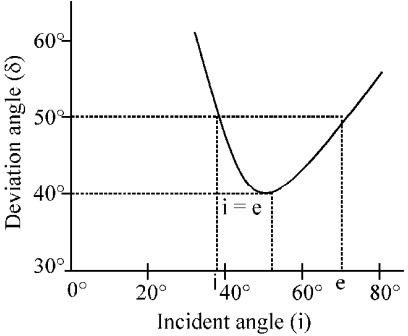
Write the formula to determine the refractive index of the material of the prism in the case of minimum deviation.
Answer
$n_2=\frac{\sin \left(\frac{ A + D _m}{2}\right)}{\sin \frac{ A }{2}}$ Where ${ }_1 n_2=$ Refractive index of the material of the prism relative to air $A =$ Prism angle $D _m=$ Minimum deviation angle
Write the formula of spherical mirror and explain it.
Answer
$\frac{1}{f}=\frac{1}{v}+\frac{1}{u}$, where $f, v$ and $u$ are the focal length, distance of the image and distance of the object respectively. $f$ is half of the radius of curvature $R$. For a concave mirror, $f$ is negative and for a convex mirror, $f$ is positive.
By looking at the construction of a compound microscope and a telescope, how will you distinguish which type of optical instrument is which?
Answer
The aperture of the objective of a compound microscope is very small and the aperture of the telescope lens is very large. Therefore, the two types of optical instruments can be differentiated by looking at the apertures of the objective.
Two thin lenses, whose power is $+ \ 5 D$ and $-3 D$. are kept in mutual contact. Find the focal length of the combination.
Answer
According to the question,
$P_1=+5 D$
$P_2=-3 D$
Therefore, $P = P _1+ P _2$
$=+5 D +(-3 D )=+2 D$
Focal length $f=\frac{1}{ P }\ ($ in meter $)$
$=\frac{1}{2}$ meter $=\frac{1}{2} \times 100=50 \ cm$
Double-convex lenses are to be manufactured from a glass of refractive index 1.55, with both faces of the same radius of curvature. What is the radius of curvature required if the focal length to be 20 cm?
Answer
Given that : $n=1.55, R _1= R$ and $R _2=- R$ (for biconvex plane), $f=+20 cm$ We know that $: \frac{1}{f}=(n-1)\left(\frac{1}{ R _1}-\frac{1}{ R _2}\right)$ $\Rightarrow \quad \frac{1}{20}=(1.55-1)\left(\frac{1}{R}+\frac{1}{R}\right)$ $\Rightarrow \quad \frac{1}{20}=0.55 \times \frac{2}{R}$ $R =0.55 \times 2 \times 20$ $=0.55 \times 40=22 \therefore R =22 cm$ ∴ Required radius of curvature R = 22 cm.
Answer the following questions: Why must both the objective and the eyepiece of a compound microscope have short focal lengths.
Answer
The angular magnification of an eyepiece is $\left[\left(\frac{25}{f_e}\right)+1\right]\left(f_e\right.$ in cm $)$ whose value of increases as $f_e$ decreases. Again magnification is obtained from $\frac{v_o}{\left|u_o\right|}=\frac{1}{\left(\left|u_o\right| / f_o\right)-1}$, which is greater if, $\left|u_o\right|$ is somewhat greater than $f_o$. The microscope is used to see very close objects. Therefore $\left|u_o\right|$ decreases and accordingly $f_o$ also.
Answer the following questions: Magnifying power of a simple microscope is inversely proportional to the focal length of the lens. What then stops us from using a convex lens of smaller and smaller focal length and achieving greater and greater magnifying power?
Answer
First, very short focal length lenses are not easy to wear. More importantly, if you decrease the focal length, the aberrations (spherical and chromatic) will increase. So in practice, you cannot get a magnifying power of 3 or more with a simple convex lens. However, the use of an aberration correcting lens system can increase this limit by a factor of 10 of nearby order so.
Answer the following questions: In viewing through a magnifying glass, one usually positions one's eyes very close to the lens. Does angular magnification change if the eye is moved back?
Answer
Yes, it is slightly less, because the angle subtended at the eye is slightly smaller than the angle subtended at the lens. If the reflection is very far away then this effect is negligible. (When the eye is kept away from the lens, the angle subtended on the eye by the first object and the angle subtended on the eye by its image are not equal.)
Answer the following questions: The angle subtended at the eye by an object is equal to the angle subtended at the eye by the virtual imae produced by a magnifying glass. In what sense then does a magnifying glass provide angular magnification?
Answer
Even if the absolute size of the image is larger than the size of the object, still the angular size of the image is same as the angular size of the object. A magnifying lens helps us in this way: If there is no magnifying lens then the object cannot be placed at a distance of less than 25 cm; by having a magnifying lens, we can keep the object relatively very close. If the object is close, its angular size is much greater than if it is placed 25 cm away. This is what, it means it get or provide our angular magnification.
What is the focal length of a convex lens of focal length 30 cm in contact with a concave lens of focal length 20 cm? Is the system a converging or a diverging lens? Ignore thickness of the lenses.
Answer
Given that: Focal length of convex lens $=f_1=+30 cm$ Focal length of concave lens $=f_2=-20 cm$ Let, the focal length of combination of both lenses $=f=$ ? We know that $: \frac{1}{f}=\frac{1}{f_1}+\frac{1}{f_2}$ $=\frac{1}{30}+\frac{1}{-20}=\frac{1}{30}-\frac{1}{20}=\frac{2-3}{60}$ $\frac{1}{f}=-\frac{1}{60}$ or $f=-60 cm$. Since the focal length of combination of both lenses is negative. Therefore, combination will work as converging lens i.e. as concave lens.