Question
Define magnetic susceptibility of a material. Name two elements, one having positive susceptibility and the other having negative susceptibility. What does negative susceptibility signify

Answer

Magnetic susceptibility of a material is defined as the ratio of the intensity of magnetisation (i) induced in the material to the magnetisation force (H) applied on it. Magnetic susceptibility is represented as: Substances such as copper, lead, etc. have negative susceptibility. These substances are called diamagnetic substances. Substances such as aluminium, calcium, etc. have positive susceptibility. These substances are called paramagnetic substances. Substances with negative susceptibility signify that they are repelled by magnets.

Need a full question paper?

Generate a complete, print-ready paper with questions like this in minutes — across 16+ boards, with answer keys.
Start Generating Free

Similar questions

Explain use of juction diode as full wave rectifier.
The number of electrons in an insulator is of the same order as the number of electrons in a conductor. What is then the basic difference between a conductor and an insulator?
Two parallel wires carry equal currents of 10A along the same direction and are separated by a distance of 2.0cm. Find the magnetic field at a point which is 2.0cm away from each of these wires
A bar magnet of magnetic moment 6J/T is aligned at 60° with a uniform external magnetic field of 0·44T. Calculate (a) the work done in turning the magnet to align its magnetic moment (i) normal to the magnetic field, (ii) opposite to the magnetic field, and (b) the torque on the magnet in the final orientation in case (ii).
Explain what would happen if in the capacitor given in Exercise 2.8, a 3 mm thick mica sheet (of dielectric constant = 6) were inserted between the plates,
  1. While the voltage supply remained connected.
  2. After the supply was disconnected.
Obtain expression $\vec{J}=\sigma \vec{E}$ of Ohm's law on the basis of drift velocity.
A spherical shell made of plastic, contains a charge Q distributed uniformly over its surface. What is the electric field inside the shell? If the shell is hammered to deshape it without altering the charge, will the field inside be changed? What happens if the shell is made of a metal?
Calculate the energy released by 1g of natural uranium assuming 200MeV is released in each fission event and that the fissionable isotope 235U has an abundance of 0.7% by weight in natural uranium.
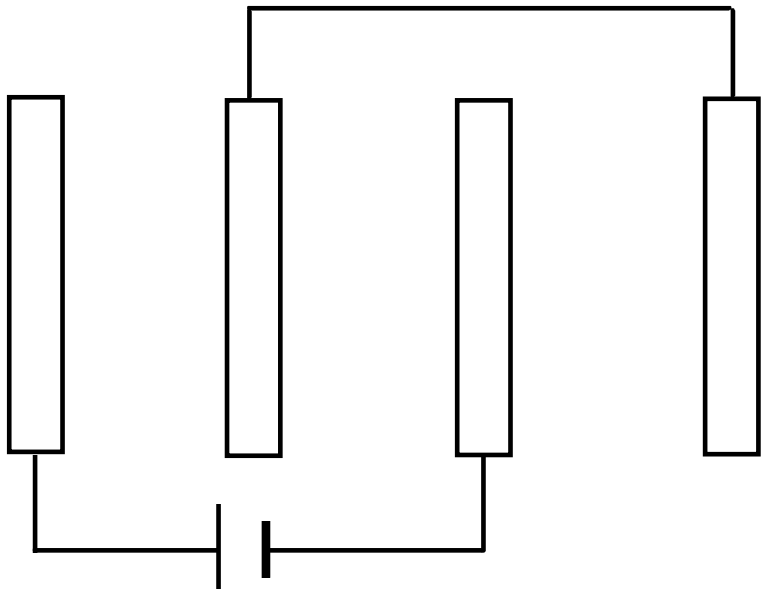
Each of the plates shown in figure has surface area $\Big(\frac{96}{\in_0}\Big)\times10^{-12}\text{Fm}$ on one side and the separation between the consecutive plates is 4.0mm. The emf of the battery connected is 10 volts. Find the magnitude of the charge supplied by the battery to each of the plates connected to it.

Summarise any three experimental features and observation described in the experimental study of photoelectric effect.