Question
Define motion. What do you understand by the terms ‘uniform motion’ and ‘non-uniform motion’? Explain with examples.

Answer

A body is said to be in motion when its position changes continuously with respect to a stationary point taken as the reference point.
  • Uniform motion: A body is said to be in uniform motion if it travels equal distances in equal intervals of time in a particular direction, no matter how small these time intervals are.
For example: A car running at a constant speed of 10m/s towards east will cover the equal distance of 10m every second towards east, so its motion will be uniform.
  • Non-uniform motion: A body is said to be in non-uniform motion if it travels unequal distances in equal intervals of time.
For example: Motion of a freely falling ball from the roof of a tall building.

Need a full question paper?

Generate a complete, print-ready paper with questions like this in minutes — across 16+ boards, with answer keys.

Start Generating Free

Similar questions

The following data was obtained for a body of mass $1\ kg$ dropped from a height of 5 metres:
 
Distance above ground
Velocity
i.
$5\ m$
$0\ m/s$
ii.
$3.2\ m$
$6\ m/s$
iii.
$0\ m$
$10\ m/s$
Show by calculations that the above data verifies the law of conservation of energy (Neglect air resistance). $(g = 10m/s^2)$.
The mass of one atom of an element $X$ is $2.0 \times 10^{-23}g.$
  1. Calculate the atomic mass of element $X.$
  2. What could element $X$ be?
Give two examples each of longitudinal waves and transverse waves.
List five characteristics by which compounds can be distinguished from mixtures.
A mixture contains water, kerosene and sand. How will you separate this mixture?
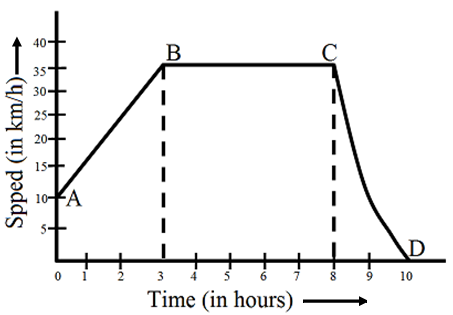
The graph given alongside shows how the speed of a car changes with time:
  1. What is the initial speed of the car?
  2. What is the maximum speed attained by the car?
  3. Which part of the graph shows zero acceleration
  4. Which part of the graph shows varying retardation?
  5. Find the distance travelled in first 8 hours.
How will you separate a mixture of common salt, sulphur powder and sand?
If the distance between two masses is increased by a factor of $5$, by what factor would the mass of one of them have to be altered to maintain the same gravitational force? Would this be an increase or decrease in the mass?
What is the difference between a compression and a rarefaction in a sound wave? Illustrate your answer with a sketch.
A boy of mass $50\ kg$ running at $5\ m/s$ jumps on to a $20\ kg$ trolley travelling in the same direction at $1.5\ m/s$. What is their common velocity?