Questions

Question Answer (5 Marks)

Take a timed test

15 questions · self-marked practice — reveal the answer and mark yourself.

Question 15 Marks
The graph given alogside shows the positions of a body at different times. Calculate the speed of the body as it moves from:
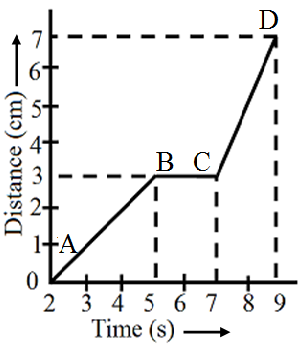
  1. A to B.
  2. B to C.
  3. C to D.
Answer
  1. The distance covered from A to B,
= 3 - 0

= 3cm

Time taken to cover the distance from A to B

= 5 - 2

= 3s

Hence speed,

$=\frac{\text{Distance}}{\text{Time}}$

$=\frac{3}{3}\text{cm/s}$

$=1\text{cm/s}$
  1. The speed of the body as it moves from B to C is zero because the distance travelled is zero.
  2. The distance covered from C to D,
= 7 - 3

= 4cm

Time taken to cover the distance from C to D,

= 9 - 7

= 2s

Hence speed,

$=\frac{\text{Distance}}{\text{Time}}$

$=\frac{4}{2}\text{cm/s}$

$=21\text{cm/s}$
View full question & answer
Question 25 Marks
A body starting from rest travels with uniform acceleration. If it travels 100m in 5s, what is the value of acceleration?
Answer
Initial velocity, u = 0m/s
Time, t = 5s
Distance, s = 100m
Acceleration, a = ?
$\text{s}=\text{ut}+\frac{1}{2}\text{at}^2$
$100=0\times5+\frac{1}{2}\times\text{a}\times5\times5$
$100=0+\frac{25\text{a}}{2}$
$\text{a}=\frac{200}{25}=8\text{m/s}^2$
View full question & answer
Question 35 Marks
A boy walks from his classroom to the bookshop along a straight corridor towards North. He covers a distance of 20m in 25 seconds to reach the bookshop. After buying a book, he travels the same distance in the same time to reach back in the classroom. Find (a) average speed, and (b) average velocity, of the boy.
Answer
  1. Total distance covered in going to the bookshop and coming back to the classroom = 20 + 20 = 40m
Total time taken = 25 + 25 = 50 sec

Average speed $=\frac{\text{Total distance}}{\text{Total time}}=\frac{40}{50}=0.8\text{m/s}$
  1. Average velocity $=\frac{\text{Total displacement}}{\text{Total time}}=\frac{0}{50}=0\text{m/s}$
View full question & answer
Question 45 Marks
A train travels the first 15km at a uniform speed of 30 km/h; the next 75km at a uniform speed of 50km/h; and the last 10km at a uniform speed of 20km/h.
Calculate the average speed for the entire train journey.
Answer
  1. In the first part, train travels at a speed of 30 km/h for distance of 15km.
$\text{Speed}=\frac{\text{Distance}}{\text{Time}}$
$\text{Time}=\frac{\text{Distance}}{\text{Speed}}$
$\text{t}_1=\frac{15}{30}=\frac{1}{2}\text{h}$
  1. In the second part, train travels at a speed of 50km/h for a distance of 75km.
$\text{t}_2=\frac{75}{50}=\frac{3}{2}\text{h}$
  1. In the third part, train travels at a speed of 20km/h for a distance of 10km.
$\text{t}_3=\frac{10}{20}=\frac{1}{2}\text{h}$
Total distance covered = 15 + 75 + 10 = 100km
Average speed $=\frac{\text{Total distance covered}}{\text{Total time taken}}$
$=\frac{100}{\frac{5}{2}}=40\text{km/h}$
View full question & answer
Question 55 Marks
Define motion. What do you understand by the terms ‘uniform motion’ and ‘non-uniform motion’? Explain with examples.
Answer
A body is said to be in motion when its position changes continuously with respect to a stationary point taken as the reference point.
  • Uniform motion: A body is said to be in uniform motion if it travels equal distances in equal intervals of time in a particular direction, no matter how small these time intervals are.
For example: A car running at a constant speed of 10m/s towards east will cover the equal distance of 10m every second towards east, so its motion will be uniform.
  • Non-uniform motion: A body is said to be in non-uniform motion if it travels unequal distances in equal intervals of time.
For example: Motion of a freely falling ball from the roof of a tall building.
View full question & answer
Question 65 Marks
The distance between Delhi and Agra is 200km. A train travels the first 100km at a speed of 50km/h. How fast must the train travel the next 100km, so as to average 70km/h for the whole journey?
Answer
Total distancce = 200km
Average speed = 70km/h
Total time taken $=\frac{\text{Total distance}}{\text{Average speed}}=\frac{200}{70}=\frac{20}{7}\text{h}$
For first part of the journey,
Distance = 100km
Speed = 50km/h
Time taken, $\text{t}_1=\frac{100}{50}=2\text{h}$
Speed $=\text{x}\ \text{km/h}$
Time taken, $\text{t}_2=\frac{100}{\text{x}}=\text{h}$
$\text{t}_1+\text{t}_2=\frac{20}{7}$
$2+\frac{100}{\text{x}}=\frac{20}{7}$
$\frac{100}{\text{x}}=\frac{6}{7}$
$700=6\text{x}$
$\Rightarrow\text{x}=116.6\text{km/h}$
View full question & answer
Question 75 Marks
A car is travelling at $20m/s$ along a road. A child runs out into the road $50m$ ahead and the car driver steps on the brake pedal. What must the car's deceleration be if the car is to stop just before it reaches the child?
Answer
We have to find the deceleration. We have the following information given, Initial velocity, $( u )=20 m / s$
Final velocity, $(v)=0 m / s$
Distance travelled, $( s )=50 m$
Let the deceleration for the entire journey be (a)
We can calculate acceleration by using the $3^{\text {rd }}$ equation of motion, $a =\frac{ v ^2- u ^2}{2 s}$
Where,
(s) - Displacement
(u) - Initial velocity
(a) - Acceleration
(v) - Final velocity
Put the values in above equation to find the deceleration,
$a=\left[\frac{0-400}{2(50)}\right] m / s^2$
$=\left(-\frac{400}{100}\right) m / s^2$
$=-4 m / s^2$
Hence, deceleration is $4 m / s ^2$.
View full question & answer
Question 85 Marks
A car is travelling along the road at $8 ms^{-1}$. It accelerates at $1 ms^{-2}$ for a distance of 18 m . How fast is it then travelling?
Answer
We have to find the final velocity of the moving object. And we have the following information:
Initial velocity, $( u )=8 m / s$
Acceleration, $( a )=1 m / s ^2$
Distance, $( s )=18 m$
So applying $3^{\text {rd }}$ equation of motion to calculate the final velocity,
$v=\sqrt{u^2+2 as}$
Where,
(a) - Acceleration
(v) - Final velocity
(u) - Initial velocity
(s) - Distance
Put the values in the above equation to get the value of final velocity,
$v=\sqrt{64+36} m / s$
$=\sqrt{100} m / s$
$=10 m / s$
View full question & answer
Question 95 Marks
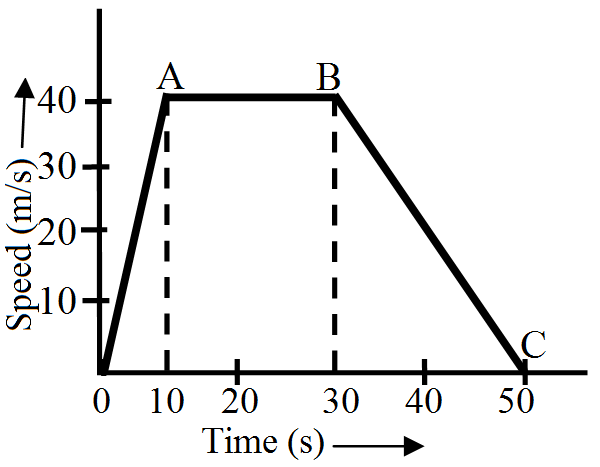
Study the speed-time graph of a car given alongside and answer the following questions:
  1. What type of motion is represented by OA?
  2. What type of motion is represented by AB?
  3. What type of motion is represented by BC?
  4. What is the acceleration of car from O to A?
  5. What is the acceleration of car from A to B?
  6. What is the retardation of car from B to C?
Answer
  1. OA represents uniform acceleration.
  2. AB represents constant speed.
  3. BC represents uniform retardation.
  4. Acceleration of car from O to A = slope of line OA
$\text{a}=\frac{(40-0)}{(10-0)}\text{m/s}^2$

$=4\text{m/s}^2$
  1. Acceleration of car from A to B is zero as it has uniform speed.
  1. Retardation of car from B to C = slope of line BC.
$\text{a}=\frac{(40-0)}{(50-30)}\text{m/s}^2$

$=2\text{m/s}^2$
View full question & answer
Question 105 Marks
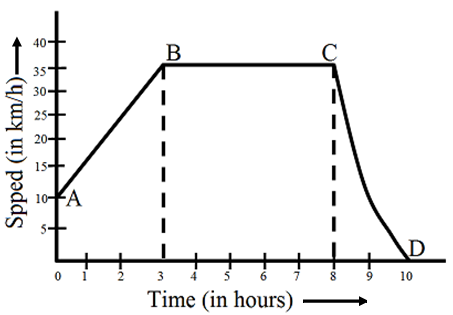
The graph given alongside shows how the speed of a car changes with time:
  1. What is the initial speed of the car?
  2. What is the maximum speed attained by the car?
  3. Which part of the graph shows zero acceleration
  4. Which part of the graph shows varying retardation?
  5. Find the distance travelled in first 8 hours.
Answer
  1. Initial speed of the car is 10 km/h
  2. Maximum speed attained by the car is 35km/h
  3. BC represents zero acceleration.
  4. CD represents varying retardation.
  5. Distance travelled is given by the area enclosed within the curve. So,
Distance travelled = Area or trapezium + Area of rectangle

So distance travelled,

$= \Big(\frac{1}{2}\Big)(8+5)(25) + (8)(10)$

$= 242.5\text{km}$
View full question & answer
Question 115 Marks
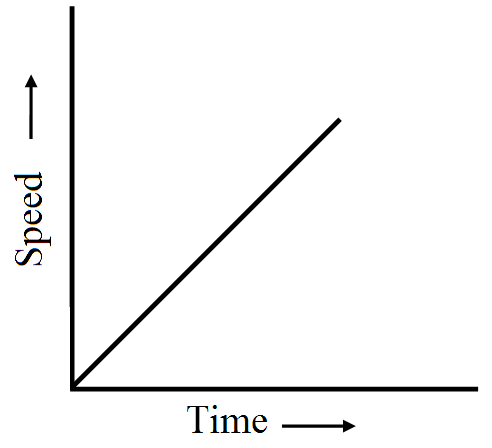
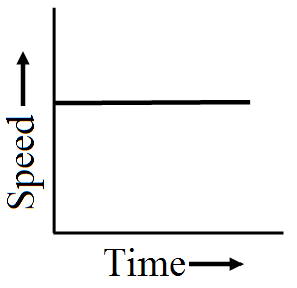
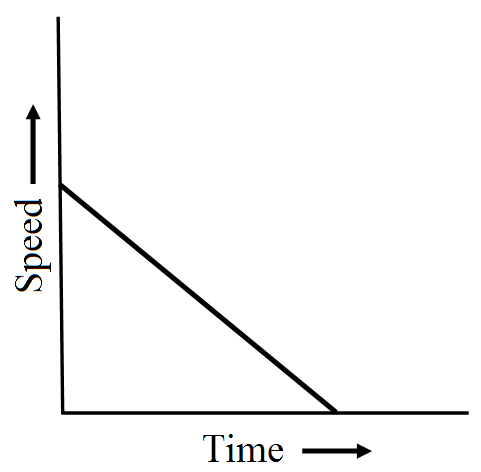
What type of motion is represented by each one of the following graphs?


Answer
  1. Graph (a) represents uniformly accelerating motion as it has a constant slope.
  2. Graph (b) represents a motion of constant speed.
  3. Graph (c) represents uniformly retarding motion as it has a constant negative slope.
  4. Graph (d) represents non-uniformly retarding as it has a varying slope.
View full question & answer
Question 125 Marks
A car travels 100km at a speed of 60km/h and returns with a speed of 40km/h. Calculate the average speed for the whole journey.
Answer
In the first case, car travels at a speed of 60km/h for a distance of 100km.
In the second case, car travels at a speed of 40km/h for a distance of 100km.
Total distance travelled = 200km.
In the first case, car travels at a speed of 60km/h for a distance of 100km.
$\text{Speed}=\frac{\text{Distance}}{\text{Time}}$
$\text{Time}=\frac{\text{Distance}}{\text{Speed}}$
$\text{t}_1=\frac{100}{60}\text{h}$
In the second case, car travels at a speed of 40km/h for a distance of 100km.
$\text{t}_2=\frac{100}{40}\text{h}$
Total distance travelled = 200km
Total time taken $=\frac{100}{60}+\frac{100}{40}$
Average speed $=\frac{\text{Total distance travelled}}{\text{Total time taken}}$
$=\frac{200}{\frac{100}{60}+\frac{100}{40}}=\frac{2}{\frac{1}{60}+\frac{1}{40}}$
$=\frac{240}{5}=48\text{km/h}$
View full question & answer
Question 135 Marks
Show by using the graphical method that:
$\text{s}=\text{ut}+\frac{1}{2}\text{at}^2$
where the symbols have their usual meanings.
Answer
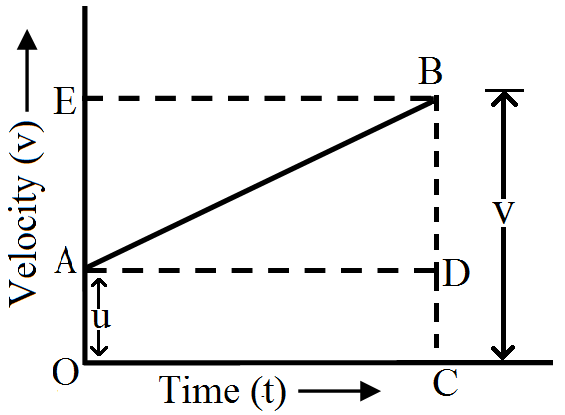
Consider the velocity-time graph of a body shown in figure. The body has an initial velocity u at a point A and then its velocity changes at a uniform rate from A to B in time t. In other words, there is a uniform acceleration a from A to B, and after time t its final velocity becomes v which is equal to BC in the graph. The time t is represented by OC.

Suppose the body travels a distance s in time t. In the figure, the distance travelled by the body is given by the area of the space between the velocity-time graph AB and the time axis OC, which is equal to the area of the figure OABC. Thus:
Distance travelled = Area of figure OABC
= Area of rectangle OABC + area of triangle ABD
Now, we will find out the area of rectangle OABC and area of triangle ABD.
  1. Area of rectangle OADC = OA × OC
= u × t

= ut
  1. Area of triangle ABD $=\Big(\frac{1}{2}\Big)\times\text{Area of rectangle AEBD}$
$=\Big(\frac{1}{2}\Big)\times\text{AD}\times\text{BD}$

$=\Big(\frac{1}{2}\Big)\text{at}^2$
Distance travelled, s = Area of rectangle OADC + Area of triangle ABD
$\text{s}=\text{ut}+\frac{1}{2}\text{at}^2$
View full question & answer
Question 145 Marks
Show by means of graphical method that:
v = u + at
where the symbols have their usual meanings.
Answer
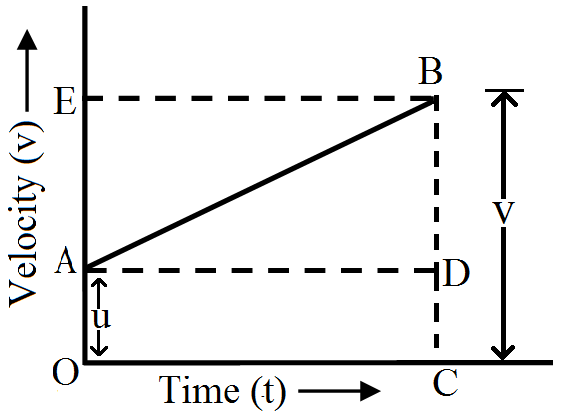
Consider the velocity-time graph of a body shown in figure.

The body has an initial velocity u at a point A and then its velocity changes at a uniform rate from A to B in time t. In other words, there is a uniform acceleration a from A to B, and after time t its final velocity becomes v which is equal to BC in the graph. The time t is represented by OC. To complete the figure, we draw the perpendicular CB from point C, and draw AD parallel to OC. BE is the perpendicular from point B to OE.
Now, Initial velocity of the body, u = OA ...(1)
And, Final velocity of the body, v = BC ...(2)
But from the graph BC = BD + DC
Therefore, v = BD + DC ...(3)
Again DC = OA
So, v = BD + OA
Now, from equation (1), OA = u
So, v = BD + u ...(4)
We should find out the value of BD now. We know the slope of a velocity-time graph is equal to the acceleration, a.
Thus, Acceleration, a = slope of line AB
or $\text{a} =\frac{\text{BD}}{\text{AD}}$
But AD = OC = t, so putting t in place of AD in the above relation, we get:
$\text{a}=\frac{\text{BD}}{\text{t}}$
Now, putting this value of BD in equation (4), we get:
v = u + at
View full question & answer
Question 155 Marks
Derive the following equation of motion by the graphical method:
$v^2 = u^2 + 2as$
where the symbols have their usual meanings.
Answer


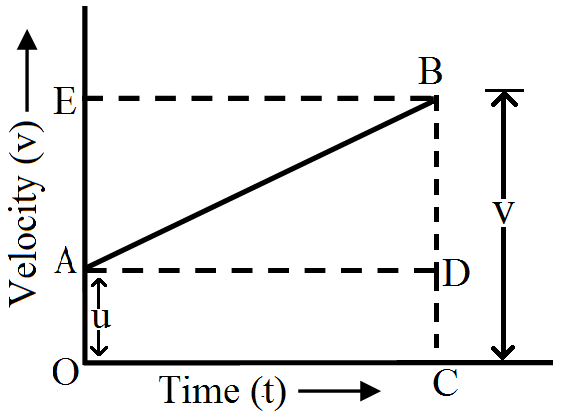
Consider the velocity-time graph of a body shown in figure. The body has an initial velocity $u$ at a point $A$ and then its velocity changes at a uniform rate from $A$ to $B$ in time $t$. In other words, there is a uniform acceleration a from $A$ to $B$, and after time $t$ its final velocity becomes $v$ which is equal to $B C$ in the graph. The time $t$ is represented by $O C$. To complete the figure, we draw the perpendicular $C B$ from point $C$, and draw $A D$ parallel to $O C$. $B E$ is the perpendicular from point $B$ to $O E$.
The distance travelled $s$ by a body in time $t$ is given by the area of the figure OABC which is a trapezium.
Distance travelled, $s=$ Area of trapezium OABC
$s =\frac{(\text { Sum of parallel sides }) \times \text { Height }}{2}$
$s =\frac{( OA + CB ) \times OC }{2}$
Now, $OA + CB = u + v$ and $OC = t$
Putting these values in the above relation, we get:
$s=\left(\frac{u+v}{2}\right) \times t \ldots(1)$
Eliminate from the above equation.
This can be done by obtaining the value of t from the first equation of motion.
Thus, $v=u+$ at (first equation of motion)
And, $at = v$.
View full question & answer