Questions

3 Marks Question

Take a timed test

8 questions · self-marked practice — reveal the answer and mark yourself.

Question 13 Marks
Show that the radius of the orbit in hydrogen atom varies as $n^2,$ where n is the principal quantum number of the atom.
Answer
According to the Bohr's theory of hydrogen atom, the angular momentum of revolving electron is given by
$\text{m v r} =\frac{n h}{2 \pi} ....(i)$
where, m = mass of the electron $, v =$ velocity of the electron.
$r =$ radius of the orbit $, h =$ Planck's constant and $n = $ principal quantum number of the atom."
If an electron of mass m and velocity v is moving in a circular orbit of radius r, then the centripetal force is given by
$F _{ C }= mv ^2 / r ...(ii)$
Also, if the charge on the nucleus is Ze, then the force of electrostatic attraction between the nucleus and the electron will provide the necessary centripetal force
$\Rightarrow F _{ C }= F _{ e }$
$\Rightarrow \frac{m v^2}{r}=\frac{k e^2}{r^2} \quad[\therefore Z=1]$
$\Rightarrow r=\frac{e^2 \cdot k}{m v^2} ....(iii)$
$r=\frac{k e^2 4 \pi^2 m^2 r^2}{m \cdot n^2 h^2} \ [$from eq. $(i)]$
$\Rightarrow r=\frac{n^2 h^2}{k e^2 4 \pi^2 m} \Rightarrow r \propto n^2$
View full question & answer
Question 23 Marks
i. Differentiate between three segments of a transistor on the basis of their size and level of doping.
ii. When is a transistor said to be in active state?
iii. Draw a plot of transfer characteristic ($V _0$ vs. $V _{ i }$ ) and show which portion of the characteristic is used in amplification and why?
iv. Draw the circuit diagram of the base bias transistor amplifier in CE configuration and briefly explain its working.
Answer
i. Emitter: It is of moderate size and heavily doped semiconductor
Base: It is very thin and lightly doped.
Collector: It is moderately doped and larger in size than the emitter.
ii. A transistor is said to be in active state when its emitter-base junction is forward biased and the base-collector junction is reverse biased. A Si transistor is in active state when its input (E-B) voltage is between 0.6 V and 1.0 V.
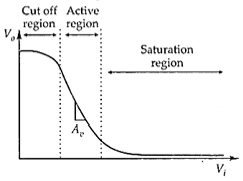
iii. A transfer characteristic is a graph of output voltage $\left(V_0\right)$ vs. input voltage $\left(V_i\right)$ for a base-biased transistor. It is of the type shown in the figure.

Image

The active region of the transfer characteristic is used for the amplification purpose. This is because in this region, $I _{ C }$ increases almost linearly with the increase of $V _{ i }$.
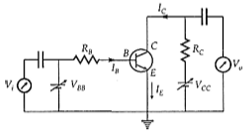
iv. The circuit diagram for the base biased n-p-n transistor amplifier, in CE configuration, is shown in the figure.
Image

Working: When a small sinusoidal voltage is superposed on the dc base bias, the base current will have sinusoidal variations superposed on the value of $I _{ B }$. As a consequence, the collector current also will have sinusoidal variations superposed on the value of $I _{ C }$. The output, between the collector and the ground, will be an amplified version of the input sinusoidal voltage.

View full question & answer
Question 33 Marks
Two cells of $\text {EMFs} \ 1 V, 2 V$ and internal resistance $2 \Omega$ and $1 \Omega$ respectively are connected in
$i$. series,
$ii.$ parallel. What should be the external resistance in the circuit so that the current through the resistance be the same in the two cases? In which case, more heat is generated in the cells?
Answer
Current in series circuit is given by
$I_s=\frac{\varepsilon_1+\varepsilon_2}{r_1+r_2+R}$
$=\frac{1+2}{2+1+2}$
$=\frac{3}{3+R}$
When the two cells are connected in parallel,
$\varepsilon_{e q}=\frac{\varepsilon_1 r_2+\varepsilon_2 r_1}{r_1+r_2}$
$=\frac{1 \times 1+2 \times 2}{2+1}=\frac{5}{3}$
$r_{e q}=\frac{r_1 r_2}{r_1+r_2}$
$=\frac{1 \times 2}{1+2}=\frac{2}{3}$
Current in the parallel circuit is given by
$I_p=\frac{\varepsilon_{e q}}{r_{e q}+R}$
$=\frac{\frac{5}{3}}{\frac{2}{3}+R}=\frac{5}{2+3 R}$
$\text { As }_{ S }= I _{ p }$
$\therefore \frac{3}{3+R}=\frac{5}{2+3 R}$
or $ 6+9 R =15+5 R$
or $ R =\frac{9}{4}=2.25 \Omega$
More heat will be generated in series case due to larger resistance.
View full question & answer
Question 43 Marks
Define mutual inductance between a pair of coils. Derive an expression for the mutual inductance of two long coaxial solenoids of the same length wound one over the other.
Answer
$i$. Mutual inductance is numerically equal to the induced emf in the secondary coil when the current in the primary coil changes by unity.
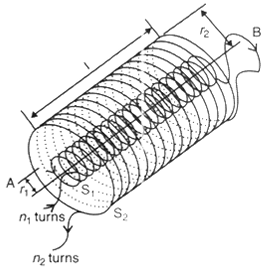
$ii$. in the question mutual inductance of two long coaxial solenoids of same length l wound one over the other is given by: $-$

Image

Let a current $l_2$ flow in the secondary coil
$\therefore B_2=\frac{\mu_0 N_2 i_2}{l}$
$\therefore $  Flux linked with the primary coil $=\frac{\mu_0 N_2 N_1 A_1 i_2}{l}$
$= M _{12} i _2$
Hence $,  M _{12}=\frac{\mu_0 N_2 N_1 A_1}{l}$
$\mu_0 n_2 n_1 A_1 l\left(n_1=\frac{N_1}{l} ; n_2=\frac{N_2}{l}\right)$
View full question & answer
Question 53 Marks
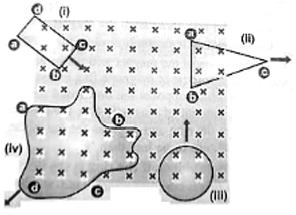
The figure below shows planer loops of different shapes moving out of or into a region of the magnetic field which is directed normal to the plane of the loops away from the reader. Determine the direction of induced current in each loop using Lenz's law. Check if you would obtain the same answers by considering the magnetic force on the charge inside the moving loops.

Image
Answer
i. Due to motion, the magnetic flux linked with the loop abcd increases. According to Lenz's law, this increase in flux is opposed by the induced current. Therefore, the induced current must flow along bcdab.
ii. Due to motion, magnetic flux linked with abc decreases. The induced current is along bacb.
iii. The magnetic flux increases in this case. Therefore, the induced current is anticlockwise.
iv. As magnetic flux decreases due to motion, the induced current is along cdabc.
Yes, we would obtain the same answers by considering the magnetic force on the charges inside the loop.
View full question & answer
Question 63 Marks
A beam of light consisting of two wavelengths $, 650 nm$ and $520 nm,$ are used to obtain interference fringes in a Young's double slit experiment.
$a$. Find the distance of the third bright fringe on the screen from the central maximum for wavelength $650 nm.$
$b$. What is the least distance from the central maximum where the bright fringes due to both the wavelengths coincide?
Answer
Here, $\lambda_1=650 nm=650 \times 10^{-9} m$
$\lambda_2=520 nm=520 \times 10^{-9} m$
Suppose $, d =$ distance between two slits
$D =$ Distance of screen from the slits
a. For third bright fringe $, n = 3$
$x=n \lambda_1 \cdot \frac{D}{d}$
$=3 \times 650 \times \frac{D}{d}=1950 \frac{D}{d}$
$b.$ Let nth bright fringe due to wavelength $650 nm$ coincide with $(n -1)^{th}$
due to wavelength $520 nm$.
Therefore $, n \lambda_2=(n-1) \lambda_1$ or, $n \times 520=(n-1) \times 650 $
$\Rightarrow n=5$
Hence, the least distance from the central maximum can be obtained by the relation:
$x=n \lambda_2 \frac{D}{d}$
$=5 \times 520 \frac{D}{d}$
$=2600 \frac{D}{d} n m$
Note: The value of d and $D$ are not given in the question.
View full question & answer
Question 73 Marks
$a$ . Differentiate between nuclear fission and nuclear fusion.
$b$ . Deuterium undergoes fusion as per the reaction:
${ }_1^2 H +{ }_1^2 H \longrightarrow{ }_2^3 He +{ }_0^1 n +3.27 MeV$
Find the duration for which an electric bulb of $500 W$ can be kept glowing by the fusion of $100 g$ of deuterium.
Answer
$a.$
Nuclear fission Nuclear fusion
It is the process of disintegration of a heavy nuclei into smaller daughter nuclei of comparable masses with a release of huge amount of energy. It is the process of combining two lighter nuclei to form a heavy nuclei with the release of huge energy.
It can be possible in nuclear reactors. It can be possible on the surface of sun.
Example ${ }_{92}^{235} U \rightarrow{ }_{56}^{142} Ba +{ }_{36}^{91} kr +3{ }_0^1 n+$ heat Example ${ }_1^2 H+{ }_1^2 H \rightarrow{ }_2^3 H e+{ }_0^1 n+$ heat
It is a controllable process. It is uncontrollable process.
$b. { }_1^2 H+{ }_1^2 H \rightarrow{ }_2^3 He +{ }_0^1 n+3.27 M ev$
when $2$ atoms of deuterium $\left({ }_1^2 H \right)$ combine energy released $=3.27 M ev$
$=3.27 \times 10^6 \times 1.6 \times 10^{-19} J$
$=5.232 \times 10^{-15} J$
So, No. of atoms in $2 g$ of deuterium $=6.022 \times 10^{23}$ atoms
No. of atoms in $100 g$ of deuterium $=\frac{6.022 \times 10^{23} \times 100}{2}$
$=3.011 \times 10^{25}$ atoms
So total energy released by fusion of $100g$ of deuterium
$=3.011 \times 10^{25} \times 5.232 \times 10^{-15} J$
$=15.75 \times 10^{10} J$
Power of bulb $= 500 W$
Energy consumed by bulb in $1$ second $=500 \times 1$
$500J$
So, time required to consume released energy $=\frac{15.75 \times 10^{10}}{500}$
$=0.0315 \times 10^{10} \sec$
$=9.989 $ years 
 
View full question & answer
Question 83 Marks
Photoelectrons are emitted from a metal surface when illuminated with $UV$ light of wavelength $330 nm$ . The minimum amount of energy required to emit the electrons from the surface is $3.5 \times 10^{-19} J$. Calculate :
$a$. the energy of the incident radiation, and
$b$. the kinetic energy of the photoelectron.
Answer
$i$. Energy of incident radiation
$ E = hv = h \frac{c}{\lambda}$
$=\frac{6.63 \times 10^{-34} \times 3 \times 10^8}{330 \times 10^{-9}}$
$=6.027 \times 10^{-19} J$
$ii$. Kinetic energy of photoelectron
$\text { K.E. }=E-\phi_0$
$=\left(6.027 \times 10^{-19}-3.5 \times 10^{-19}\right) J$
$=2.527 \times 10^{-19} J$
View full question & answer