Question
Define oral rehydration solution and when is it given to the patient? How can you prepare ORS at home?

Answer

Oral rehydration solution is the solution of sugar and salt in a particular ratio in the clean water. When a person passes out watery stools frequently, the disease is called diarrhoea. In this condition there is a loss of water and salt from the body of a person.
This is called dehydration, which may be fatal if not cured at proper time. In order to prevent dehydration, the person or patient should be given ORS. It makes up the loss of water and salts in the body and sugar provides energy which helps in the recovery of disease. It should be given to a patient suffering from diarrhoea at a regular interval.
At home the ORS can be prepared by dissolving a teaspoonful of sugar and pinch of salt in a glass of clean water. The water used for preparing ORS should be first boiled and then cooled so that all the microorganisms or harmful bacteria may be killed.

Need a full question paper?

Generate a complete, print-ready paper with questions like this in minutes — across 16+ boards, with answer keys.
Start Generating Free

Similar questions

Oxygen which is essential for the survival of all organisms is produced during photosynthesis. In the absence of photosynthesis, life would be impossible on the earth. During photosynthesis, chlorophyll containing cells of leaves, in the presence of sunlight, use carbon dioxide and water to synthesise carbohydrates. During the process oxygen is released. The presence of starch in leaves indicates the occurrence of photosynthesis. Starch is also a carbohydrate.
Q.1. Which component is essential for the survival of all the living organisms?
(a) Oxygen$\quad$(b) Carbon dioxide$\quad$(c) Carbon Monoxide$\quad$(d) Hydrogen
Q.2. Name the green pigment present in leaves.
Q.3. How we come to know the occurrence of photosynthesis in a plant?
The side mirror of a scooter got broken. The mechanic replaced it with a plane mirror. Mention any inconvenience that the driver of the scooter will face while using it?
Why should we not throw:
  1. Used tea leaves into sink?
  2. Cooking oil and fats down the drain?
Like humans and animals, transportation of water, mineral and nutrients also take place in plants. How?
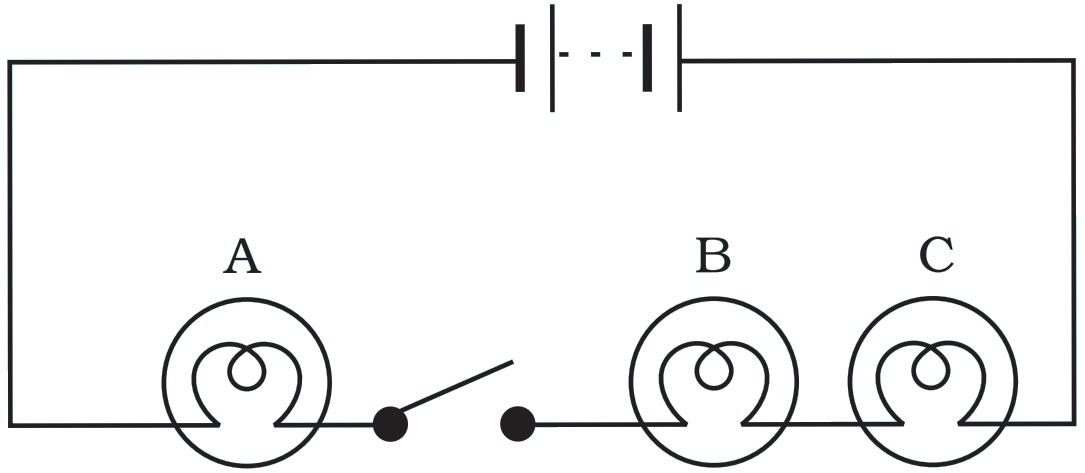
In the circuit shown in figure.
  1. Would any of the bulb glow when the switch is in the $‘OFF’$ position?
  2. What will be the order in which the bulbs $A, B$ and $C$ will glow when the switch is moved to the $‘ON’$ position?
Sahil placed some pices of chapati in test tube A. Neha placed chewed chapati in test tube B, and Santushti took boiled and mashed potato in test tube C. All of them added a few drops of iodine solution to their test tubes A, B, and C, respectively. What would be their observations? Give reasons.
Three statements are provided here which define the terms– $(a)$ sludge, $(b)$ sewage and $(c)$ wastewater. Pick out the correct definition for each of these terms.
  1. The settled solids that are removed in wastewater treatment with a scraper.
  2. Water from kitchen used for washing dishes.
  3. Wastewater released from homes, industries, hospitals and other public buildings.
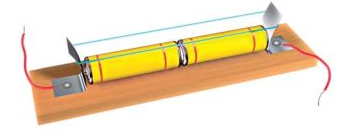
Zubeda made an electric circuit using a cell holder shown in Figure, a switch and a bulb. When she put the switch in the ‘ON’ position, the bulb did not glow. Help Zubeda in identifying the possible defects in the circuit.

Image

Match the animals in Column $I$ with their mode of feeding listed in Column $II$
  Column I   Column II
  Animals   Mode of Feeding
$(a)$ House fly $(i)$ Biting and chewing
$(b)$ Cockroach $(ii)$ Suckling
$(c)$ Mosquito $(iii)$ Sponging
$(d)$ Infants $(iv)$ Sucking